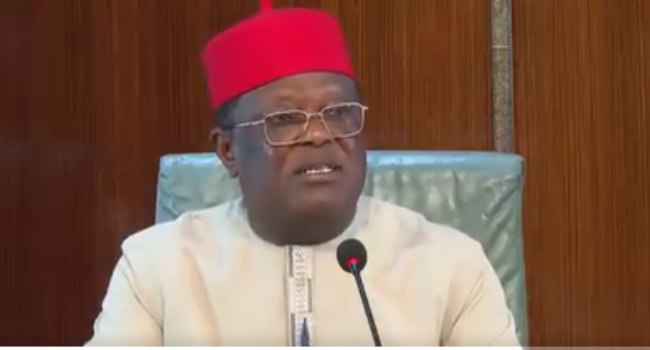
The Minister of Works, Senator David Umahi, has strongly defended President Bola Tinubu’s economic policies, asserting that strategic infrastructure investment rather than fiscal saving is the key to unlocking Nigeria’s economic potential.
Addressing journalists during an inspection of the Calabar–Abuja Super Highway at the Ebonyi–Benue boundary, Umahi argued that no responsible government or economist would prioritise saving money while critical infrastructure remains undeveloped and citizens face economic hardship.
He maintained that the administration is actively repositioning the nation’s economy by prioritising long-term development over short-term reserves.
According to the Minister, the Tinubu administration inherited a severely degraded road network and has since launched an aggressive nationwide rehabilitation and construction program.
”Infrastructure development is a catalyst for economic growth and increased GDP.”
“That is exactly what President Tinubu is doing.”
He pointed to the ongoing progress of major projects as evidence of the administration’s commitment, noting that public criticism regarding federal roads has significantly waned due to the visible pace of work across the country.
Umahi also praised the President’s governance style, describing him as a de-tribalised and exceptional leader.
“His type comes once in a generation. Every part of Nigeria is treated as if it were his hometown. A leader who is tribalistic can never succeed,” he added.
READ ALSO: Nigeria Meets 104% OPEC Quota As Production Hits 74-Month High — NUPRC
Providing updates on the corridor, Umahi disclosed that construction is moving forward simultaneously across multiple sections to accelerate completion.
The Calabar–Ebonyi–Benue–Kogi–Nasarawa–Abuja Super Highway is designed to serve as a vital economic artery, dramatically improving connectivity between the South-South, South-East, and the Federal Capital Territory (FCT).
Umahi noted that once completed, commuters from the South-South can reach Abuja in approximately six hours, while travelers from the South-East, particularly Ebonyi State, will see travel times to the capital cut to about three hours.
“Integration of new bypasses and bridges along the corridor is expected to ease traffic congestion, facilitate safer transit, and boost interstate commerce.”
”The infrastructure is positioned to stimulate regional markets and support community development for generations.”
The Minister urged host communities along the construction corridor to sustain their support and cooperation, emphasising that the administration’s current investments are designed to yield lasting economic relief and regional transformation.