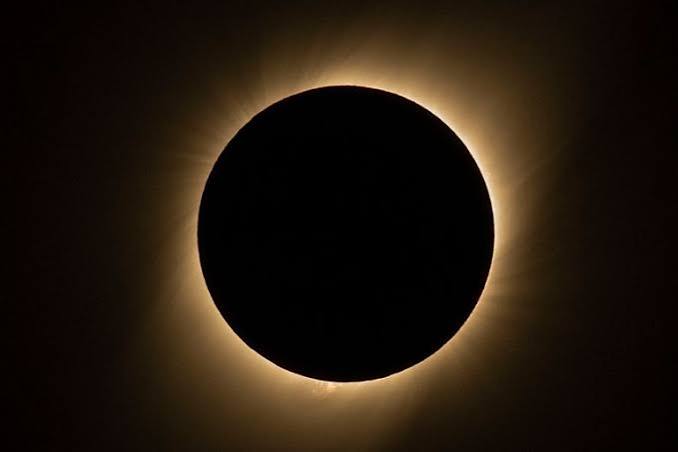
A rare total solar eclipse will briefly turn day into night across parts of northern Spain on August 12 as the Moon completely blocks the Sun, marking the first total solar eclipse visible from mainland Europe since 2006.
The celestial event is expected to attract thousands of skywatchers, with the path of totality stretching across parts of Russia, Greenland, Iceland, Spain and northeastern Portugal. Here is what you need to know about the total solar eclipse
What is a total solar eclipse?
A total solar eclipse occurs when the Moon passes directly between the Earth and the Sun, casting a narrow shadow on the Earth’s surface and completely obscuring the Sun for observers within the path of totality.
The phenomenon creates an eerie twilight, causing temperatures to fall and allowing the Sun’s outer atmosphere, known as the corona, to become visible.
According to NASA, the spectacle is possible because of a remarkable “cosmic coincidence.”
“Even though the Sun is about 400 times bigger than the Moon, it is also about 400 times farther away,” the US space agency explains. As a result, the Moon appears just large enough in the sky to completely cover the Sun.
Where will it be visible?
The eclipse will first be seen in a remote part of northern Russia before the path of totality moves across Greenland, Iceland, Spain and the northeastern tip of Portugal.
In Spain, the eclipse will sweep from the northern city of Oviedo across the country towards the Mediterranean island of Mallorca.
Outside the path of totality, a partial solar eclipse will be visible across most of Europe, Canada, the northern United States and parts of northwest Africa.
How long will it last?
Observers in Spain will experience less than two minutes of total darkness shortly before sunset.
In Burgos, for example, totality is expected to last one minute and 48 seconds.
The eclipse will last slightly longer in parts of Russia and Greenland, though nowhere will totality exceed two and a half minutes.
The partial phases of the eclipse, when the Moon gradually moves across and then away from the Sun, will last approximately one hour and 45 minutes.
How rare is the event?
While one or two solar eclipses occur somewhere on Earth each year, total eclipses are rare for any specific location because the Moon’s shadow covers only a narrow strip of the planet.
As a result, some places may wait centuries before experiencing another total eclipse.
Skywatchers will have another opportunity on August 2, 2027, when a total solar eclipse crosses southern Spain, northern Africa and the Arabian Peninsula.
Dubbed by some astronomers as the “eclipse of the century,” the 2027 event will feature more than six minutes of totality—the longest total solar eclipse of the 21st century.
Spain is also expected to witness an annular, or “ring of fire,” eclipse on January 26, 2028, when the Moon passes in front of the Sun but leaves a bright ring of sunlight visible around its edges.
How can you watch it safely?
Experts warn that looking directly at the Sun during any phase of a solar eclipse can cause permanent eye damage.
They recommend using certified eclipse glasses that meet the international safety standard ISO 12312-2:2015, which filters harmful ultraviolet and infrared radiation.
Because the human eye has no pain receptors to signal damage, injuries may not become apparent until hours later.
Researchers noted that following the 2024 total solar eclipse in the United States, online searches for the phrase “my eyes hurt” spiked significantly, highlighting the importance of proper eye protection during the event.
AFP
We’ve got the edge. Get real-time reports, breaking scoops, and exclusive angles delivered straight to your phone. Don’t settle for stale news. Join LEADERSHIP NEWS on WhatsApp for 24/7 updates →