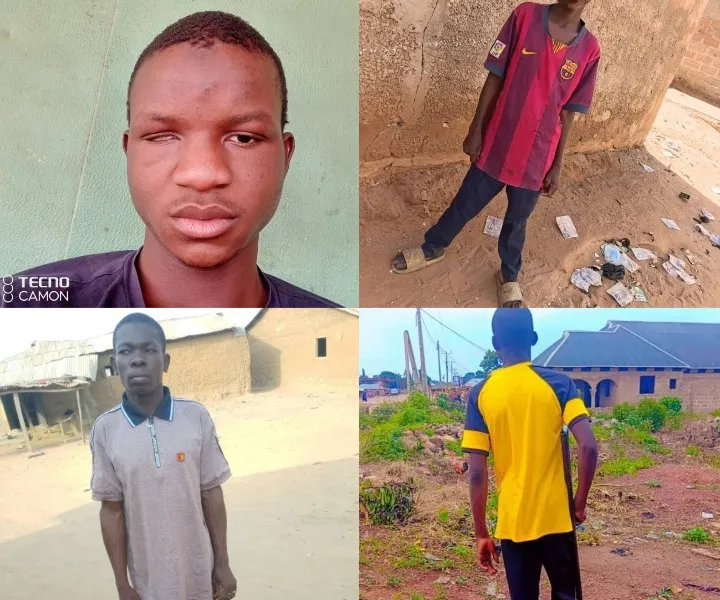
At just 28, Idris Buko still remembers the injection that changed his life forever. Growing up in Boriya community, Baruten Local Government Area of Kwara State, North Central Nigeria, he was healthy just like other children until a wrong injection treatment for malaria left him with a physical deformity at the age of 11. Buko couldn’t walk properly again.
Now, he’s living with a physical condition he never had before.
Enduring the painful condition was hard enough. However, it hurt more knowing too well that it resulted from the doctor’s careless mistake. His confidence shattered the day he understood he would never have the opportunity to move around like other boys. The memory still lingers with him.
“All I had was malaria and fever,” he said. “The kind of sickness people get over in days. But one wrong injection took that simple illness and turned it into something permanent. It now left me with damage I carry in my body, and a distress I carry in my mind.”
At first, Buko’s family moved him from one place to another in search of treatment to get him back to position. They spent the money they could barely afford on him. But the condition still worsened.
“After then, every night was a pain that came with tears which echoed through our house, keeping my single mother awake whose heart was dreaded with regret for trusting a doctor who, with every visit, proved less competent than the last,” he recalled with grief.
Buko’s story is not unique. Across Nigeria, allegations of medical negligence, which is affecting both rural and urban hospitals, continue to surface. While some victims who are not so lucky end up dead, others live with permanent disabilities that affect their education, marital life, and employment opportunities.
Medical negligence happens when a healthcare professional or medical organisation provides care that falls below an acceptable standard, causing a patient to suffer avoidable harm. This includes mistakes by doctors, nurses, surgeons, dentists, pharmacists, hospitals, care homes, private clinics or NHS Trusts.
Salihu Farhan
Credit: Habibullah Temako
And where medical treatment causes an injury through negligence or improper diagnosis, leading to worsened condition or avoidable pain, victims may be entitled to claim compensation.
A research conducted at the University College Hospital (UCH), Ibadan, identified 27 children who suffered sciatica nerve injury. Fever was the most common complaint for which the injection had been given. The study found that while few patients sought medical attention shortly after developing complications, most arrived much later, after which some significant damage had already appeared.
The research also found that most of the injections were administered in privately owned health facilities, where staff with minimal training are often allowed to administer injections. The story concluded by discouraging intramuscular injections, and only trained staff should be allowed to administer injections. For survivors like Buko, injuries linked to poorly administered injection is a painful reality.

Idris Buko. Credit: Habibullah Temako
A Problem Hidden in Plain Sight
According to the World Health Organization (WHO), one in every 10 persons dies from healthcare negligence or is harmed while receiving healthcare services. In Nigeria, about 250,000 persons die annually due to medical errors, according to experts, while four in 100 persons are harmed during medical treatments, a WHO report stated.
Another report also revealed that Nigeria has a medical error prevalence rate ranging from 42.8% to 89.8%, with 33.3% of patients experiencing additional injuries as a result of treatment. It added further that the prevalence of this issue, coupled with systemic strains caused by poor doctor-to-patient ratios and infrastructural deficits, has resulted in 61.69% of Nigerian patients reporting that they feel medical practitioners in the country are arrogant and indifferent to their conditions.
In January 2026, Nkanu Nnamdi, the 21-month-old son of Chimamanda Ngozi Adichie, an author, died following a medical procedure at Euracare Hospital in Lagos. Adichie alleged that her son was administered propofol for sedation during an MRI scan and central line insertion but was not properly monitored afterwards. According to her, the child became unresponsive, suffered seizures, and later went into cardiac arrest. She maintained that her son “would be alive” if not for what she described as an incident of medical negligence at the hospital.
The above data are not just statistical figures, they represent people whose lives have been shaped by substandard healthcare deliveries. This problem is not restricted to one locality in Nigeria, every region across the country is battling similar fate.
Meanwhile, before Buko’s fate, he developed a permanent limp. He said when he fell sick with malaria, his family took him to the village clinic, but after an injection there, he could no longer walk properly. That injection left him with the limp he still has today.
For Ibrahim Awalu, a resident of Sokoto State, North West Nigeria, the experience began with a community immunization programme in his village. He was 14 at that time, ail, and fit.
Like other children in the neighborhood on that fateful day, he joined the queue for a vaccine meant to protect him from diseases. He never imagined that the encounter would mark the beginning of a lifelong struggle. Soon after receiving the vaccine, he began experiencing difficulties moving his legs.
“I was perfectly fit when they called us for the community vaccination. I was with fear when taking the injection, painful and quick, yet it rewrote my life in an instant. Now I cannot walk properly any longer,” Awalu recounted sadly.
The memory of the wrong penetration of the injection, leading to his current physical condition, still stings Awalu.
“Even till now, I couldn’t get over how my condition turned me to limping. I regret the day those community doctors, whose competence now felt like malpractice pressed that injection into my buttock,” he voiced distress.

Ibrahim Awalu
Credit: Habibullah Temako
More Tales Surface
Salihu Farhan, a resident of Boriya community, is another child whose life was changed forever by medical negligence at just 11 months old. What began as a simple childhood fever turned into a series of complications that left him unable to work without assistance.
“Farhan was born fit and had started walking on his own before he became sick,” his father recalled. But after receiving treatment, we discovered that his leg was swollen resulting from the injection given to him.”
Concerned, his father sought further treatment outside the community, hoping to restore him to his normal condition. According to him, Farhan’s illness brought unbearable distress and drained him emotionally to the point where he came to regret the first treatment they received.
“I did everything possible within my means to ensure that my child regains his ability to walk. Sadly, all treatment got him no improvement until he became disabled and couldn’t walk without the support of a walking stick,” he said.
“Medical mistreatment cost me my eyesight”, Ibrahim Koto, another resident of Boriya community shared during an interview with this reporter in May, 2026.
Koto’s ordeal began when he was hit by a stone in his eyes and a visit to a local clinic for treatment. He said that this incident occurred while he was in around 16.
According to him, his condition was misdiagnosed, and he was given the wrong treatment, which worsened his condition. Now he can no longer see with the eye despite undergoing many surgeries.
After the condition worsened, he was referred to Ilorin for treatment, but the damage had already been done.
“The bleeding inside my eye hadn’t been treated in time, so my eyesight was already damaged. My parents insisted I have the surgery, but even after it, I still couldn’t see with that eye,” he recounted.
What the law says
Several laws regulate medical practice in Nigeria, some of which are the Medical and Dental Practitioners Act, the Code of Medical Ethics in Nigeria, among others.
The Medical and Dental Council of Nigeria (MDCN) is the body which regulates medical practitioners in Nigeria and prescribes the rules of professional conduct and ethics.
Therefore, where medical negligence occurs resulting in injury, an aggrieved victim can file a petition against the medical practitioner and send it to the office of the MDCN as provided under the said medical rules.
In an interview with Abdulrasheed Hammad, an Abuja based lawyer, he noted that for a medical treatment to amount to negligence, there are certain factors that must be examined.
According to him: “Medical negligence as a tort arises where there exists a duty of care expected from a doctor, such duty of care was breached and that the victim suffered damage resulting from the negligence.”
He further addressed that under section 343 of the Criminal Code, it provides that any person who gives medicine or medical or surgical treatment in a rash or negligent manner as to endanger life or likely to cause harm to a person shall be guilty of a misdemeanor.
“Also, section 303 of the Act prescribes that persons who undertake to administer surgical or medical treatment should possess reasonable skill and use reasonable care in acting except in cases of necessity,” he added.
Speaking on remedies available to victims, Barrister Abdulrasheed Hammad stated that damages and other reliefs may be granted by the court where an action against the doctor succeeds. He noted that medical expenses, psychological trauma, pain and suffering, and loss of income can be considered damages in a case of medical negligence.
“Similarly, the doctor can also be prosecuted under the law in a situation where negligence causes the death of a patient. Such doctor will be liable for manslaughter under section 325 of Criminal Code or culpable homicide not punishable with death under section 220 of Penal Code,” he stated.
Victims Recount Life-threatening Challenges
While regretting the incident of medical negligence, victims recounted the untold struggles they experienced growing up. These painful memories compound their challenge leading to chronic suppression of ongoing challenges including missed opportunities, discrimination and marginalisation.
For Awalu, his disability has cost him so much. He said, “right from a young age, my parents asked me to drop out from school because they couldn’t bear seeing me struggling to trek the distance and they couldn’t afford mobility support. Losing that chance at education still haunts me, especially because my condition wasn’t natural. It was caused by a reckless injection.”
Awalu expressed his challenges stressing that his disability brought nothing to him but misery, misfortune, and frustration. He said each day became a struggle as he wrestled with the rising cost of living while trying to figure out what he could still do for himself.
Ibrahim Koto also lamented that after losing one of his eye to poor treatment, he sometimes feels dejected when he looks in the mirror and sees the person he has become. According to him, it’s very sad to think that if he hadn’t been treated by a doctor with no knowledge of eye problems, he wouldn’t have ended up with such a condition.

Ibrahim Koto
Credit: Habibullah Temako
“Anytime I remember how I ended up with this disability, tears roll down from my eye. It makes me feel like I’ve lost everything around me, especially seeing my peers whom I grew up with. It’s very depressing…” he said sadly.
Koto further expressed his distress stating that he feels embarrassed in the public due to his condition and also because his disability has become an identity people use to describe him. That reality, according to him, left him feeling embittered.
“It hurts me more when people describe me with the disability of my eye. I wish I was not taken to this poor doctor,” he regretted.
In the same vein, Farhan opened up about how challenging it is to live with a disability. He shared that using a walking stick makes him feel limited and less capable than his peers, almost as if he’s no longer allowed to dream big. For him, the condition feels like a barrier to productive work and to holding on to the determination needed to pursue greatness.
“Sometimes I don’t feel motivated to do anything, the reason being that I see myself as a physically challenged person. So, hardly anybody with such conditions is doing well except relying on support from others. Yet, the sadness of it all comes when I think about what I would become in future,” Farhan cried out.
He also revealed that it’s exhausting living like this. Even the thought of working feels heavy when he’s surrounded by people who look healthy and do it effortlessly. What bothers him most is how society has made it normal to sideline disabled people and assume they can’t do great things on their own.
Health Expert Weighs In
In an interview with this reporter, Dr Aliyu Shehu, a public health expert, serving as House Officer at Birnin Kebbi Teaching Hospital, explained that medical negligence could be in the form of wrong diagnosis, defective treatment and dereliction of required duty of care from medical practitioners.
Briefly highlighting, he pointed out actions that may constitute negligence under the medical profession.
According to him, “failure to properly diagnose or delay in diagnosis, wrong prescription or improper administration of drugs and or failure to exercise the standard of care expected of a reasonably competent doctor are the common actions which could be counted as negligence on the part of any medical practitioner.”
He further noted that medical negligence also arises from several factors including lack of diligence or inadequate professional skill, carelessness or poor judgment during patient management, inadequate hospital facilities or defective equipment, employment of unqualified or inexperienced personnel, failure to follow standard medical procedures and ethics etcetera.
Speaking further, Dr Aliyu raised observations and awareness towards curtailing these issues. He said that medical negligence can be minimized through continuous professional development, strict adherence to medical ethics, and improvement in healthcare systems noting that doctors should always practice within the limits of their competence and maintain diligence in patient care.
“Prevention of medical negligence requires both individual responsibility from doctors and systemic support from healthcare institutions and regulatory authorities,” he added.
By: Habibullah Temako