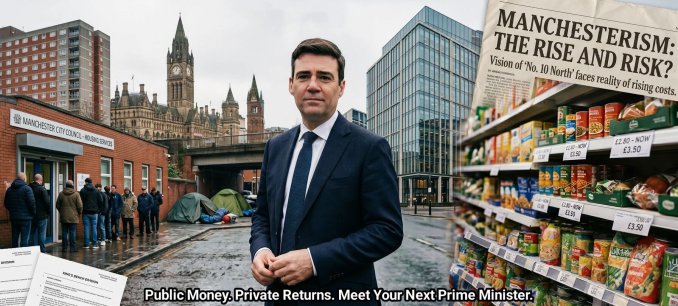
Andy Burnham built his reputation on a promise to put public money to work for ordinary people. The court record, the housing figures, and your supermarket receipt suggest the money had other ideas.
THE RATIONALS
Your weekly food shop costs roughly fifty percent more than it did five years ago. Your rent, if you are among the majority of working-age Britons who do not own their home outright, has risen by more than half in the same period. If you live in Greater Manchester and placed your name on the council housing waiting list when Andy Burnham became mayor in 2017, there is a reasonable chance you are still on it. And if you happened to be sleeping rough on the streets of the city Burnham made his political home, the official count of people doing the same thing has, after a brief improvement, risen consistently since its 2021 low point.
None of this is what was promised. But then, what is promised and what is delivered are two entirely different things in British politics — a gap so reliable it has almost ceased to be a scandal and become simply a feature of the landscape, like potholes and rain.
What makes Andy Burnham’s particular version of this gap interesting is it is not incidental to his politics. It is architectural. It is baked into the mechanism he ran in Manchester, the mechanism he is now proposing to scale nationally, and the mechanism that is quietly making your food more expensive while someone else quietly makes a great deal of money.
Burnham became the uncontested candidate for the Labour leadership on June 22nd 2026, the same day Keir Starmer announced his resignation with the weary dignity of a man who has finally been given permission to stop. Seven days later, standing at the People’s History Museum in Manchester — a venue chosen with the kind of symbolic precision that suggests an adviser of genuine talent, or at least a very good guidebook — he delivered his first major speech as Labour’s prime minister-in-waiting.
“Growth cannot be ordered from the top down,” he said. “It can only be nurtured from the bottom up.” The instinct — that Westminster has failed the country by hoarding power and resources in one city while everywhere else declined — is shared by most people who have ever lived outside the M25. It is not, it should be said, wrong.
He called it Manchesterism. Business-friendly socialism. The biggest rebalancing of power in British political history. No. 10 North — a second Prime Minister’s office based in Manchester, acting as, and here one transcribes this with respectful neutrality, “the nerve centre of a rewired Britain.”
The example ran for nine years. The results are on the public record, documented in court judgments, competition tribunal rulings, and the measured prose of official findings that manage, in the way only official findings can, to describe something fairly remarkable in language specifically designed to prevent anyone from noticing.
Let us begin with what worked. The Bee Network — Greater Manchester’s integrated public transport system, with buses returned to public control for the first time in England in nearly forty years — is a genuine achievement, and Burnham will cite it in every leadership debate between now and the day he enters Downing Street. He will be right to do so. Credit where it is earned
Now let us look at the housing fund, which tells a rather different story.
In 2017, Burnham made ending rough sleeping his signature commitment. By 2021, the official rough sleeping count had fallen from 268 to 89. Then it reversed. It has risen consistently since that low point — four consecutive years of increases, more than doubling from that low point.
Manchester City now ranks third highest for homelessness outside London, with one in sixty-one residents without a permanent home, according to Shelter’s most recent analysis. Average private rents stand at around £1,352 a month, having risen fifty to sixty percent since Burnham took office, against wage growth of roughly thirty-five to forty percent. The people who needed affordable housing in 2017 needed it considerably more by 2026.
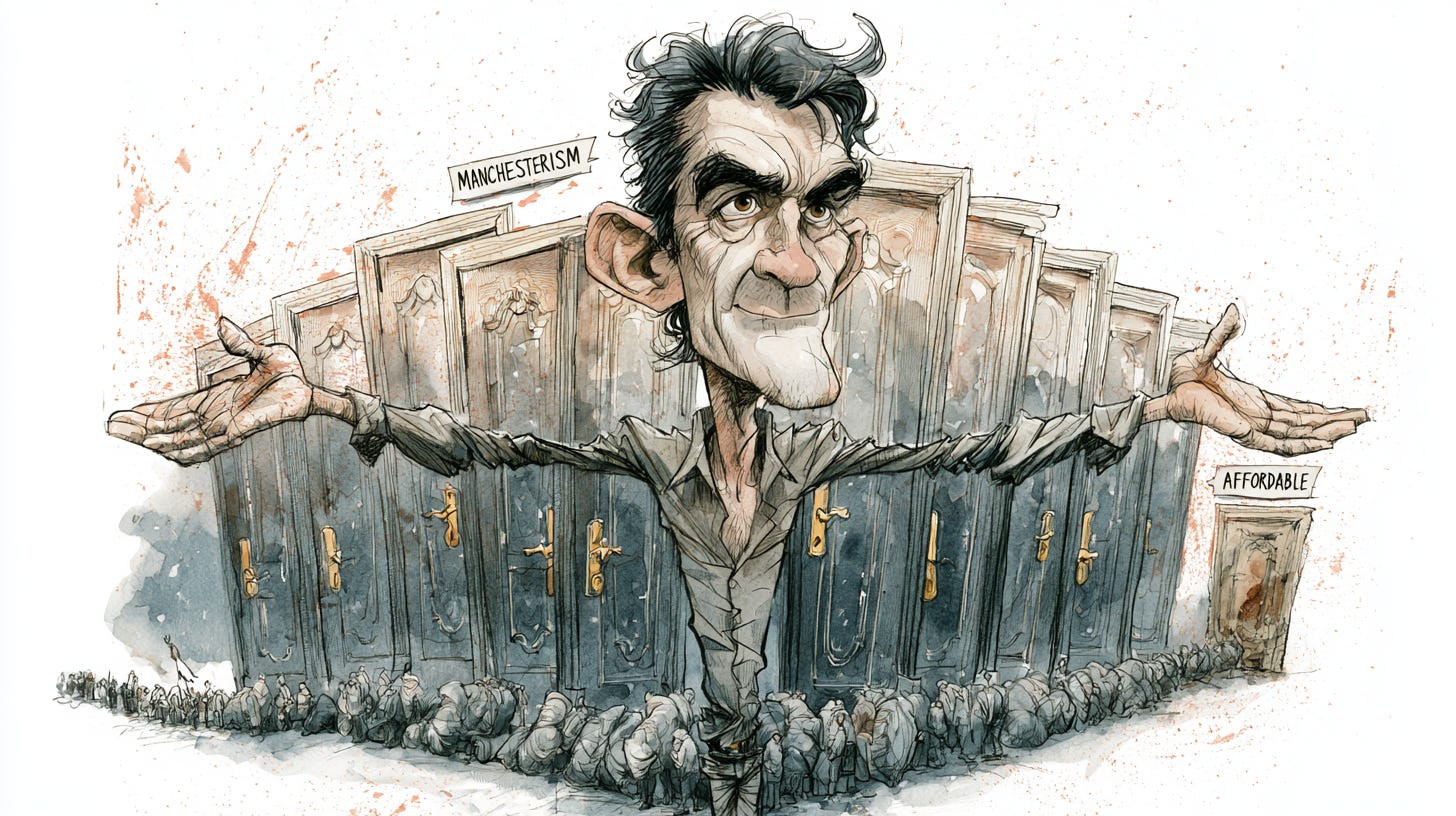
Into this landscape, a public housing investment fund worth eventually £1.2 billion was deployed. Across the life of that fund, approximately eleven thousand homes were built. Five hundred and three of them met the threshold for affordable housing. Let that number settle for a moment. Not a rounding error. Not a statistical anomaly.
One affordable home for every twenty-two built with public money specifically allocated to address an affordable housing crisis. For every twenty-two homes built with your taxes, twenty-one were priced beyond the reach of the people the fund was designed to serve. One notes, in passing, that this represents a hit rate which most people, presented with it in any other context, would describe as a miss.
More than half of that fund — the largest single allocation by a distance that makes “concentration” too gentle a word — went to one developer. Renaker, owned by Daren Whitaker, whose estimated personal fortune stands at £698 million, received public loans to build luxury high-rise apartments in Manchester city centre.
One-bedroom apartments in Renaker’s Manchester developments start from £297,500. In March 2024, a Greater Manchester Combined Authority meeting chaired by Burnham approved £120 million in additional loans to two Renaker special-purpose vehicles — the legal structures that separate individual projects from one another and, in practice, from the scrutiny that might otherwise attach to the parent company. The decision was reached in under a minute.

Both the Competition Appeal Tribunal and the Court of Appeal ruled in the GMCA’s favour on the question of whether the loans constituted an unlawful subsidy. However the Court of Appeal judge, Justice Zacaroli, described as “well founded” the criticisms that Whitaker had not provided a personal guarantee for the loans and that the GMCA had not conducted due diligence on his financial position before approving them. Those concerns, the judge noted, would need to be tested through a separate judicial review — a process that remains open. Whether a further appeal to the Supreme Court will be sought remains to be seen.
Whitaker, it is worth noting in passing, briefly filed Monaco as his primary residence at Companies House before subsequently reverting to the United Kingdom. This detail tells us nothing definitive. It simply sits there, requiring no commentary.
Burnham’s own pre-election pledge was to redirect the housing fund away from — and these are his precise words — “city centre and luxury schemes.” The fund, under his chairmanship, delivered luxury towers in the city centre. The pledge and the outcome share a postcode, which is perhaps the closest they ever came.
There is a word for the consistent conversion of public resources into private returns while maintaining the language of democratic accountability. It is not socialism, which at least maintains, as a theoretical proposition, that public money should produce public outcomes. It is not market capitalism, which dispenses with the progressive language entirely and makes no particular claim to serve anyone. It is considerably older than either, and it has always found its most comfortable habitat in the vicinity of good intentions — because good intentions, unlike bad ones, tend not to generate the kind of scrutiny that might otherwise interrupt the process.
Burnham is not proposing to reform what happened in Manchester. He is proposing to replicate it. More mayors. More locally controlled funds. More decisions about who receives public money made at regional rather than national level — with, in theory, greater democratic accountability closer to the ground.
The accountability infrastructure already existed in Manchester. An Overview and Scrutiny Committee, an Audit Committee, a Police, Fire and Crime Panel — the full formal apparatus of devolved governance, assembled with admirable thoroughness and consulted, one must assume, with equal thoroughness on every matter that did not involve approving £120 million in loans in under a minute without conducting due diligence on the recipient’s financial position.
Devolution did not fail to prevent the problem. It provided the conditions in which the problem could occur with the minimum of interference, by concentrating consequential decisions in fewer hands while distributing the appearance of scrutiny across enough committees to satisfy the formal requirements of transparency without troubling its substance.
To extend this model to every English region is not to solve the accountability deficit. It is to multiply the surface area on which the same outcome becomes possible, in areas with less investigative journalism than Greater Manchester, fewer campaign organisations, and developers who have had the considerable advantage of watching the Manchester process in some detail.
Then there is the net zero transition — which presents itself as an entirely different story, but is, in its underlying architecture, the same one wearing different clothes.
The public funds it. The private sector profits from it. The public, meanwhile, absorbs the compliance costs as they travel down supply chains, arrive in unfamiliar places, and appear on your energy bill with no label identifying their origin.
The Parliamentary Under-Secretary of State for Climate, the minister who helps design the rules governing the net zero transition — previously worked as a Director at both Friends of the Earth and WWF.
This is not an accusation of wrongdoing. It is merely an observation that the people who spent their careers arguing the transition was necessary are now, in government, designing the framework that determines who profits from it. One would not wish to draw any conclusion from this. The conclusion draws itself.
The mechanism operates in clean energy precisely as it operated in Manchester housing. Public purpose. Private return. Regulatory architecture shaped by people with a professional history in the outcome.
This is where it lands on you. Not as policy. Not as politics. As the thing your receipt says when you put it in your pocket. UK food prices are on course to be fifty percent higher by late 2026 than they were at the start of the cost-of-living crisis in mid-2021 — a pace of price growth that has achieved in five years what previously took nearly twenty.
A basic weekly food basket has risen between twenty-eight and thirty-three percent since April 2022. The staples that define a British household’s relationship with the supermarket have been hit hardest: eggs up fifty-nine percent, beef up sixty-four percent, olive oil up one hundred and thirteen percent.
One notes, in passing, that olive oil has increased in price by more than twice the proportion of affordable homes delivered by a billion-pound public housing fund. This is, no doubt, entirely coincidental.

In November 2025, sixty-one percent of adults in Great Britain reported an increase in their cost of living compared with the previous month. Of those whose cost of living had increased, ninety-five percent attributed it to the rising cost of food shopping — a figure that suggests the British public has, in its quiet and undramatic way, already reached a conclusion that the People’s History Museum has not yet caught up with.
The causes are multiple — energy markets, Ukraine, three bad harvests, Iran — but the Bank of England has explicitly identified Net Zero-related regulatory costs as a current, measurable contributor to food inflation. Not a 2050 projection. Now.
That compliance cost is absorbed by manufacturers and retailers, passed along the supply chain with the mechanical efficiency of systems designed to ensure costs travel as far as possible from their origin, arriving eventually at your checkout as a price increase that carries no label identifying where it came from or who decided it was acceptable.
Meanwhile Ofgem has confirmed, in its RIIO-3 Final Determinations, that business transmission charges will rise significantly: a medium factory faces indicative network charge increases of around £9,760 a year by 2031 — a gross figure that will travel down supply chains before any offsetting savings materialise.
The food becomes more expensive. The transition cost is borne collectively. The return on the clean infrastructure being built — funded in part by those same levies — accrues to private capital.
The language is different. The geography is different. The mechanism is the same.
The conditions Andy Burnham would inherit as Prime Minister reward plain statement, because they are not the conditions in which the promises he has made are straightforwardly deliverable — and the distance between the two is, by this point in the article, a familiar kind of distance.
Labour suffered historic losses in May 2026’s local elections, losing control of thirty-eight councils and nearly fifteen hundred councillors. In Wales, Labour failed to win either an outright majority or plurality in the Senedd for the first time in its history, losing to Plaid Cymru — a defeat that ended over a century of Welsh Labour dominance in a single evening.
Reform UK took 1,453 councillor positions across England, marching into the old industrial north and walking out with the silverware in councils Labour had held for decades, among them Tameside — Labour since 1979 — in the heart of Greater Manchester itself.
The fiscal position affords no room for the scale of investment that Burnham’s prospectus — the largest council housing programme since the post-war period, genuine devolution of essential services, a rewired Britain — would actually require.
The OBR’s March 2026 Economic and Fiscal Outlook puts available headroom against the fiscal rules at £9.9 billion — the tightest position in modern history. Defence spending commitments alone may require up to £4.7 billion of that, with the recent Five Eyes warning about AI-enabled cyber threats — co-signed by GCHQ’s own National Cyber Security Centre — doing nothing to suggest those commitments will contract.
This week The Independent reports that Burnham is considering exempting young people from income tax for their first three years of full-time employment — a policy his allies describe as a “major offer” to Generation Z, at a cost of up to £3.5 billion. The arithmetic of what remains for everything else he has promised is, to put it with appropriate delicacy, challenging.
One notes, without drawing any conclusion, that the same generation being offered this tax break in order to save for a house deposit will be saving toward a housing market shaped in no small part by a public fund that delivered one affordable home for every twenty-two built. A policy requiring three consecutive years of unbroken full-time employment to deliver its full benefit assumes a labour market that most young people in 2026 do not recognise.
It also assumes a housing supply capable of meeting the demand — a supply chain this publication has documented collapsing at ten firms a day. The people who need it most will find, as before, that the details are in the small print.
He arrives having been handed the wheel at the precise moment the wheel is most likely to come off — by people who understood the waters rather well before they invited him to sail them.
The mechanism belongs to no single party and flatters the record of none. It operated under Blair, Brown, Cameron, May, and Johnson. It is the default operating system of the British state when it encounters a large sum of money and a good cause. The cause provides the cover. The money finds its level.
Andy Burnham is, by most accounts of those who have observed him closely, a politician of genuine conviction — which is not the same thing, it is worth being precise, as a politician of guaranteed effect. The People’s History Museum was not an accidental choice of venue. Manchesterism is not a cynically constructed brand. He means what he says.
The documented record of how public money moved in Greater Manchester under his leadership, and the architecture he proposes to extend nationally, suggest only that meaning something and delivering it are not — and have never been, for any politician of any persuasion who has stood before a crowd and promised to return power to the people — reliably the same undertaking.
There is, in the circumstances, one question worth carrying away from this.
Which people?
In Manchester, the Competition Appeal Tribunal, the Court of Appeal, and the rather illuminating detail of a developer’s Companies House filing have supplied something approximating an answer. The country is shortly to discover whether the answer is different when the fund is larger, the mayors more numerous, and the man making the promise is operating from a building in Whitehall rather than one in Salford.
Given what we know of the mechanism, and given what we have watched it do with £1.2 billion of public money and eleven thousand homes, the expectation that this time will be different is not irrational. It is simply a position that requires, in the light of the available evidence, rather more justification than optimism alone can supply.
The King of the North is heading south. The nerve centre of a rewired Britain will be in Manchester. And somewhere in that city, in a tower where one-bedroom apartments begin at £297,500 and the concierge operates around the clock, the lights are already on — paid for, in no small part, by the public fund that was supposed to house the people looking up at it from the street below.
That is Manchesterism. Coming soon to a region near you.
One last thing. The cost of living survey remains open for those who have not yet completed it. It takes less than three minutes. Your answers are read, not filed. If you have not filled it in, now would be the time. Tell us what you think.