…Experts Fault Defence Spending Priorities, Seek Funding Overhaul
Between 2020 and 2026, the Nigerian Army received a total budgetary allocation of N5.99tn from the Federal Government, THE WHISTLER investigations have revealed.
Yet, across battlefields in the North-East and other conflict zones, high-ranking officers—from lieutenant colonels to brigadier generals—have continued to die in insurgent attacks, ambushes and improvised explosive device (IED) explosions.
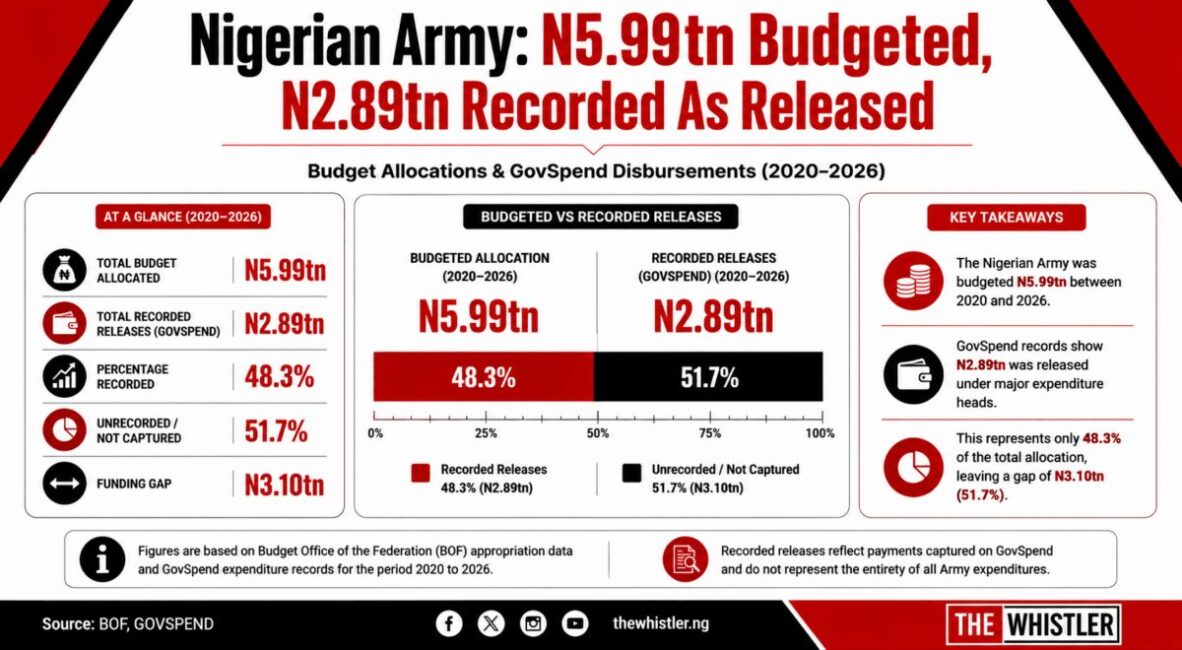
An investigation by THE WHISTLER, based on an analysis of Budget Office of the Federation (BOF) appropriation data and GovSpend disbursement records, revealed that while the Army was allocated N5.99tn over the seven-year period, actual releases captured on the Federal Government’s expenditure portal stood at N2.89tn, representing less than half of the total allocation.
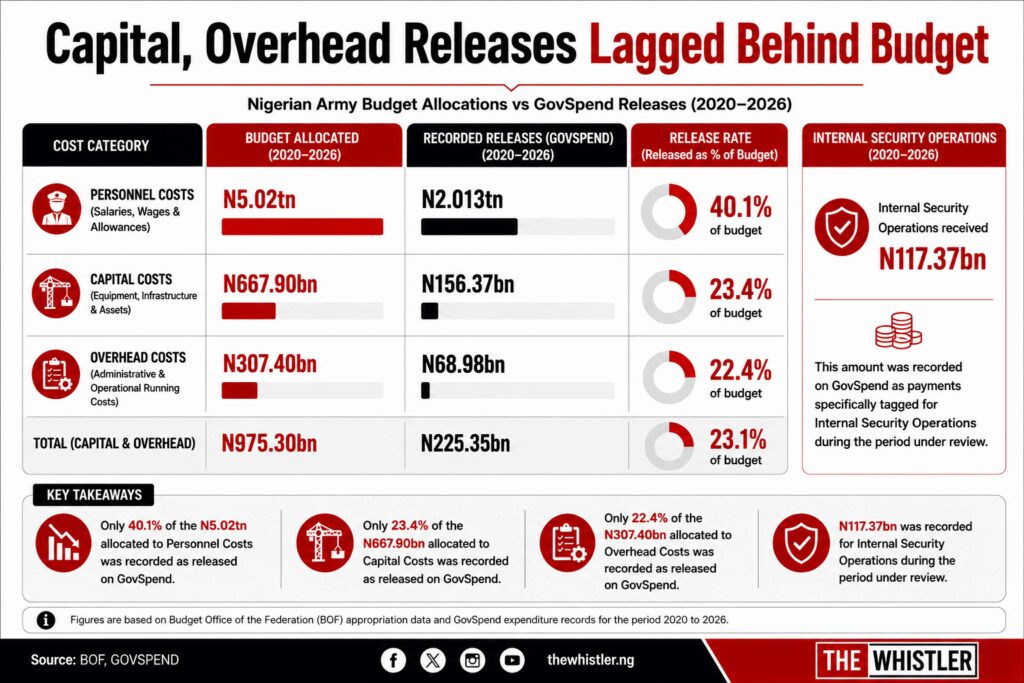
The BOF data showed that personnel costs accounted for N5.02tn of the Army’s budget between 2020 and 2026, overhead stood at N307.4bn, while capital expenditure totalled N667.9bn.
This places personnel spending at about 83.7 per cent of the total allocation, with overhead accounting for 5.1 per cent and capital expenditure making up 11.1 per cent, underscoring the heavy concentration of defence spending on salaries and personnel-related obligations.
A year-by-year breakdown also showed a steady increase in appropriations throughout the review period.
The Army received N463.4bn in 2020, rising by 10.2 per cent to N510.6bn in 2021. Funding increased further to N580.8bn in 2022 before climbing to N665.1bn in 2023.
The upward trajectory continued in 2024 when the allocation rose to N789.8bn, an 18.8 per cent increase from the previous year.
The biggest increase came in 2025 as the Army’s budget almost doubled to N1.48tn which is an increase of 88.1 per cent increase over 2024.
For 2026, the appropriation rose marginally to N1.50tn, bringing cumulative allocations for the seven-year period to N5.99tn, an overall increase of about 224.8 per cent from the 2020 figure.
However, GovSpend records tracking actual payments present a different picture.
An analysis of expenditure data on the Federal Government’s transparency portal showed that a cumulative N2.89tn had been released to the Nigerian Army under major expenditure heads during the period under review.
This represents about 48.3 per cent of the N5.99tn appropriated for the Army over the seven years.
The disbursement records show that Non-Regular Allowances accounted for the largest share of releases at N2.16tn, followed by Capital Expenditure with N483.55bn.
Overhead releases stood at N135.96bn, while Internal Security Operations received N117.37bn, bringing the total amount disbursed through the tracked expenditure heads to N2.89tn.
A comparison of both datasets revealed noticeable differences between budgetary provisions and recorded releases.
While N667.9bn was earmarked for capital projects over the period, GovSpend records showed N483.55bn in capital disbursements, leaving a gap of about N184.35bn.
Similarly, although overhead was budgeted at N307.4bn, releases captured on GovSpend amounted to N135.96bn.
Personnel allocations were budgeted at N5.02tn, while GovSpend specifically records N2.16tn under Non-Regular Allowances, a personnel-related expenditure category, though this does not represent the entirety of personnel payments.
The recorded amount is about 43 per cent of the budgeted allocation, leaving a difference of approximately N2.86tn (57 per cent)
The comparison illustrates that while appropriations outline government spending intentions, actual releases reflect the pace and extent of implementation.
These funding trends unfolded as the military continued sustained operations against Boko Haram and the Islamic State West Africa Province (ISWAP), alongside other internal security threats across the country.
However, THE WHISTLER contacted the Nigerian Army’s Acting Director of Public Relations, Lt. Col Appolonia Anele, following its findings, but messages and calls sent via WhatsApp received no response.
A Pattern Of Losses On The Frontlines
Despite rising allocations and trillions of naira in recorded releases, the loss of senior officers has persisted, particularly in recent years, with insurgents increasingly targeting frontline commanders.
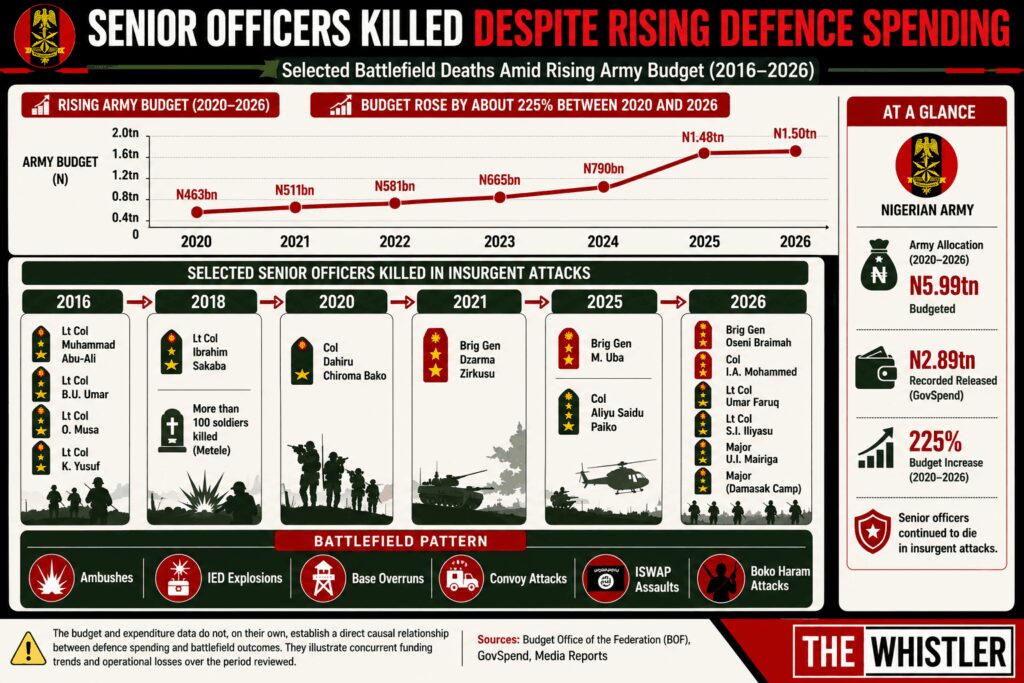
In April 2026, Brigadier General Oseni Braimah, commander of the 29 Task Force Brigade under Operation Hadin Kai, was killed during a Boko Haram attack on a military base in Benisheikh, Borno State.
The insurgents launched a coordinated assault on the installation, engaging troops in a fierce battle before the attack was eventually repelled.
Days later, Colonel I.A. Mohammed was killed after his vehicle struck an improvised explosive device while responding to an ongoing attack in Monguno, Borno State.
According to the Media Information Officer, Headquarters Joint Task Force (North East), Operation HADIN KAI, Lieutenant Colonel Sani Uba, the troops were successful in repelling the attack, prior to their death.
In March 2026 alone, multiple senior officers were killed in separate insurgent attacks across Borno State, highlighting the growing intensity of assaults on military formations.
Lieutenant Colonel Umar Faruq, commander of the Kukawa military camp, was killed after insurgents stormed the base under the cover of darkness, overpowering troops and setting military vehicles ablaze.
Within the same period, Lieutenant Colonel S.I. Iliyasu, commander of the 2nd Battalion in Konduga, was killed during a coordinated ISWAP attack that formed part of a broader wave of offensives against military formations in the state.
Also in March, Major U.I. Mairiga, commander of the Mayanti military camp in Bama, lost his life after insurgents overwhelmed the base during an overnight raid.
Earlier in January 2026, a Major who commanded the Damasak military camp was killed after troops were ambushed by ISWAP fighters. Reports indicated that he was later executed alongside other military personnel and members of the Civilian Joint Task Force.
The pattern had also emerged in 2025. In November, Brigadier General M. Uba, commander of the 25 Task Force Brigade in Damboa, was killed after insurgents tracked and ambushed his convoy along the Damboa–Biu road.
Only weeks earlier, Colonel Aliyu Saidu Paiko, commanding officer of the 202 Battalion, was killed during a Boko Haram attack on a military formation in Bama.
Beyond the period covered by this investigation, similar attacks had already exposed the vulnerability of senior military commanders on the battlefield.
In 2021, Brigadier General Dzarma Zirkusu was killed alongside other personnel after insurgents ambushed troops in Askira Uba, Borno State. A year earlier, Colonel Dahiru Chiroma Bako died from injuries sustained during an insurgent attack near Damboa.
The trend stretches back even further. In 2018, Lieutenant Colonel Ibrahim Sakaba was among the senior officers killed during the deadly Metele attack, one of the bloodiest assaults on the Nigerian military, which also claimed the lives of more than 100 soldiers.
Earlier, in 2016, Lieutenant Colonels Muhammad Abu-Ali, B.U. Umar, O. Musa and K. Yusuf were killed in separate Boko Haram attacks involving ambushes and improvised explosive devices.
Collectively, these incidents point to a troubling pattern in which insurgents have repeatedly succeeded in targeting experienced field commanders despite successive increases in defence spending.
Recall that President Bola Ahmed Tinubu had said more than 13,000 terrorists had been killed while over 124,000 fighters and their dependants have surrendered since 2023 through Operation Safe Corridor, despite persistent attacks and kidnappings by armed groups across the country.
In his 2026 Democracy Day address, Tinubu said terrorist-related killings have fallen by 81 per cent since he assumed office in 2023, attributing the decline to sustained military operations and the rehabilitation of repentant fighters under Operation Safe Corridor.
Although the budget and expenditure data do not, on their own, establish a direct causal relationship between funding levels and battlefield outcomes, they reveal a significant disconnect that warrants closer scrutiny.
Over the last seven years, the Nigerian Army’s budget more than tripled from N463.4bn to N1.50tn, while GovSpend records show that N2.89tn has been released under key expenditure heads. Yet, attacks on military formations have persisted, and the loss of senior commanders has continued.
The figures raise broader questions about how defence resources are prioritised, the pace at which appropriated funds are released, and whether spending is translating into improved operational capability, force protection, intelligence gathering and battlefield preparedness.
The concerns become even more pronounced against the backdrop of the evolving insurgency.
Recall that the Islamic State West Africa Province (ISWAP) intensified its offensive in 2025 by launching what it described as the “Burning of the Camps,” also referred to as the “Camp Holocaust” campaign—a coordinated strategy designed to weaken Nigeria’s security architecture by systematically attacking and overrunning military formations across the North-East.
The campaign resulted in repeated assaults on forward operating bases, the destruction of military equipment and the deaths of both officers and soldiers, signalling a shift in the group’s operational capability and tactical sophistication.
The deteriorating security situation is also reflected in global terrorism data.
The Institute for Economics and Peace, in its Global Terrorism Index 2026, ranked Nigeria the fourth-most terrorism-affected country in the world.
According to the report, ISWAP reclaimed its position as the deadliest terrorist organisation operating in Nigeria, carrying out more than 90 attacks that resulted in 384 deaths in 2025 alone.
Subsequently, the SBM Intelligence’s report titled “Locust Business: The Economics of Nigeria’s Kidnap Industry – 2025 Update,” revealed that Nigeria recorded 997 kidnapping incidents between July 2024 and June 2025, during which 4,722 people were abducted and 762 people were killed in kidnapping-related attacks.
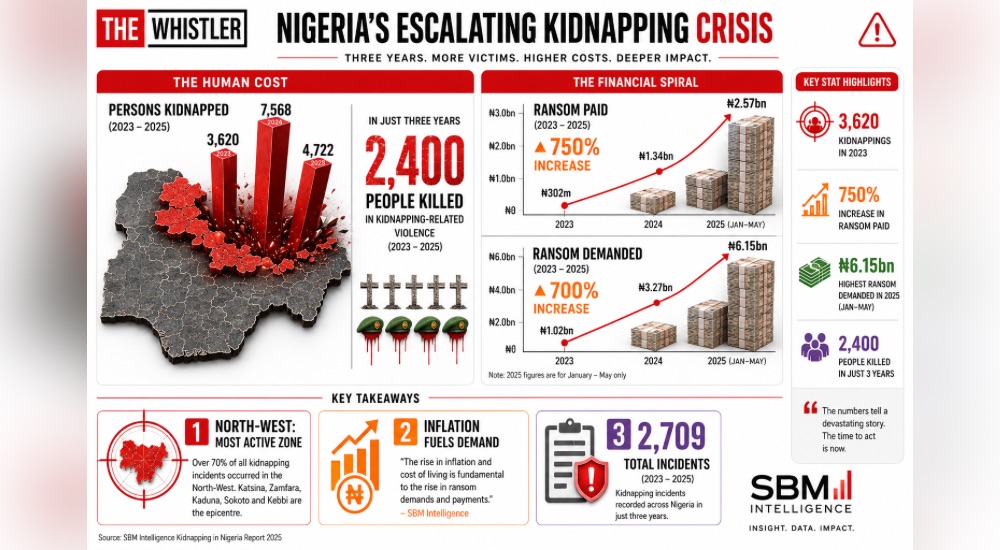
During the period, kidnappers demanded more than N48bn in ransom but received about N2.57bn, representing just over five per cent of the amount demanded.
The report identified the North-West as the epicentre of Nigeria’s kidnapping crisis, accounting for 425 attacks, or 42.6 per cent of all kidnapping incidents nationwide.
The region also recorded 2,938 victims, representing 62.2 per cent of all abductees during the review period. Zamfara State emerged as the worst-hit state with 1,203 kidnapped victims, followed by Kaduna and Katsina, where large-scale abductions remained prevalent.
SBM Intelligence further noted that mass abductions, involving more than five victims in a single incident, accounted for nearly 23 per cent of all recorded kidnapping attacks, with most occurring in northern Nigeria.
The report attributed the concentration of attacks in the North-West to entrenched bandit networks, weak state presence in rural communities and expansive ungoverned forests that continue to provide safe havens for criminal groups.
Funding Must Follow Operational Needs -Experts
The data raises questions about whether rising defence allocations and recorded disbursements are translating into improved operational effectiveness. Security analysts and military experts who spoke with THE WHISTLER said the figures point to deeper structural challenges that extend beyond the size of the budget.
Security analyst and Managing Director of Beacon Security and Intelligence Limited (BSIL), Dr. Kabir Adamu, believes Nigeria’s security challenges cannot be solved simply by increasing budgetary allocations.
Rather, he argued that defence spending should begin with a careful assessment of operational requirements to ensure resources are directed to areas of greatest need.
According to him, funding only becomes meaningful when it responds to clearly identified gaps within the country’s defence and security architecture. Without that process, he warned, larger appropriations may have little impact on operational effectiveness.
Adamu told THE WHISTLER that an ideal budgeting process should begin with the various components of the defence sector identifying their requirements before presenting them to the executive and, ultimately, the National Assembly for appropriation.
“The most important thing is to start by saying that funding is necessary for security and defence operations, but that funding must be geared towards operational requirements. In other words, when funding is made, is it based on an initial assessment that identifies the requirements for the different aspects of both security and defence? This must first be addressed,” Adamu stated.
Adamu noted that Nigeria’s defence structure comprises several strategic institutions, each with different responsibilities and operational demands that should be reflected in the budgeting process.
He said, “There are around 10 strategic components to our defence apparatus, ranging from the Ministry of Defence to the Defence Headquarters to the three services (Army, Navy and Air Force). Then under those services, you also have different sorts of components. At that same strategic level, we have the tactical and operational level.”
He argued that once those needs are identified, they should form the basis of budget proposals submitted by the defence establishment, while lawmakers exercise their constitutional responsibility of scrutinising and approving the estimates.
He said, “So was there any assessment to identify the requirements upon which a budget was developed? Now, if that is the case, it means after the budget was developed, and remember that the budgeting process is handled by the legislature, the National Assembly, the House of Reps, and the Senate.
“So that means, for instance, the process should have been done in such a way that the defence sector and its components will submit their needs. And hopefully, that submission is based on a strategic process where the needs were identified.
“And then the National Assembly will now use their own knowledge and their understanding of the legislative process for budgeting to come up with a budget figure.”
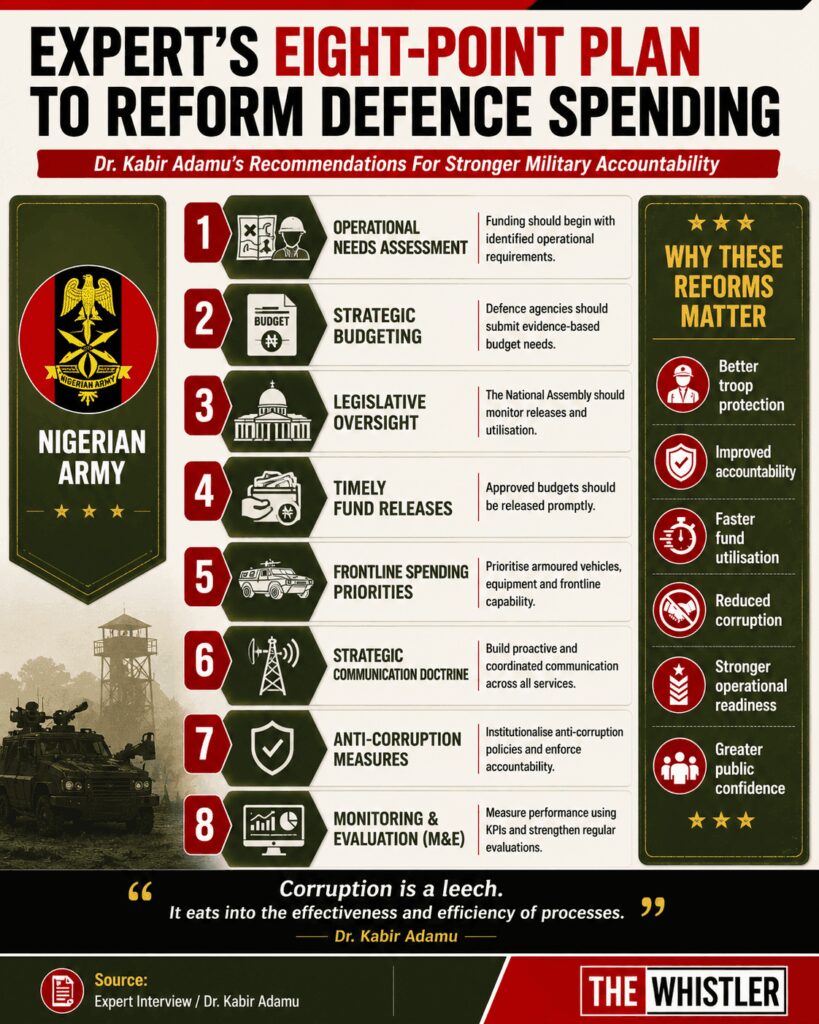
Adamu stressed that appropriating funds is only the first stage of the process, arguing that effective oversight is necessary to ensure public funds are deployed for their intended purpose.
He said legislative oversight should not end once budgets are passed but should extend to monitoring releases and expenditure across the defence establishment.
According to him, such accountability mechanisms are essential to determining whether allocations translate into operational outcomes on the ground.
He continued, “Now, the second component is compliance. So, after this process that I described has been arrived at, it means there must be a review process to ensure compliance. What do I mean by that? Let’s say N1tn was marked or budgeted for the defence sector under this arrangement with each of the components. The National Assembly should have a process through oversight.
“There is an oversight committee within the National Assembly for the military and for defence. That means they must have a process of knowing. At the executive level, the money is being released. And then, when the money is being released, at the operational, strategic and tactical level, the money budgeted is actually used.”
While describing oversight as critical, Adamu said another major challenge lies in the actual release of approved funds.
He argued that delayed or incomplete releases undermine implementation, regardless of how well the budgeting process is designed.
He pointed to reports indicating that only a fraction of approved capital allocations had been disbursed to the military, saying such a situation weakens the ability of security agencies to execute planned operations.
Adamu said, “Now the third element is the actual release of funds. Now we know, for instance, that in this administration, the 2024, 2025, and 2026 budgets at a point were all running concurrently, mainly because funds were never released.
“A report had claimed that less than 10 per cent of the capital budget for the army was released. So, if that is true, it means, for instance, that what was actually budgeted was never released.”
Adamu said the consequences of delayed or incomplete releases extend beyond financing, arguing that they make it difficult to assess whether defence spending is achieving its intended objectives.
According to him, evaluating military effectiveness requires not only a sound budgeting process but also transparency over how much of the approved allocation is eventually disbursed, noting that without those benchmarks it becomes nearly impossible to link funding with operational outcomes.
“But remember, I started saying that funding is necessary for defence and security purposes, but then that funding must be tied to a strategic requirement and needs. And some of these issues I’ve mentioned are the challenges within the Nigerian space that make it difficult to tie funding to the effectiveness of operations.
“Because if you are going to measure effectiveness, first you have to make sure that the process that led to the budget was the best practise.
“You must also be able to measure how much was released. And at the moment, there is an allegation that only a very meagre amount was released.”
Beyond the issue of fund releases, Adamu questioned how available resources are ultimately spent within the defence establishment.
He argued that expenditure should reflect operational realities, with greater emphasis placed on equipping troops actively engaged in combat.
While acknowledging that infrastructure projects have their place, he maintained they should not come at the expense of frontline capabilities.
He said, “Now, even when the amount is released, based on evidence, and you can go around and see, you’ll find out that the leadership of the security defence sector prefers to do certain things rather than the real core issues. So, for instance, if you go around Abuja, the command guest house, you’ll see a swimming pool being built. You’ll see them renovating those commands.
“Now, that’s necessary. Don’t get me wrong. It is important. We need to do that. But when you now put them on a scale of importance and relevance, they are not as important as, for instance, buying armoured vehicles for our frontline troops. Because our frontline troops are moving in soft-skinned vehicles.
“So how do you justify building swimming pools when you have that reality? How do you justify building a university when you don’t have barracks and training institutions?”
While criticizing spending priorities, Adamu acknowledged that the current administration has taken steps to improve the welfare of military personnel.
He noted that the welfare of frontline troops is recognised under the Renewed Hope Agenda but argued that implementation has yet to fully match the policy’s objectives.
According to him, although measures such as improved insurance, housing and troop rotations have been introduced, much more remains to be done.
Stressing this, Adamu said, “So I want to emphasise that the Bola Tinubu administration, the document that guides the policy imperative, that’s the renewed hope agenda, has as one major element the welfare of frontline troops.
“So that means the administration actually realises the importance and relevance of the welfare of frontline troops. The challenge, however, is that three years into the administration, the complete realisation of that is yet to be had. I know they’ve made some effort.
“A few policies have been done, including some policies to enhance insurance, houses have been built, rotations of the military have been improved, and things like that. So, a bit of progress is being made, but it’s not an act that was envisaged under the renewed hope agenda.
“It’s important to say that security and defence are totally different.
“When bandits, for instance, put up such agendas, it’s more security than defence. The military is more about defence.
“For years, vehicles have been bombed, and it’s because we’ve not been able to dominate the space, the operational space, where we have activities ongoing.
“For us to achieve success, we must be able to dominate the space. And part of the challenge, where we’re having what we’re having, is because we’ve not been able to dominate the operational space.
“So, the operational space is, for instance, the forested part or the so-called ungoverned space, which is where all these bandits operate, and it would be unfair to put that responsibility on the military. It is a security issue.
Another security expert, Stephen Adebayo argued that addressing Nigeria’s security crisis requires more than increased military spending, saying structural weaknesses within the country’s security architecture have created opportunities for criminal groups to flourish.
He maintained that many of the threats confronting the country are internal security issues, even though the military has increasingly been called upon to respond to them.
According to him, success against banditry and other violent crimes depends on denying criminal groups the ungoverned spaces from which they operate.
“We left a gap in our national security architecture that has allowed criminal groups, non-state actors, to go and occupy space in ungoverened spaces and forest areas.
“So, I mean, I want you to envision security from that point of view. That’s not still the responsibility of the defence sector, even though in Nigeria, we kind of made it like that.
“Until Nigeria takes full control of these spaces, insecurity, insurgency will continue to thrive.”