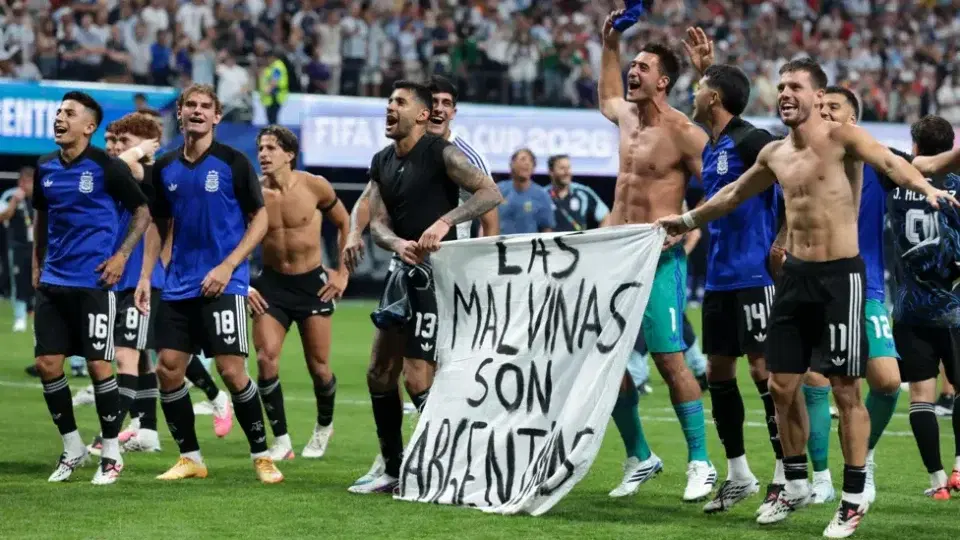
Argentine players display the Falklands banner after the game. Photo: Getty Images
By Adegboyega Adeleye
FIFA is currently “reviewing match reports” before deciding whether to punish Argentina after players celebrated their dramatic 2026 FIFA World Cup semi-final victory over England with a banner supporting the country’s claim to the Falkland Islands.
The reigning world champions came from behind to beat Thomas Tuchel’s England 2-1 in Atlanta on Wednesday, with late goals from Enzo Fernández and Lautaro Martínez sealing Argentina’s place in Sunday’s World Cup final against Spain.
After the final whistle, several Argentina players held up a banner reading “Las Malvinas son Argentinas” (“The Falklands are Argentine”), referring to the disputed British overseas territory in the South Atlantic.
According to the BBC, a FIFA spokesperson confirmed that its independent disciplinary committee is reviewing the match reports before deciding on any further action.
“As is standard procedure, FIFA’s independent disciplinary committee is currently reviewing the match reports and considering the relevant circumstances before deciding on potential further steps based on the FIFA disciplinary code.”
Argentina have faced sanctions over a similar incident before. In 2014, FIFA fined the Argentine Football Association after players displayed the same political message before a friendly against Slovenia, ruling that it breached regulations on political statements and team misconduct.
The issue has also drawn a response from the British government. A spokesperson for UK Prime Minister Keir Starmer said: “The World Cup might not be ours, but the Falkland Islands definitely are. Our commitment to the Falklands will never waver.”
Argentine President Javier Milei reportedly described the players’ gesture as “understandable” and “valid”, while stressing that events on the football pitch should remain separate from diplomacy.
Although Argentina are under FIFA investigation, there is no indication that the team could lose its place in Sunday’s World Cup final against Spain. Any disciplinary measures, if imposed, are more likely to involve fines or individual sanctions than affect the final itself.