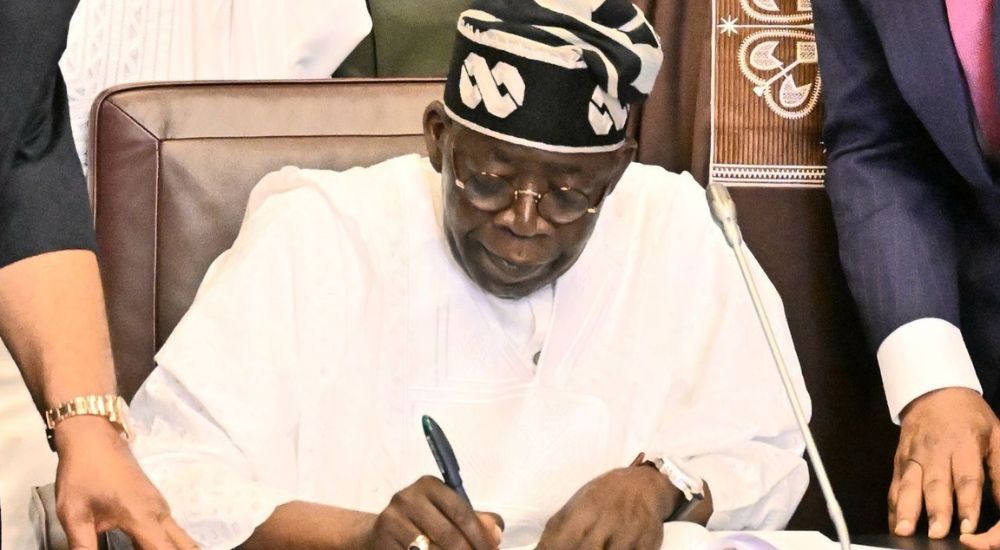
The Minister of Works, Senator David Umahi, on Thursday, disclosed that President Bola Tinubu has approved the extension of the Fourth Legacy Highway by an additional 400 kilometres.
He said the approval had increased the length of the strategic road corridor from about 700 kilometres to approximately 1,100 kilometres.
Umahi stated that Tinubu approved the extension of the project on Wednesday.
Speaking during a media briefing in Abuja, Umahi stated that the new extension would take the highway through Taraba State to create stronger links between the North-Central and North-East.
According to him, the route would pass through several historic communities and prominent towns before connecting to Taraba.
He explained that it would
pass through the towns of General Yakubu Gowon, the former Head of State;
late Solomon Lar, former Civilian Governor of Plateau State; the National Chairman of the All Progressives Congress (APC), Professor Nentawe Goshwe Yilwatda, and others.
He said: “The greatest story is that yesterday, President Bola Ahmed Tinubu approved the addition of 400 kilometres to our Fourth Legacy Road. That is unprecedented.
“The Project will pass through the place of General Gowon. It will pass through the place of (late) Solomon Lar. It will pass through the place of the present National Chairman of the APC. It goes down to Taraba, and that is unprecedented.”
THE WHISTLER recalls that the Fourth Legacy Highway was designed as a dual carriageway linking Akwanga in Nasarawa State with Maiduguri in Borno State through Plateau, Bauchi, Gombe and Biu.
The minister also disclosed that the president had approved the reconstruction of the Lagos-Ibadan Expressway with reinforced concrete pavement, the completion of the abandoned Ibi Bridge in Taraba State, the construction of the 5.76-kilometre Lau Bridge, and the dualisation of an additional 400 kilometres of the East-West Road.
According to him, the latest approvals further demonstrate Tinubu’s commitment to delivering legacy infrastructure projects across all geopolitical zones.
Umahi also announced presidential approval for the complete reconstruction of the Lagos-Ibadan Expressway after sections of the road began deteriorating less than five years after rehabilitation.
He said the decision vindicated his ministry’s insistence on using reinforced concrete pavement instead of asphalt for major highways.
“The president yesterday approved the reconstruction of the Lagos-Ibadan Road, and that is the justification for our fight for the use of reinforced concrete pavement”, he said.
Umahi explained that the existing asphalt pavement had repeatedly failed despite maintenance works.
“It is 135 kilometres by two carriageways. That project is not up to five years old, yet it has already started failing. We took journalists there. We took members of the National Assembly there. You could see the road failing. They repaired it, and it still failed”, the Minister said.
Umahi further disclosed that Tinubu had approved the completion of the abandoned Ibi Bridge project in Taraba State.
He explained that the bridge, awarded in 2018, had reached about 40 per cent completion before work stopped.
“That bridge was awarded in 2018, got to about 40 per cent completion and was abandoned. Yesterday, the President approved the review and completion of the Ibi Bridge in Taraba State,” Umahi said.
The minister also announced the approval for the construction of the Lau Bridge across the Benue River.
He said: “The Lau Bridge in Taraba State, which is 5.76 kilometres across the river, the president approved that it should be designed, procured and awarded.”
The minister said the president has equally approved the dualisation of another 400 kilometres of the East-West Road corridor.
He said: “The President also approved 400 kilometres of dualised East-West Road running from Lokoja down to Benin. This is another very important intervention in our road infrastructure.”
According to Umahi, the project would improve safety, facilitate trade and reduce travel time along one of Nigeria’s busiest transport corridors.
In another major announcement, Umahi disclosed that the Lagos-Calabar Coastal Highway would henceforth be known as the President Bola Ahmed Tinubu Coastal Highway.
He said the decision was taken by the Ministry of Works in recognition of Tinubu’s long-standing vision for the landmark infrastructure.
“The highway is named President Bola Ahmed Tinubu Coastal Highway. By the powers conferred on me as Minister of Works, in consultation with my Permanent Secretary, the Honourable Minister of State, directors and staff of the ministry, we decided to name it after him because of his dream for it.”
On the 750-kilometre coastal highway, the minister said work was progressing simultaneously from different sections of the corridor.
He said the first section, stretching from Victoria Island to Eleko Village in Lagos State, had become a model for modern highway construction.
He said: “Section One, from Victoria Island to Eleko Village, is 47.47 kilometres. It is a dual carriageway with a 25-metre median reserved for a future railway line. That project is a beauty to behold.”
He disclosed that Section Two, extending from Eleko Village to the Lagos-Ogun boundary, had reached about 60 per cent completion.
“We believe that by the end of November, we will have finished that project. What may remain will be some of the bridges because of the complexity of the structures,” he said.
On the Sokoto-Badagry Super Highway, he described it as the actualisation of a vision conceived more than five decades ago.
He said the project would reduce travel time between Sokoto and Lagos to about 10 hours at an average speed of 100 kilometres per hour.
“The dream of our founding fathers during the Shagari administration over 50 years ago is being actualised. Presidents came and went, but nobody attempted it. Today, work is ongoing from Ilela to Sokoto, from Kebbi and also from the Badagry end.”
The minister also highlighted progress on the Trans-Saharan Highway, saying the project would significantly improve connectivity between the South-East and the Federal Capital Territory.
He said ongoing sections through Ebonyi, Benue, Enugu and Kogi states would drastically reduce travel time from the South-East to Abuja.