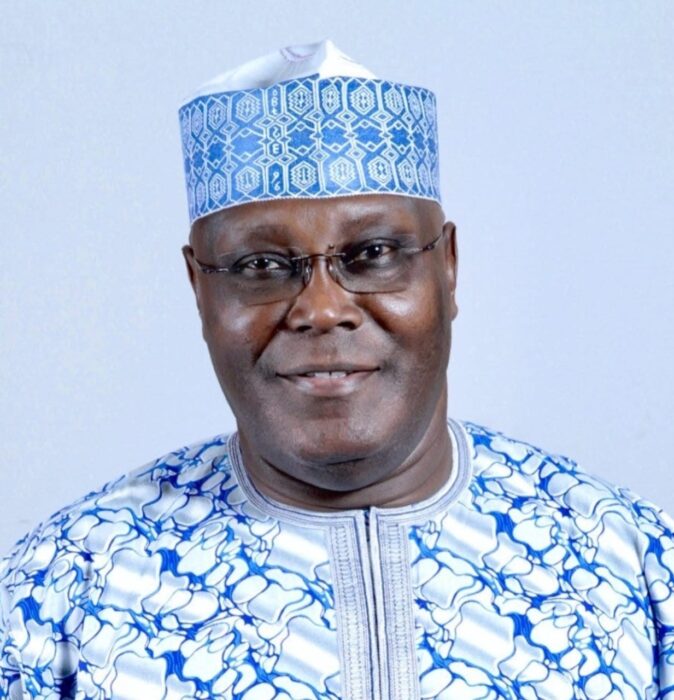
Presidential Candidate of the African Democratic Congress (ADC), Atiku Abubakar, has declared that Nigeria cannot borrow, import and tax its way to prosperity, insisting that the country’s economic salvation lies in producing what it eats, manufacturing what it uses and exporting what it makes.
In a statement issued on Monday by his Senior Special Assistant on Public Communication, Phrank Shaibu, Atiku said Nigeria could not “borrow, import and tax its way to prosperity,” insisting that sustainable economic growth would only come through increased production, industrialisation and exports.
According to the former vice president, the nation’s economic challenges are not solely driven by global factors but by years of policy choices that rewarded consumption over production.
“For too long, we have celebrated importation while neglecting production. We import food that should be grown in our fields, goods that should be manufactured in our factories and even raw materials that ought to be processed by Nigerian hands. No nation has ever become prosperous by exporting jobs and importing poverty,” he said.
Atiku pointed to rising food inflation and the struggles of Nigeria’s manufacturing sector as evidence of what he described as a failed economic model.
He noted that national food inflation currently stands at 17.52 per cent, with significantly higher rates in some states, including 53.02 per cent in Kogi and 43.83 per cent in Niger, warning that millions of Nigerians were being pushed beyond the reach of basic nutrition.
He also said Nigerian manufacturers spent ₦3.53 trillion importing raw materials within six months, while declining tax contributions from manufacturers indicated weakening industrial activity and reduced factory output.
“A nation cannot build prosperity when its factories are falling silent. We are exporting jobs, importing inflation, weakening the naira and mortgaging our future,” Atiku stated.
Atiku called for an urgent restructuring of the economy around agriculture, manufacturing, solid minerals, technology and value addition.
He argued that processing locally produced commodities and expanding domestic manufacturing would create jobs, strengthen the naira and reduce dependence on imports.
“Every bag of cocoa processed from Idanre and the rich cocoa belt of Ondo State, every bag of rice harvested in Kebbi, every yam cultivated in Benue, every tomato processed in Kano, every pharmaceutical produced in Aba, every leather product made in Kano and every machine assembled in Nnewi creates jobs, strengthens the naira and reduces our dependence on imports,” he said.
Reflecting on his time in government, Atiku said the administration of former President Olusegun Obasanjo implemented market-oriented reforms that restored investor confidence, liberalised key sectors and attracted significant private investment, which he said laid the foundation for one of Nigeria’s strongest periods of economic growth.
He also outlined what he described as the economic priorities of an ADC-led government if elected.
According to him, his administration would restore security in farming communities and industrial corridors, stressing that “food security begins with farm security.”
Atiku said the proposed policies would include reducing import duties on industrial machinery not produced locally, providing affordable long-term credit for farmers and manufacturers, ensuring competitive electricity and fuel pricing, stabilising the naira, investing in power, roads, rail, irrigation and storage infrastructure, promoting agro-processing and industrial clusters, reforming the tax system to encourage production, and guaranteeing decent wages to improve consumers’ purchasing power.
“Factories cannot thrive where borrowing is prohibitive, energy is unaffordable, the currency is unstable, and consumers are too poor to buy locally made goods. Our mission is simple: Produce in Nigeria. Employ Nigerians. Consume Nigerian products. Export Nigerian excellence.
“The wealth of nations is measured not by what they import but by what they produce, process and export. That is the Nigeria we helped build before, and by the grace of God, that is the Nigeria we shall build again,” he added.
We’ve got the edge. Get real-time reports, breaking scoops, and exclusive angles delivered straight to your phone. Don’t settle for stale news. Join LEADERSHIP NEWS on WhatsApp for 24/7 updates →