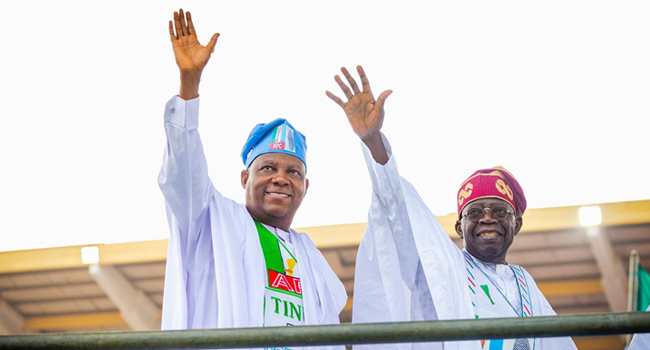
Vice President Kashim Shettima is not new to the technique of how to handle a “hostile crowd”. In August 2022, as vice presidential nominee to then presidential candidate Bola Ahmed Tinubu, Shettima had worn a suit on sneakers to attend a colloquium of the Nigerian Bar Association in Lagos.
There followed a mild media uproar which felt more like political beef than a genuine reproach for his dress sense. His outfit has since become a fashion statement, with perhaps many of those who rebuked him at the time now adopting sneakers for just about anything in the wardrobe.
If Shettima has suffered more blushes than that episode, it must have been when political jobbers got busy peddling permutations that he was likely to be dropped as President Tinubu’s running mate in the second term. But both he and his principal turned a deaf ear to the speculations and quietly ignored the ‘hostile crowd’.
Nonetheless, there was a bit to worry about, especially in respect to the time-tested wisdom that politics harbours no permanent friends. As Governor of Lagos State between 1999 and 2007, Tinubu had changed three deputies from 1999-2002, 2002-2007, and the last in 2007. If precedent was of any account, that handwriting was very legible and political speculators drummed a bass on it.
There had been an even bigger precedent in the presidency. Between 1999 and 2002, every political pundit had imagined that the Obasanjo-Atiku presidential combo was the best partnership that ever happened in politics. Indeed, President Obasanjo had, in an interview, described his relationship with his vice as “auren zobe”, a Hausa expression that connotes a tightly-bound marriage. It did look, at some point, as though President Obasanjo was going to round off his term by seamlessly transferring power to Atiku.
But then things went south towards the end of their first term. The relationship deteriorated so fast and so badly that the Obasanjo-Atiku political marriage nearly became homicidal.
27 years down the road and out of power, the public posturing of both men remains politically ambiguous and, at best, tolerant. But not before Obasanjo ensured he cremated Atiku’s political umbilical cord and scattered the ashes to the four.
If the Obj-Atiku combo provided a religious balance – one of Nigeria’s tectonic plates in the politics of identity, Tinubu and Shettima have stoically borne the pressure of violating the norm.
As the spare tyres that deputies have become in the Nigerian polity, it wouldn’t take too much trouble to humiliate or even replace one. In particular, Shettima must have constantly been under the tension of one swimming against the tide, who faced the constant threat of being overwhelmed by the current and was in real danger of being politically swept away as Muslim, whose principal is a Muslim.
Nigeria’s geopolitics of ethnic and religious balancing dictated that Tinubu, a Muslim from the South-west, choose a Christian from the North as running mate – an unwritten code that guarantees the necessary symmetry in all political calculations and resolves even if only by appearance, the question of inclusiveness.
But in 2022, political realism and pragmatism dictated otherwise for Tinubu, who had against all odds, emerged presidential candidate of the APC. The same dynamic that prevented candidate Muhammadu Buhari from choosing the incumbent President as his running mate in 2015, had to be flipped if Tinubu was to stand a chance with the northern vote.
And flip it he did, courting the angst of northern Christians, many of whom became protest voters in a general election that one of the candidates openly proclaimed as a religious war.
Political victory for the Muslim-Muslim ticket didn’t silence the undercurrents of suspicion and resistance – the effluents of which manifested in 2025 classifying Nigeria as a “country of particular concern” carrying out genocide against Christians.
Tinubu and Shettima have waded through it all, with the President amplifying the suspense when he left speculators guessing that he was considering Bishop Hassan Kukah, or former Speaker of the House of Reps, Yakubu Dogara as possible replacements for Shettima. All conjectures have been put to rest, especially as Shettima has proved himself a competent and reliable spare tire.
One outstanding character of the All Progressives Congress’ administration since 2015 has been in the quality of its vice presidents. For eight years, late President Muhammadu Buhari enjoyed the cerebral intellect and gifted collaboration of Prof. Yemi Osinbajo, whose intellectual sagacity and political competence provided a much-needed buffer and elbow room for his boss.
Tinubu, didn’t settle for anything less. Defying the odds that only the late MKO Abiola had overcome in 1993, Tinubu opted for a candidate who could not only deliver the votes, but who is no less a capable politician with a huge academic reservoir and extensive political resume.
Only the military governments of General Yakubu Gowon (1966-75), and General Muhammadu Buhari ((1983-85) defied the code of religious binaries. In the six years of Nigeria’s First Republic which was run under the British Parliamentary system, there were no officially designated deputies for the Prime Minister, Sir Abubakar Tafawa Balewa, or the President, Dr. Nnamdi Azikiwe.
Given the palpable disarray in opposition political camps, it’s a given that President Tinubu is coasting to another four-year term and, hopefully, to lay the ghost to rest that the politics of religious identity can be overcome where there’s the will.
– Julius Ogar writes from Utako, Abuja.
We’ve got the edge. Get real-time reports, breaking scoops, and exclusive angles delivered straight to your phone. Don’t settle for stale news. Join LEADERSHIP NEWS on WhatsApp for 24/7 updates →