
As a group of military officers allegedly plotting to overthrow the President Bola Tinubu-led government scrambled for weapons and money, they quickly figured out they needed to settle on how to gain smooth, non-violent access into the Presidential Villa in Abuja.
They reasoned that working with insiders would help overcome the Presidential Villa’s fortification, which would largely determine what happened next.
PREMIUM TIMES has obtained confidential documents investigators compiled for the prosecution of suspects linked to last year’s failed coup. These documents reveal a fuller picture of the planning for what the alleged conspirators called the “H-Hour” of their intended strike on the Presidential Villa.
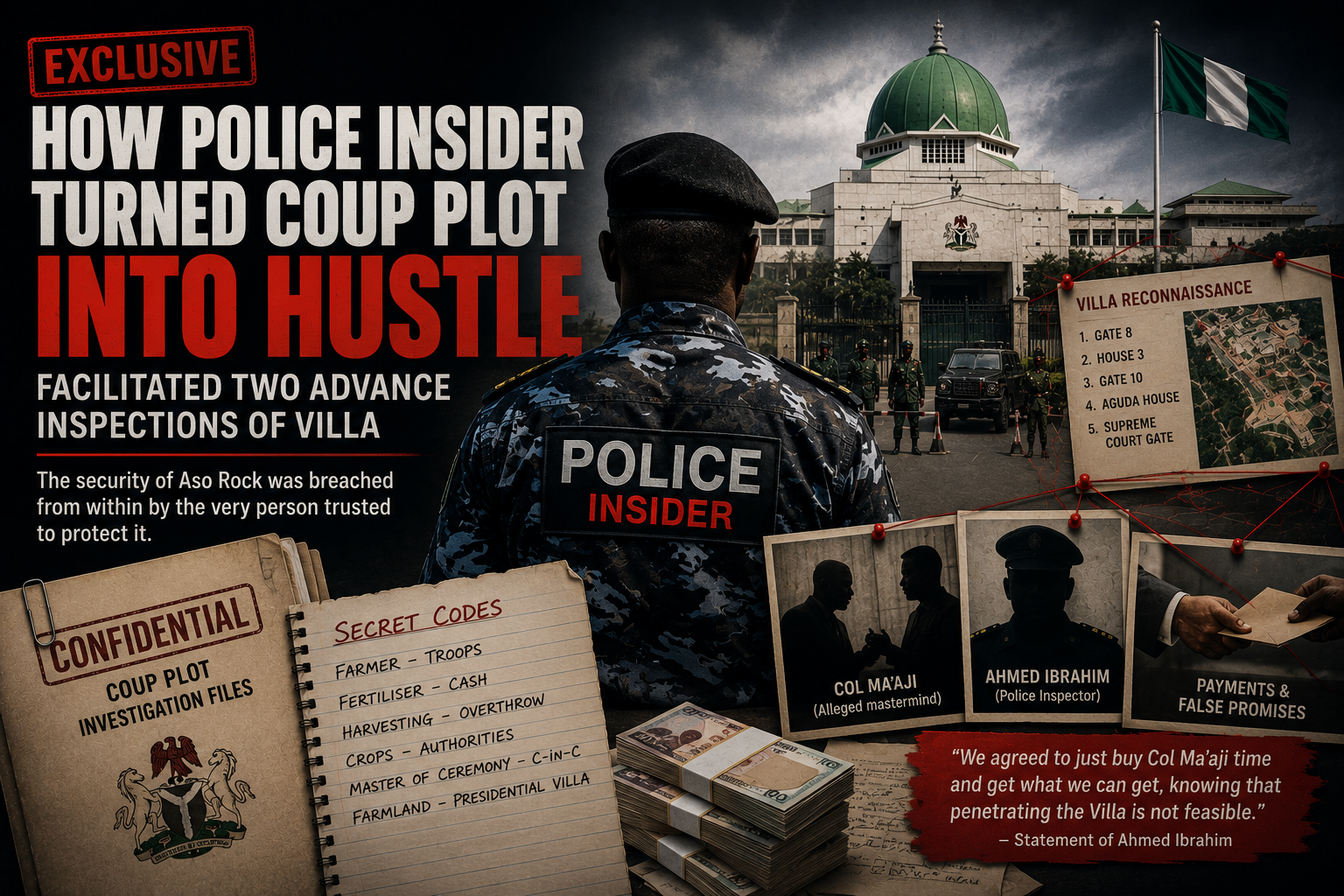
The need for access brought the conspirators directly to a serving police inspector attached to the Presidential Villa, Ahmed Ibrahim, who was serving in the VIP escort with a daily routine to guard the gates to Nigeria’s seat of power, arguably the most secure fortress in the country.
The confidential files show how this request for assistance transformed into an extraordinary insider game of deception, where Mr Ibrahim allegedly turned a treasonous coup plot into a highly lucrative personal hustle.

More details are now emerging as 36 serving military officers face a General Court Martial in Abuja and six alleged conspirators, including former military officers and Mr Ibrahim undergo trial on 13 charges before Judge Joyce Abdulmalik at the Federal High Court in Abuja.
The suspects include senior military officers across the armed forces, a police officer attached to the Presidential Villa and civilians allegedly involved in reconnaissance, funding and propaganda operations.
PREMIUM TIMES also obtained the names of several military personnel, police officers and civilians arrested during a covert intelligence operation coordinated by the Army Headquarters and the State Security Service (SSS). Not all of them have been charged so far.
The defendants in the Federal High Court case, marked FHC/ABJ/CR/206/2026, include Muhammed Gana, a retired major-general; Erasmus Victor, a retired navy captain; Ahmed Ibrahim, the serving police inspector; Zekeri Umoru; Bukar Goni; and Abdulkadir Sani.
All the defendants have pleaded not guilty, and their legal teams objected to the admissibility of their pre-trial, extra-judicial statements they made to investigators by the court.
The shifting plan
According to intelligence reports, the alleged coup plot busted by Nigerian authorities last September was not the promoters’ first attempt.
The reports indicated that the alleged plotters had been looking for a way into the Villa for years.
They initially planned to disrupt the official handover of power from former President Muhammadu Buhari to President Tinubu during the presidential inauguration on 29 May 2023. That plan collapsed due to a lack of money and poor logistical arrangements, forcing the conspirators to suspend their operations temporarily.
The plot was reactivated in 2025 when Timipre Sylva, a former Bayelsa State governor who served as the minister of state for petroleum during the immediate past administration of the late former President Muhammadu Buhari, allegedly moved nearly N1 billion in multiple tranches through a Bureau De Change operator to finance the operation. With the funds secured, the plotters compiled a high-profile assassination list.
PREMIUM TIMES reported that sources with direct knowledge of the investigation revealed that the targets marked for execution included President Bola Tinubu, Vice President Kashim Shettima, Senate President Godswill Akpabio, and Speaker of the House of Representatives Tajudeen Abbas.
The alleged coupists also targeted service chiefs and the Commander of the Guards Brigade, the elite military unit dedicated to protecting the president.
The Aso Rock insider
Mr Ibrahim, who is attached to the Presidential Villa as a guard escort for President Tinubu and senior presidential aides, told investigators that his duties include escort assignments and guarding various entry gates within the Villa. When he was not on escort duty, he took position to watch the Villa’s entry gates.
According to his statement, he first became acquainted with the alleged chief strategist and financier of the coup, Mohammed Ma’aji, a colonel, through Audu Momoh, a corporal, of the 343 Artillery Regiment.
Mr Momoh, who was then attached to the Presidential Villa before his transfer, allegedly introduced the retired officer during a Ramadan lecture at the Central Mosque in Abuja.
“I didn’t know Col Ma’aji in person until during this year’s fasting lecture at Central Mosque in Central Area, Abuja. Cpl Audu Momoh said to me that this was Col Ma’aji ‘I was telling you who brought that madam for the audience with the Chief of Staff that failed’,” Mr Ibrahim stated.
According to him, Mr Momoh described the colonel as someone from Bida in Niger State and requested his assistance in arranging access to one of the president’s aides because Mr Ma’aji’s promotion to brigadier-general had allegedly been stalled.
Mr Ibrahim said he suggested approaching Musa Haro, whom he described as a cousin of the late former President Muhammadu Buhari, but said the effort yielded no result.
Mr Ibrahim said his first substantive meeting with Mr Ma’aji took place after he attended an invitation to break the Ramadan fast at the retired officer’s residence in Lokogoma, Abuja.
He said they later met at a tea spot on Gimbiya Street in Garki, Abuja, where discussions centred on the country’s economic hardship and delays in military promotions.
According to the investigation statement, it was during another meeting at the same location in the first week of August 2025 that Mr Ma’aji allegedly disclosed plans to overthrow the government.
Mr Ibrahim quoted him as saying the government “was not being sincere to the citizens” and that worsening economic hardship meant “they need to be flushed out.”
He alleged that Mr Ma’aji then requested assistance in securing access to the Presidential Villa.
Rather than facilitate the request, Mr Ibrahim claimed he privately agreed with Zekeri Umoru, a Julius Berger electrician working at the Villa, to deceive the colonel into believing access was possible while collecting money from him.
According to the statement, “we agreed to just buy Col Ma’aji time and get what we can get, knowing that penetrating the Villa is not feasible.”
He alleged that Mr Ma’aji subsequently transferred money to him on several occasions, including Ramadan and Sallah gifts, bank transfers of N200,000, N100,000, N50,000 and N20,000 into his Opay and Union Bank accounts, as well as N1 million in cash before his wedding in October 2025.
Mr Ibrahim also told investigators that he later introduced Mr Ma’aji to Mr Umoru during another meeting at Tiger Bar along Airport Road in Abuja.
He said he gave Corporal Momoh N200,000 to pay his children’s school fees and spent N380,000 from the money on wedding expenses, including dowry, food and other ceremonies.
Reconnaissance around the Villa
Despite insisting that gaining access to the Villa was impossible, Mr Ibrahim admitted in his written extrajudicial statement that he escorted two serving major-generals around parts of the Presidential Villa at Mr Ma’aji’s request.
He alleged that he took M.A. Usman, a major-general, through Gate 8, House 3, Gate 10, Aguda House and exited through the Supreme Court Gate before leaving at the Bullet Secretariat.
He also stated that he conducted a similar tour for another senior officer, A.J. Ibrahim, also a major-general.
Investigators are relying on those alleged movements as part of their evidence.
Secret lexicons and funding claims
Mr Ibrahim further disclosed what investigators described as coded language allegedly adopted by members of the network.
According to his statement, “farmer” referred to troops, “fertiliser” and “equipment” meant cash, “harvesting” meant overthrowing the government, “crops” referred to authorities, “master of ceremony” meant the Commander-in-Chief, while “farmland” referred to the Presidential Villa.
He also claimed that he fabricated the identity of a man identified as Sarkin Malami and suggested he travel to Sokoto to source funds for the alleged operation.
Mr Ibrahim said Mr Ma’aji booked flight tickets for him and the non-existent Malami but that he never travelled, instead pretending he had undertaken the trip.
He also claimed he introduced another acquaintance, identified simply as Alhaji Musa from Kano State, to Mr Ma’aji under the pretence that the businessman could source between N500 million and N1 billion for the operation.
According to him, he later falsely informed Mr Ma’aji that they were awaiting a cheque from Sokoto, although no money materialised.
Mr Ibrahim further alleged that on 9 April, 2025, he requested additional money from Mr Ma’aji, claiming it was meant for “gate guys” – fellow officers who would supposedly facilitate access into the Villa.
He told investigators that this was another fabricated story intended solely to obtain money from the retired officer.
Reason for silence
Although he claimed he never intended to assist the alleged coup plotters, Mr Ibrahim admitted he did not report the conversations to his superiors or any security agency.
Asked why, he replied that he acted out of “fear of the unknown.”
He also stated that, apart from himself, only Mr Umoru and Ali Musa, an ambulance driver attached to the Presidential Clinic, were aware of the alleged coup discussions within the Presidential Villa.
The allegations contained in Mr Ibrahim’s statement remain part of the prosecution’s case and have not been established by any court. The defendants have all pleaded not guilty and they reserve the right to challenge the admissibility of the statements as the trials continue before both the Federal High Court and the General Court Martial.