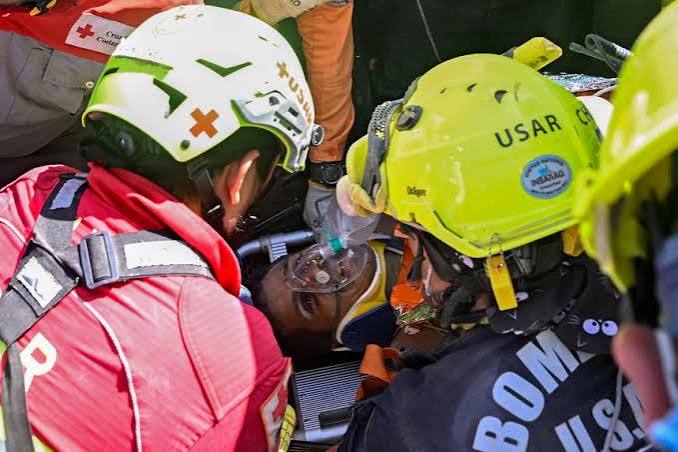
Hundreds of rescue workers erupted in cheers and embraced one another on Thursday after a 43-year-old man was rescued alive from the ruins of a collapsed building in Venezuela, eight days after twin earthquakes devastated parts of the country.
The dramatic rescue came as the official death toll from the June 24 disaster climbed to nearly 2,300, with thousands of people still unaccounted for, making the survival of security guard Hernan Gil a rare beacon of hope amid the tragedy.
Gil was carefully pulled from the wreckage of the seven-storey building where he worked in Catia La Mar, a coastal community that was almost completely flattened by the powerful earthquakes. He was carried away on a stretcher after rescuers completed a painstaking operation that lasted several days.
Describing the rescue as extraordinary, Gil’s wife, Gusbimar Gonzalez, said she had never lost hope.
“This is truly a miracle,” she told AFP as emergency workers completed the rescue.
The operation involved rescue teams from Venezuela, Chile, the United States, Portugal, Costa Rica, El Salvador and Mexico, who worked continuously for three days to reach the trapped man.
During the rescue, emergency personnel kept Gil alive by supplying him with more than 10 litres of water through a hose and providing oxygen via a tube. In the final stage, around 30 rescuers cleared debris from the building’s parking area while two specialists dug a three-metre tunnel to reach him.
“It wasn’t easy to reach the exact spot where the victim was located,” said Cristian Vera, who led the Chilean rescue team.
Despite Gil’s remarkable survival, hopes of finding many more survivors were rapidly fading. Earlier this week, rescuers also pulled a three-year-old boy alive from the rubble six days after the earthquakes, but such rescues have become increasingly rare.
Authorities and humanitarian agencies were now shifting their focus from rescue efforts to addressing the growing humanitarian crisis facing survivors.
Thousands of people have been left homeless, while shortages of food, clean water and medical supplies continued to worsen. Hospitals remained overwhelmed, raising concerns among health experts over the potential outbreak of infectious diseases.
The twin earthquakes, measuring 7.2 and 7.5 in magnitude, tore through several communities in oil-rich Venezuela, exposing decades of deteriorating infrastructure caused by the country’s prolonged economic crisis.
According to NASA, nearly 60,000 buildings wsre believed to have been damaged or destroyed by the disaster.
National Assembly President Jorge Rodriguez said the confirmed death toll had risen to 2,295, while more than 11,000 people sustained injuries. Nearly 13,000 residents have also been displaced and were living in makeshift shelters, tents, parks and open spaces.
Authorities feared the actual number of casualties could rise further, as tens of thousands of people remained missing.
In the worst-hit city of La Guaira, many collapsed buildings have been marked with the letter “D” to indicate that rescue teams have searched them and found no survivors.
Across the disaster zone, rescue workers and grieving relatives have increasingly shifted their efforts from searching for survivors to recovering victims’ bodies.
In Catia La Mar, volunteers and emergency workers continued digging through massive piles of concrete where apartment buildings once stood.
Crane operator Manuel Alejos described one collapsed eight-storey building as having fallen “like a slab sandwich.”
“We break through slab by slab to retrieve the bodies. The families need the bodies to say their goodbyes,” he said, adding that seven bodies had already been recovered from the site.
Mexican firefighter Cesar Gonzalez, who is working with search-and-rescue dogs Zeus and Bom, admitted that optimism has diminished significantly.
“One is for detecting the living, the other for cadavers. Just two days ago, there was much more hope. Now, it would take a miracle to find anyone alive,” he said.
Meanwhile, humanitarian needs continued to mount.
The World Food Programme (WFP) has appealed for $50 million to provide food assistance to about 500,000 people over the next three months as the crisis deepens.
Security has also become a growing concern, with police and military personnel deployed across affected communities to prevent widespread looting.
Long queues have formed at relief distribution centres, while many survivors depend entirely on donations and volunteer support for food, clothing and shelter.
Among them is 33-year-old Maria Arteaga, a mother of four, who now sleeps on a football field beneath a makeshift shelter constructed from tarpaulins and a Venezuelan flag.
“We lost everything, except our lives. We’re even barefoot,” she said.
We’ve got the edge. Get real-time reports, breaking scoops, and exclusive angles delivered straight to your phone. Don’t settle for stale news. Join LEADERSHIP NEWS on WhatsApp for 24/7 updates →