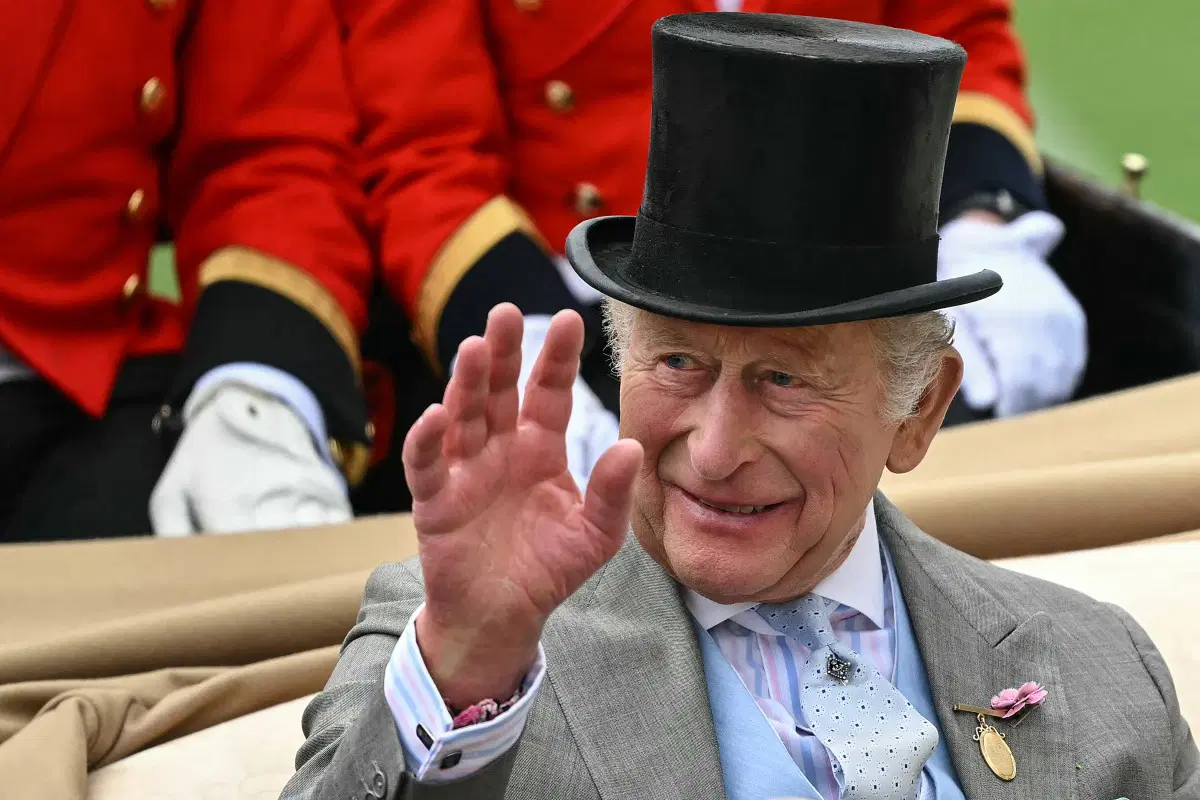
Britain’s King Charles III waves as he arrives on the second day of the Royal Ascot horse racing meeting in Ascot, west of London, on June 17, 2026. (Photo by JUSTIN TALLIS / AFP)
Prince William revealed that his father King Charles “hates football” in an appearance on Travis Kelce’s podcast that aired Friday, just hours before the NFL star was due to celebrate his marriage to pop megastar Taylor Swift.
The World Cup, rather than the wedding, was the main theme of the chat with Kelce and his co-host brother Jason Kelce, with the prince saying he would travel to the competition in the United States if England made it into the final.
The prince is known as a fan of the Premiership side Aston Villa and, when asked if King Charles was the one who got him interested, he responded: “Absolutely not. My father hates football.”
Thanks to a powerhouse performance from team captain and FC Bayern Munich striker Harry Kane, who made two late goals against DR Congo, England is in the round of 16.
The “Three Lions” are slated to play Mexico at high-altitude Azteca Stadium on Sunday.
When Kelce asked if the Prince of Wales would cross “the pond” to see the final if England makes it that far, William said “definitely.”
“If we’re in the finals…maybe see you both there for the final?”
The interview also coincided with the July Fourth celebrations in the United States, marking 250 years of independence from Britain.
“Be honest, are you surprised we made it?” Kelce asked.
“There were times…there were times,” William said, adding “yeah, but I’d like to think the UK and the US have been together for those 250 years.”
AFP
Related News
- Supreme Court orders release of crude aboard FPSO Tamara Tokoni to General Hydrocarbons
- From Vision to Reality: Kwara Garment Factory Creates 2,000 Jobs, Attracts Private Investment•It’s a place to access world class quality —Folake Akindele, CEO,Tiffany AmberBy Demola Akinyemi IlorinThe Kwara Garment Factory, one of the flagship industrial projects of the Governor AbdulRahman AbdulRazaq administration, has created employment for more than 2,000 residents since commencing operations on November 28, 2023, reinforcing the state’s drive toward industrialisation, youth empowerment and economic diversification.Kwara State Commissioner for Business, Innovation and Technology, Mrs. Damilola Yusuf-Adelodun, said that the factory has provided meaningful jobs for over 2,000 residents, with women and young people accounting for the majority of the workforce.She said the vision behind the project is to establish one of West Africa’s largest and most technologically advanced garment manufacturing facilities, capable of serving both local and international markets.The factory is equipped with state-of-the-art industrial machinery, including automated cutting systems and heavy-duty pneumatic pressers capable of producing up to 10,000 polo shirts in a single eight-hour shift. It also runs continuous skills development programmes to strengthen the capacity of its workforce and maintain global production standards.Factory handed over to private operatorMeanwhile, in order to ensure sustainable commercial viability, drive large-scale industrialization, and prevent the facility from becoming a redundant government-owned asset, the state government signed a management agreement with KWS Garment Production Village, empowering the private sector operator to manage and run the state’s premier apparel manufacturing facility.The signing ceremony, held at the Kwara Garment Factory in Ilorin on May 12, 2026, was conducted by the Managing Director of Kwara Garment Factory Limited, Hajia Bukola Adedeji, and witnessed by the Commissioner, Ministry of Business, Innovation and Technology, Mrs. Damilola Yusuf-Adelodun.KWS Garment Production Village was led by Folake Akindele, founder and CEO of the internationally acclaimed Tiffany Amber, and one of the most consequential figures in African fashion over the last three decades.A firm commitment of the agreement is that a minimum of 80 percent of the factory’s production workforce will be women and indigenous people of Kwara State.Speaking at the ceremony, Commissioner Yusuf-Adelodun described the handover as the tangible realisation of Governor AbdulRazaq’s long-held industrialisation vision for Kwara State.“The Kwara State Garment Factory has always represented more than a building or a set of machines. It represents the governor’s vision of an industrialised kwara, where our youths do not just consume but produce, where the state’s resources translate into real livelihoods and lasting economic activity.”She said the management model was carefully structured to protect the state’s investment while creating the space for private sector excellence to flourish.On her part, Managing Director Hajia Bukola Adedeji, who signed the agreement on behalf of Kwara Garment Factory Limited, described the occasion as a defining milestone in the life of the facility.“This occasion marks yet another bold step in the commitment of the Kwara State Government under Governor AbdulRahman AbdulRazaq, towards industrialisation, economic growth, job creation, and sustainable development in our dear state.”She highlighted the scale of investment that the state had made in preparation for this moment.“Over the years, this administration has made substantial investments in establishing this high-capacity industrial facility, world-class machinery, modern production infrastructure, and the training of hundreds of Kwara youths in garment production, machine operations, and technical skills. The foundation has been built. Today, we take the step that puts it to full use.“The commitment to hiring 80 percent women and Kwarans is central to what this agreement means. It is not a condition; it is a conviction. The impact we are working towards is tangible: employment for trained Kwara women and youths, a boost to our internally generated revenue, and the development of a textile and garment ecosystem that can serve not just Kwara, but the wider region.“Beyond the economic value, this agreement demonstrates genuine confidence in Kwara State as an emerging destination for investment, business growth, and industrial expansion. It is our expectation that this will not only strengthen the garment and textile value chain, but inspire more strategic investments into our state.”she said.For Folake Akindele, the agreement represents the culmination of nearly three decades spent identifying the structural gap at the heart of Nigeria’s creative and industrial economy.“After 28 years in the Nigerian fashion industry, moments like this remind me why I started this journey. What began with passion and resilience has evolved into something much bigger than fashion itself. Today is about industry, infrastructure, manufacturing, job creation, and legacy.“This factory represents the possibility. It represents scale. It represents structure. It is about building systems that allow Nigerian businesses, creative, institutional, and corporate alike, to produce competitively, efficiently, and proudly within Nigeria. If you have been going outside Africa to manufacture and access world-class quality, you can get that same standard right here,” she said.Akindele then affirmed KWS’s commitment to the workforce in terms of the agreement.The Kwara Garment Factory is fully equipped with industrial-grade machinery covering the entire production chain, from cutting, sewing, embroidery, and printing, to finishing, quality control, and shipping.The facility is designed to support large-scale apparel production across fashion, uniforms, sportswear, institutional, hospitality, and corporate sectors, and is fully powered by an on-site solar village embedding sustainability at its operational core.With infrastructure capable of supporting up to 4,000 workers across its production ecosystem, the factory stands as one of the most significant industrial garment manufacturing hubs on the continent. Kwara State’s deep-rooted history in textile weaving and cotton cultivation makes it a natural home for an initiative of this scale.
- Feels like ‘victory’ – Cape Verde celebrates heroic World Cup defeat
Source link