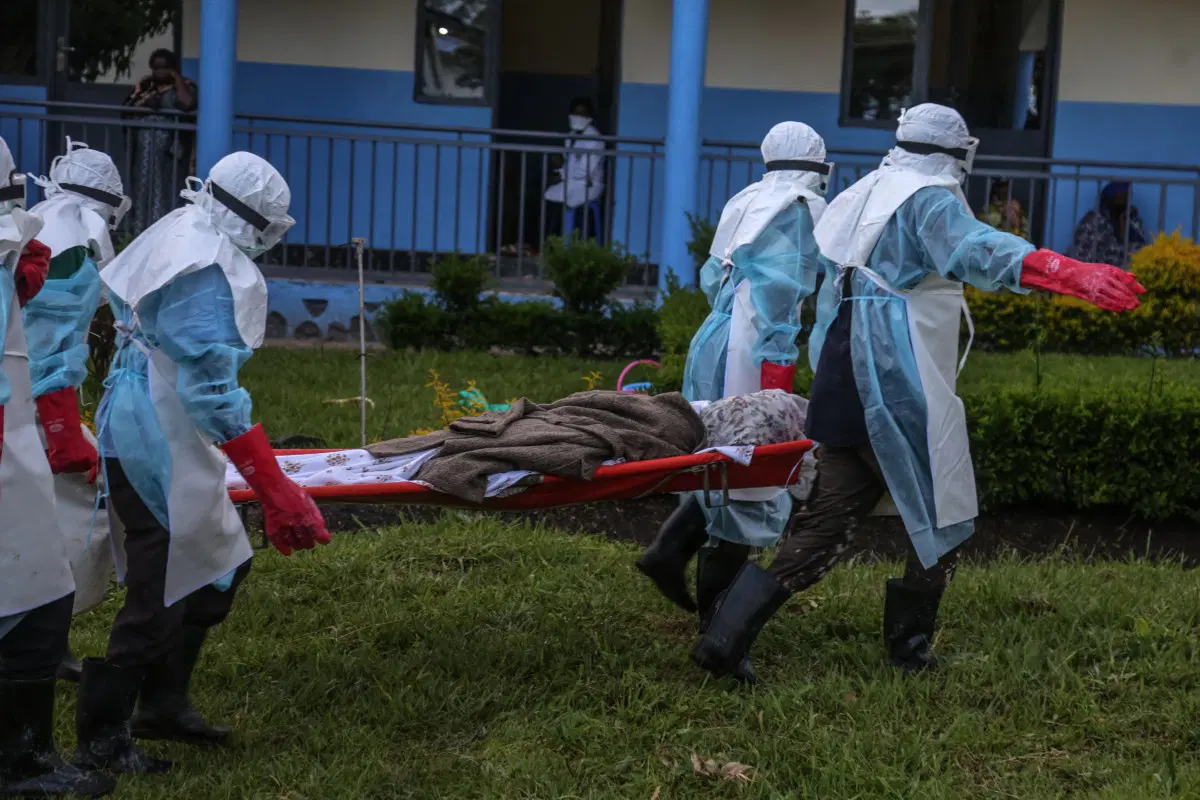
File: Medical staff wearing personal protective equipment (PPE) transport a patient at the hospital in Rwampara on May 21, 2026. Photo by Seros MUYISA / AFP.
By Chioma Obinna
The World Health Organization (WHO) has raised alarm over a rapidly escalating outbreak of Bundibugyo virus disease (BVD), a deadly Ebola strain, which has killed 454 people and infected 1,481 others in the Democratic Republic of the Congo, Uganda, and France, fuelling fears of a broader regional health crisis.
WHO said the outbreak, driven by sustained transmission in Congo’s conflict-ridden eastern provinces, is evolving rapidly and poses a severe threat to neighbouring countries due to cross-border movement, fragile health systems and humanitarian crises.
According to the update, “As of July 1, Congo had recorded 1,460 confirmed infections and 452 deaths, with health officials warning that the disease continues to spread into new health zones.”
Uganda has reported 20 confirmed cases and two deaths, while France confirmed an imported case involving a doctor who returned from Congo after treating infected patients.
“This outbreak is expanding at a dangerous pace, particularly in areas affected by insecurity and displacement.
“The conditions on the ground are creating major barriers to surveillance and response, increasing the risk of undetected transmission,” WHO said in its latest update.
Health authorities say the latest figures represent a steep increase of 564 new infections and 220 deaths in less than two weeks, underlining the scale and speed of the crisis.
It reported that the epicentre remains Ituri Province, where more than 91 per cent of all cases have been recorded. Major hotspots include Bunia, Rwampara and Mongbwalu.
“Alarmingly, 102 healthcare workers have also been infected, with 25 deaths among them, a development experts say reflects dangerous gaps in infection prevention and control,” the report noted.
WHO said over 10,800 contacts are currently being monitored in Congo, while Uganda has successfully completed surveillance for over 800 contacts, with no new cases reported since June 21.
In a worrying sign of international spread, French authorities in the report disclosed that a middle-aged doctor who worked for five weeks in Ituri tested positive upon arrival at Charles de Gaulle Airport.
The doctor reportedly self-declared symptoms and was immediately isolated.
WHO praised the move, saying: “Early self-reporting and rapid isolation significantly reduce transmission risk and demonstrate the importance of border health vigilance.”
Bundibugyo virus disease is one of the lesser-known but deadly Ebola strains, with symptoms including fever, weakness, vomiting, diarrhoea and internal bleeding. There is currently no approved vaccine or specific treatment for the virus.
WHO warned that overcrowded camps for displaced persons, weak healthcare infrastructure and insecurity in eastern Congo could worsen the outbreak.
“The combination of conflict, mass displacement and limited access to clean water and healthcare is a perfect storm for Ebola transmission,” WHO said.
Despite the rising toll, WHO advised against travel or trade restrictions on Congo and Uganda but urged stronger border surveillance and community-based response systems.
The agency classified the outbreak risk in Congo as “very high”, “high” in Uganda and neighbouring border countries, but “low” globally.
With the disease now crossing continents, global health authorities said the coming weeks will be critical in determining whether Africa can contain yet another deadly Ebola outbreak before it spirals further.