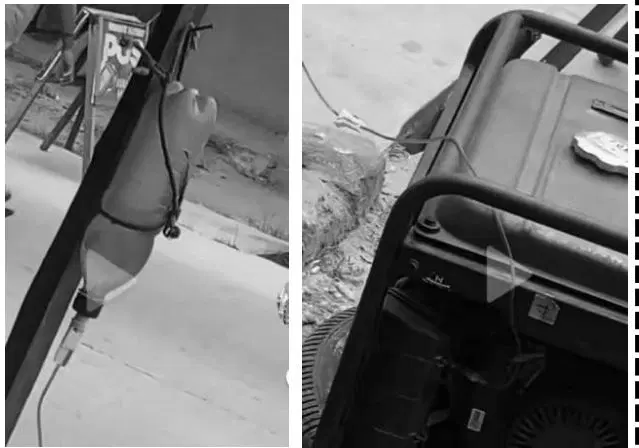
•Pet bottle with fuel (left), connected to a generator set.
By Elizabeth Adegbesan
In the bustling heart of Nigerian cities and towns, the deafening roar of small gasoline generators, popularly called ‘I better pass my neighbour’, is the soundtrack of survival for hundreds of small business owners.
However, a quiet, homemade engineering trend is spreading through local workshops. Economy&Lifestyle discovered that Nigerian artisans, hit hard by the high cost of petrol, are bypassing their generators’ built-in steel tanks.
Instead, they are using discarded polyethylene terephthalate (PET) plastic bottles, to act as makeshift, gravity-fed fuel compartments.
This viral hack is saving them thousands of Naira daily.
The birth of the bottle hack
The concept is incredibly simple but highly effective.
Artisans remove or close off the large, traditional top-mounted metal fuel tank of a standard 950-watt or larger generator. They then suspend a clean, 1-litre or 2-litre plastic soda bottle, upside down, from the generator’s outer metal frame.
A slim rubber hose is inserted through a small hole drilled into the bottle cap.
This hose feeds petrol directly into the carburetor fuel intake.
Mr. Dirisu Jayjay, a local mechanic, explained that this set-up drastically reduces fuel waste.
“Many older generator tanks suffer from microscopic leaks, rust accumulation, or evaporation loss, due to intense tropical heat.
“Furthermore, standard carburetors can over-consume fuel when under a heavy tank load.
“But the small PET bottle relies on a gentle, gravity-fed system. This delivers only the exact amount of fuel the engine needs to keep running under a steady load.
“The procedure is:
Suspended PET Plastic Bottle —-> Gravity-Fed Rubber Hose —-> Carburetor Fuel Intake Line —-> Generator Engine Power Cycle.”
For many entrepreneurs, this creative trick is the only reason they can keep their shop doors open.
Oluchi Nnadi, a fashion designer, said: “I used to spend more than half of my daily profit just buying petrol to run my sewing machines.
“A colleague showed me this bottle trick last month.
“By feeding the fuel straight from a small plastic bottle into the engine hose, I can see exactly what the machine uses. My generator now runs for nearly three hours on a single litre of fuel, compared to barely an hour and a half when using the main tank. It has cut my fuel bill by almost forty per cent.”
Mr. Abdulrahmon Marvelous, an electrical technician, uses the same method to power his soldering irons and testing equipment.
“People think it is just a joke, but it is real science from the streets.
“When you fill a huge metal tank with just one or two litres of petrol, a lot of it turns into gas vapor and vanishes into the air because the metal gets very hot. “The plastic bottle keeps the fuel tightly sealed, cool, and concentrated.
“Every single drop goes straight into the engine work.”
In May 2026, Nigeria’s average retail price of Premium Motor Spirit (PMS/petrol) reached N1,596.25 per litre, according to the National Bureau of Statistics, with Edo State recording the highest cost at N1,722.91 per litre.
While the economic benefits are keeping small businesses afloat, safety experts and mechanical engineers urge caution.
They warned that hanging a highly flammable plastic container directly over a hot, vibrating combustion engine poses major safety hazards.
Mr. Agbaje Odion, an automotive and generator repair specialist said: “I completely understand that times are tough and Nigerians are incredibly resourceful.
“However, PET bottles are not designed to withstand heat.
“Over time, the plastic near the exhaust pipe can melt, or the heavy vibrations can cause the bottle to fall off.
“If petrol spills onto a hot generator engine, it can instantly cause a terrible fire.”
Odion also noted that while the hack helps bypass faulty carburetors that burn too much fuel, it is a temporary fix.
“If your generator is consuming too much fuel, the real solution is to clean or replace the faulty carburetor, not just shrink the size of the fuel tank,” he explains.
Despite the underlying safety concerns, the widespread adoption of the PET bottle hack highlights a larger trend across the country. Local communities are repeatedly forced to invent grassroots engineering solutions to handle tough economic shifts and unstable power grids.
From turning nylon waste into usable diesel to converting petrol generators to run on cooking gas, the PET bottle fuel compartment is just the latest example of everyday survival innovation. Even commercial vehicle drivers are not left out.