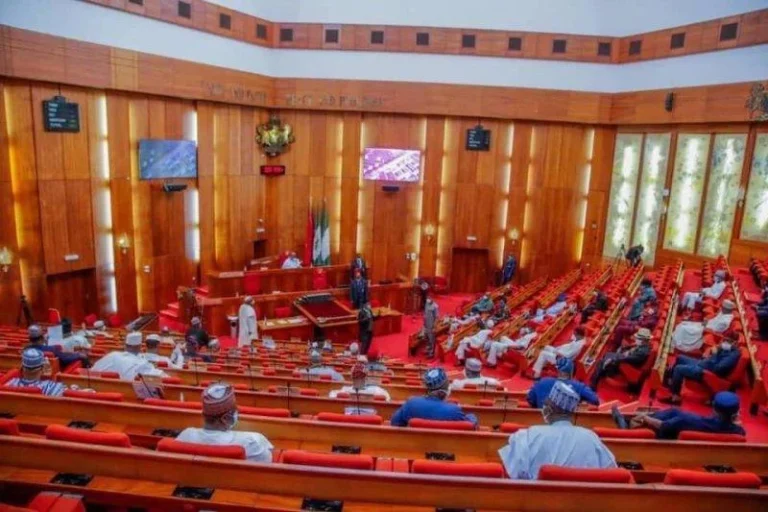
The Senate Committee on Regional Development on Tuesday subjected the North West Development Commission (NWDC) to intense scrutiny over its governance structure, financial management and operational performance, raising concerns over the absence of executive directors and the payment of about N943 million in board allowances.
During an oversight session attended by officials of the commission and the Federal Ministry of Regional Development, lawmakers questioned why the NWDC remains the only regional development commission yet to appoint executive directors despite being one of the earliest commissions established by an Act of the National Assembly.
Leading the session, Chairman of the committee, Senator Babangida Hussaini, expressed concern that administrative shortcomings were undermining the commission’s ability to deliver critical development projects in the North-West, a region facing persistent security and infrastructure challenges.
Responding to lawmakers, the Minister of State for Regional Development, Alhaji Uba Ahmadu, said the ministry had stepped in to resolve the prolonged disagreement surrounding the commission’s office accommodation in Kano.
He explained that although the commission initially operated from office spaces donated by private organisations, disagreements over which location should serve as its official headquarters resulted in tensions between the governing board and management.
According to the minister, the Kano State Government has now provided a fully furnished office complex, operational vehicles and land for the commission’s permanent use.
Ahmadu disclosed that representatives of the ministry, the governing board and the commission’s management jointly took possession of the facility last week and ordered the closure of all other offices to end the dispute.
“The North West Development Commission is the only commission that does not yet have executive directors. Every other regional commission has its full management structure in place. Something has to be done urgently so that the commission can function effectively,” the minister told the committee.
He attributed many of the commission’s operational difficulties to the prolonged absence of executive directors, noting that although the governing board was inaugurated in February 2025 to accelerate the agency’s take-off, it has struggled with recurring administrative challenges.
The minister further pointed out that other regional commissions had enjoyed smoother take-offs because state governments in places such as Enugu, Oyo and Nasarawa readily provided office accommodation without controversy, expressing confidence that the intervention by the Kano State Government would finally settle the headquarters issue.
As the hearing progressed, lawmakers shifted attention to the commission’s financial records, questioning the frequency of board meetings, spending priorities and what they described as excessive expenditure on governance-related allowances.
Some senators also challenged the rationale behind official visits undertaken by board members, arguing that the commission could not complain of inadequate funding while expending public resources on courtesy visits to governors and other stakeholders.
Senator Hussaini specifically criticised the payment of duty tour allowances to the Managing Director for an official visit to the Governor of Kano State, despite the commission’s headquarters being located in the same city. He also questioned claims covering air travel, local transportation and other logistics connected to the trip.
He said, “The committee was particularly alarmed by documents indicating that out of N1.19bn spent by the commission, N943m was used for allowances paid to members of the governing board, representing about 79 per cent of the expenditure under the subhead.”
Lawmakers described the spending pattern as inconsistent with the commission’s core mandate of driving development across the seven states of the North-West.
Defending the board’s actions, Chairman of the Governing Board, Prof. Abdullahi Ma’aji, maintained that all activities carried out by the board complied with the provisions of the North West Development Commission Act, 2024.
He said, “The board had held seven meetings—five regular and two emergency sessions—during which it adopted 63 resolutions aimed at establishing the commission’s institutional and policy framework.”
Ma’aji explained that the board had approved standing orders, governance procedures, committee structures, operational guidelines, budget frameworks and principles for distributing resources among the seven North-West states.
He insisted that committee operations and sitting allowances were legitimate governance expenses recognised under the commission’s enabling law.
The board chairman, however, distinguished between approving expenditures and authorising payments, stressing that while the board approved governance-related expenses, the responsibility for processing and disbursing funds rested with the commission’s management, particularly the Managing Director and the finance department.
He also lamented delays in implementing board decisions, citing poor communication and slow execution of critical operational resolutions as factors that had affected the commission’s smooth take-off.
Several senators argued that responsibility for the commission’s incomplete management structure ultimately rested with the supervising ministry, insisting that the prolonged delay in appointing executive directors had weakened the agency at a time when the North-West urgently requires coordinated interventions to address insecurity, infrastructure deficits and other socio-economic challenges.
Lawmakers further expressed dissatisfaction over delays in staff recruitment and the implementation of approved capital projects, despite reports that funding approvals had been granted since February.
At the conclusion of the public hearing, the committee resolved to move into a closed executive session to deliberate on sensitive matters and seek additional clarification from the ministry and commission officials.
The hearing is part of the Senate’s ongoing oversight of the country’s newly established regional development commissions, which were created to promote infrastructure development, economic revitalisation and peace-building across Nigeria’s six geopolitical zones.