Katsina State Governor, Malam Dikko Umaru Radda, has revealed that the state is targeting an African model for enterprise development in the policies and programmes of the Katsina State Enterprise Development Agency, KASEDA.
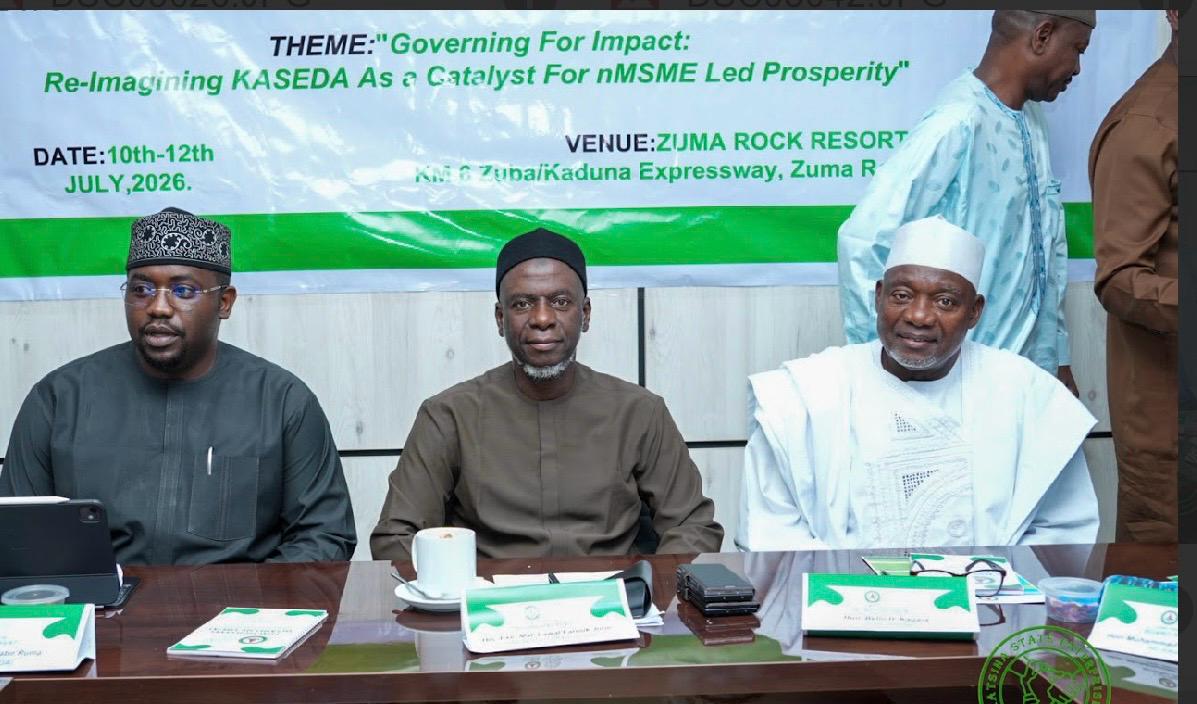
A statement by the Chief Press Secretary to the Governor, Ibrahim Kaula Mohammed, disclosed that Radda made this known on Saturday at the KASEDA 2026 High-Level Board Retreat held at Zuma Rock Resort, Niger State.
The governor, represented by the Deputy Governor Faruk Lawal, said KASEDA had reached a defining moment that would determine what the agency becomes over the next decade.
“At the end of this retreat my expectation is that, we would have laid the foundation for an institution that is not only respected within the confines of our state but recognized nationally and ultimately across Africa as a model for enterprise development, institutional excellence, innovation, and inclusive economic transformation,” he said.
The governor noted that the Micro, Small and Medium Enterprises remain the backbone of every resilient economy. He stressed that they create jobs, stimulate innovation, strengthen local value chains, reduce poverty, provide opportunities for women, young people, artisans, farmers, and emerging entrepreneurs.
He said Katsina had already earned national recognition after being named the Best Sub-National SME Development Agency in Nigeria, while one indigenous enterprise won the Most Outstanding SME at the 2025 National MSME Awards.
“Our ambition should not simply be to remain among the best in Nigeria. Rather, it should be to build an institution that other states deliberately study, learn from, and seek to replicate,” the governor added.
Governor Radda also highlighted the KASEDA Road Corridor Enterprise Infrastructure Programme, which maps roadside enterprises across the state’s 34 Local Government Areas.
“The comprehensive mapping of roadside enterprises across the 34 Local Government Areas has provided government with an immeasurable understanding of the enterprise landscape within our state,” he explained.
He urged the management of KASEDA to implement the initiative with urgency in line with government approval.
According to him, the success of the programme should not be measured by the number of enterprise structures provided, but by access to finance for entrepreneurs, improved productivity, expanded markets and better livelihoods for families.
“Government creates the enabling environment, entrepreneurs create the prosperity. KASEDA exists to ensure that the latter is naturally achieved,” he said.
Earlier, in his welcome address, the Director-General of KASEDA, Dr. Babangida Kabir Ruma, pledged to build an institution that delivers measurable results.
“The responsibility entrusted to us goes beyond programme implementation. It is a responsibility to build an institution that inspires confidence, delivers measurable results and serves as a model for enterprise development across Nigeria,” Ruma said.
He noted that entrepreneurs today require more than training, adding that they need access to finance, markets, technology, business advisory services, digital solutions, strategic partnerships and responsive institutions.
“Let us speak openly, let us challenge ideas constructively, let us learn from one another, and above all, let us remain focused on one shared objective — to build a stronger institution capable of delivering greater value to the entrepreneurs and people of Katsina State,” the DG said.
The Lead Presenter and CEO CRC Credit Bureau, Ahmed ‘Tunde Popoola, called for a fundamental shift in how Nigeria approaches economic development, stating that Micro, Small and Medium Enterprises, MSMEs, institutions are “critical infrastructure for national economic transformation” and not just support programs.
Popoola said the real work of inclusive prosperity happens at the sub-national level, through agencies built to support MSMEs. He stressed that when these institutions are built with intention, they identify entrepreneurial talent early, build business capacity to survive and scale, and surface the financing gaps that limit a country’s economic potential.
“The true measure of an MSME institution is not the number of entrepreneurs it trains or the volume of loans it disburses. Its success lies in how effectively it transforms businesses into engines of innovation, jobs, wealth creation, and inclusive economic prosperity,” Popoola stated.
He noted that for states like Katsina, where poverty rate stands at approximately 72.7% according to MPI 2023, bridging the gap through enterprise development is not optional, it is urgent.
Popoola outlined a roadmap for KASEDA to position itself as the architect of Katsina State’s economic transformation by adopting a “Strategic Modern Model” instead of the traditional approach of training, grants and one-off interventions.
The modern model, according to Popoola focuses on ecosystem building and coordination, policy leadership and advocacy, investment facilitation, cluster and sector development, innovation, digital transformation, and export readiness.
“KASEDA must embrace the modern model to drive real economic transformation in Katsina,” he said. “This means statutory autonomy, the right people with entrepreneurial passion, and revenue independence to ensure sustainability.”
Popoola also called for the adoption of technology to drive impact, including a Digital MSME Registry, Data-Driven Targeting, AI for Credit Access, and Digital Market Linkages to connect Katsina businesses to e-commerce and export opportunities.