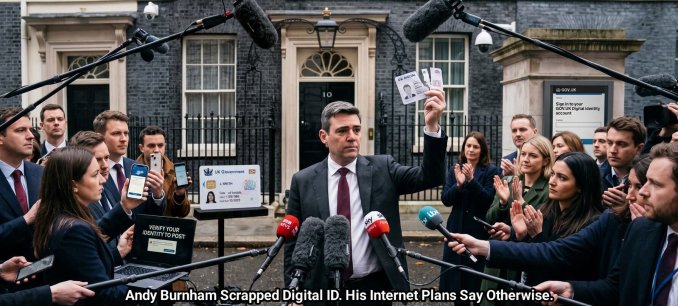
The applause for scrapping digital ID arrived before anyone checked what survived it.
CAM WAKEFIELD
The new UK Prime Minister, Andy Burnham, is in Downing Street, and he has spent twenty years telling you exactly what he wants to do to the internet. He won the Makerfield by-election on June 18 2026. He then collected the backing of roughly 349 Labour MPs, more than 85 percent of the parliamentary party. By the time he walked through the black door, the job had been settled for weeks.
His first big announcement was the one privacy campaigners had been hoping for. Starmer’s digital ID scheme for all adults is dead, scrapped before Burnham had finished unpacking, the money moved to the cost of living. The applause came quickly. Perhaps it should not have.
This is a read on a government barely a day old. On speech and privacy, the early signals point one way, and it is not the way that loosens the state’s grip. He is not about to tear up the settlement he inherits from Keir Starmer. The open question is how much further he carries it.
Burnham arrives with a long record on all this. He is one of the few senior British politicians with a documented, two-decade appetite for putting the government closer to what you can see, say and read online.
His first ministerial job, at the Home Office in 2005 and 2006, was pushing Tony Blair’s Identity Cards Bill through Parliament. He told the BBC that compulsory national ID cards would be a major breakthrough. Twenty years later, asked about it again, he was unembarrassed about the principle: “I’m not kind of arguing against the principle. I was very pro, actually, I thought there was a real clear case for it.”
Two decades of hindsight, and the case is still clear to him. What that case rests on is a claim about the relationship between a person and the state, and it is the same claim underneath every age check and identity gate now being built. The Identity Cards Act reached the statute book on 30 March 2006 and was repealed on 21 January 2011.
Then came 2008, and Culture Secretary Burnham produced a plan that looks like a blueprint for everything running today. The organizing idea was that online content should meet the same regulatory standards as television. He wanted taste and decency rules applied to the web, cinema-style age certificates and warning signs on anything featuring sex, violence or strong language, alerts bolted onto viral content, and ISP-level “child-safe” packages.
He floated making YouTube and Facebook delete offensive material within a set time once alerted, and changing libel law so suing an online publisher got easier. He even wanted to sound out the incoming Obama administration about international rules for English-language websites. Age gating, takedown clocks, regulator muscle aimed at platforms, it is all sitting there in 2008, waiting for the technology to catch up.
The plans died, and the body that killed them was Ofcom, which called them undesirable and unworkable online. This was back when the speech regulator was more levelheaded. The regulator that told Burnham in 2008 that broadcast rules could not be stretched over the internet is the regulator now enforcing the Online Safety Act. The intellectual weight at Ofcom has obviously severely declined.
Then 2016, and the episode that should be read before anyone celebrates this week. As Shadow Home Secretary, Burnham went after the Investigatory Powers Bill. He said Britain needed a new law in this area, then listed what was wrong with the one in front of him: thin privacy safeguards, surveillance powers that went too far, thresholds set too low, weak oversight, definitions loose enough to justify almost any intrusion. Labour abstained in March 2016. The government made amendments. In June, Burnham and Labour voted for it, and the Snoopers’ Charter received Royal Assent that November.
The Act remains one of the most expansive surveillance laws in any democracy, and it exists because the opposition of the day decided its objections had been satisfied. That is the pattern worth holding onto. Burnham objects to how a power is packaged, wins changes to the packaging, and votes the power into the statute book. Ten years later the objections are a footnote and the Act is still there.
The recent statements finish the picture. During an April 2025 Times interview he talked warmly about regulating social media for teenagers, saying that if it is not a ban it needs to be something.
By January 2026 he agreed with much of what Conservative leader Kemi Badenoch was saying about children and social media and welcomed a cross-party mood for bolder action. Earlier this month, days after winning Makerfield and while the leadership was already effectively his, he confirmed the current government’s online age verification scheme keeps running and imposes election purdah rules online.
That is twenty years pointing the same way.
The purdah idea has a name attached to it. Lucy Powell has argued that social media platforms should face something close to the rules that restrict broadcasters during election campaigns. Powell was elected deputy leader by the membership, which means Burnham cannot remove her, and she is close to him. The same government is separately pushing to lock legacy media outlets into people’s feeds. Put those together and the shape is familiar: the state deciding which voices get carried during an election and which get turned down.
Expect the Online Safety Act to survive Burnham intact, because the pressure on him runs toward strengthening it. A coalition of charities, campaign groups and academics wrote to him before he reached No 10, asking him to toughen the law.
Their specific wish is to drag it past illegal content and into “legal but harmful” territory, the exact area the Act was careful to leave alone. The Science, Innovation and Technology Committee wants the same, arguing the Act is too weak on “misinformation” and that platforms should answer for how they amplify lawful content people dislike. 2024’s Southport unrest is the case they keep reaching for.
That “legal but harmful” line is where the state stops chasing crime and starts refereeing opinion. The government gets to write the definition of harmful, and then the government gets to enforce it.
A change of direction was always likelier on digital ID than on the Online Safety Act, and today proved the point.
The enforcement machine that has already pushed platforms into restricting British users has been inherited whole and will probably be widened, while ministers keep insisting none of this touches free speech.
Here is where the flattering headline about Burnham falls apart on contact. He confirmed before taking office that Starmer’s digital ID program for all adults is being scrapped, with the money redirected to the cost of living and the whole thing badged as a reset of priorities.
The Office for Budget Responsibility had costed the program at £1.8 ($2.42B) billion over three years, a figure Downing Street rejected without offering one of its own.
Read on its own, that sounds like a victory for anyone who values privacy.
That reading collapses for two reasons. The objection was never to identity infrastructure as a principle. Asked in September 2025 whether he backed Starmer’s digital ID plans, Burnham said “not now,” and the reason he gave was tactical.
He pointed back to 2005 to 2010, warning of an opportunity cost situation where something consumes a huge amount of time and does not come through, exactly as the last ID card scheme consumed a lot of air time and never materialized. That is a complaint about political return on investment, not a commitment to civil liberties.
This is the same man who sold compulsory ID cards as a major breakthrough and who still says the case for them was clear.
Mandatory right-to-work checks had already been softened to voluntary before he arrived, which makes the announcement partly a decision to stop paying for something that had already lost its purpose.
And killing a work-linked BritCard sits a very long way from opposing ID to use the internet. Burnham’s team confirmed he intends to press ahead with plans to demand everyone pass digital ID checks to post on social media. His spokesperson said he is “committed to keeping kids safe online, and has been vocal in his support of age restrictions for kids using social media.”
Follow that logic. A government can drop the digital ID card, bank the applause, build the far more consequential thing, an identity gate between you and your ability to speak online, and sell the swap as a retreat.
There is no way to enforce a ban on under-16s without checking the age of everyone else, and no way to check age at that scale without checking identity. The card you were not going to carry becomes the login you cannot avoid.
Age checks and social media IDs hand more of your privacy away than a right-to-work card ever would, because they bolt your name to what you say rather than to where you work.
So take the win, but count it properly. What was scrapped is a £1.8 billion database. What was kept is the part that touches speech. The infrastructure of the digital ID scheme is still being built, and none of it ever depended on the card.
GOV.UK One Login isn’t going away. Digital driving licenses are coming, and they’ll be used to grant access to social media. Police are getting access to driving license records with facial recognition. Mandatory Companies House identity verification stays. The NHS Logins and the Single Patient Record isnt coming.
Assemble that list and you have a national identity system. It is arriving one service at a time instead of in one bill, which is precisely why it never gets a launch announcement to celebrate or a cancellation to campaign against.
Then there is the hire. On 16 July, Burnham appointed Matthew McGregor as his head of political strategy in No 10, and the appointment tells you something concrete, provided you do not oversell it.
Start with the facts. McGregor was Director of Campaigns and Communications at Hope Not Hate and remained a listed director there until 29 April 2022, then ran 38 Degrees as chief executive until this month.
Hope Not Hate is not a neutral party in the fight over online speech. The organization has argued, out loud and often, that deplatforming works and platforms should be pressured into removing content. It has endorsed deplatforming as a tactic in its own material, which says tech companies had to be shamed into changing their moderation policies and then shamed again into enforcing them, and that the pressure to remove content comes from governments, journalists, researchers and campaigners.
Install a former campaign director from that outfit at the heart of political strategy, and you learn how the people around the prime minister see the world. Content removal and pressure on platforms are treated as good governance rather than a danger to speech.
One detail is hard to read as anything other than what it looks like. Within a day of the appointment being reported, McGregor deleted his X account.
Here are the honest caveats, because the case gets stronger when it stops reaching. McGregor’s own public record is campaigns, communications and, lately, tax, not content policy. His job was messaging.
There is no evidence in front of me that he personally ran online-censorship campaigns, and the clearest examples of Hope Not Hate pushing for removals came after he had left. But what it says is that Burnham has drawn his inner strategy team from the campaigning world, Hope Not Hate, which treats organized pressure to delete online speech as legitimate and effective. The people who see deplatforming as a feature now sit closer to power than the people who see it as a fault.
So the signal from Burnham is not reassuring. He believes in regulating speech, he has the paper trail to prove it, and he inherits an enforcement machine he shows no interest in dismantling while people lean on him to extend it into lawful speech.
His one privacy credential dissolves the moment you look at it, a scrapped ID card while the more speech-relevant version, ID and age checks to post, goes ahead.
This isn’t a time to celebrate a perceived end to digital ID. There’s still a big fight ahead. Under this new agenda, the machinery keeps growing no matter who holds the keys. Britain’s new keyholder has spent two decades asking for exactly this machinery, and he now has it.