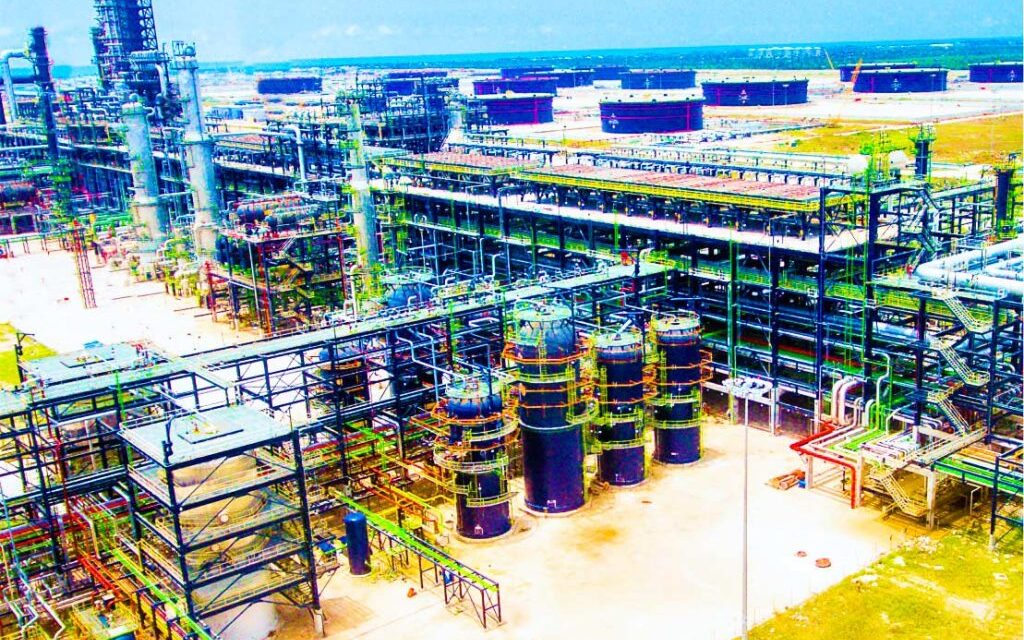

Dangote Petroleum Refinery & Petrochemicals Industries has continued to cushion Nigeria’s fuel market from global price volatility by keeping domestic petrol prices stable despite rising international gasoline prices, higher freight rates, and tightening global supply, according to S&P Global Commodity Insights.
The market intelligence firm said the refinery’s pricing strategy has helped shield consumers from mounting import costs that are putting upward pressure on fuel prices across West Africa.
According to its latest market intelligence, S&P noted that importers supplying the Nigerian market are becoming increasingly concerned over the sharp rise in international gasoline prices, with traders attributing the pressure to higher global product values and rising shipping costs.
Market participants told S&P that gasoline prices in Nigeria are effectively being “capped by Dangote prices”, limiting the ability of importers to pass on higher international costs to the domestic market.
One trader noted that while Ghanaian-specification gasoline currently commands higher premiums, Nigerian-specification cargoes remain constrained because the Dangote Refinery has kept its coastal sales prices unchanged despite mounting international price pressures.

“Lomé values have risen above Dangote sales prices, which has shut the arbitrage,” a trader was quoted as saying, highlighting that importing fuel into Nigeria has become increasingly uneconomic under prevailing market conditions.
The development comes against the backdrop of a sharp increase in global freight rates.
According to S&P Global, the cost of transporting clean petroleum products from Northwest Europe to West Africa has risen from US$29.70 per metric tonne at the end of June to US$37.12 per metric tonne, as vessels reposition to serve alternative markets.
At the same time, diesel markets have tightened following reduced supplies of Russian Black Sea cargoes, pushing up prices for high-sulphur gasoil across West Africa and further increasing import costs.
Despite these global pressures, Dangote Petroleum Refinery has continued its policy of gradual price moderation.
Price reduction
Since the end of May, the refinery has reduced the ex-depot price of Premium Motor Spirit (PMS) by more than N200 per litre, Automotive Gas Oil (AGO) by N300 per litre, and Jet A1 aviation fuel by N520 per litre.
This occurred while processing crude oil purchased when international prices were substantially higher than current levels.
The refinery has consistently maintained that petroleum product pricing is driven by actual crude procurement costs rather than daily movements in international Brent prices.
It noted that crude oil is acquired weeks or months before refining under commercial contracts linked to monthly average pricing mechanisms.
Industry analysts say the latest market developments further validate the strategic importance of domestic refining capacity in insulating Nigeria from external supply shocks.
With international product prices rising, freight costs increasing, and regional trading hubs such as Lomé recording gasoline prices above those offered by Dangote Refinery, Nigeria’s dependence on imported fuel would likely have led to significantly higher domestic pump prices had the refinery not been operating at scale.
Regional benchmark
The latest S&P assessment also reinforces Dangote Refinery’s growing influence on petroleum pricing in West Africa.
READ ALSO: Dangote Refinery cuts fuel prices again, signals further moderation
Market participants increasingly view the refinery’s pricing as the regional benchmark, with importers finding it difficult to compete whenever international replacement costs exceed domestic refinery prices.
Analysts say the development illustrates one of the key objectives behind establishing the 700,000-barrel-per-day refinery.
The objective will shield Nigeria from global market disruptions, eliminate dependence on imports, conserve foreign exchange, and provide greater price stability for consumers and businesses.
As geopolitical tensions, tighter product supplies, and higher shipping costs continue to reshape global fuel markets, the Dangote Petroleum Refinery is increasingly emerging not only as Nigeria’s primary source of refined petroleum products but also as a stabilising force for energy markets across West Africa.