Every structural engineer knows that a building rarely collapses because of the paint peeling off its walls. It collapses because of invisible cracks in its foundation. The most dangerous failures are often those hidden beneath the surface, quietly ignored until they become impossible to repair. Nations are no different. Their greatest crises rarely begin with inflation, unemployment or insecurity. Those are symptoms. The deeper problem is usually the quality of governance that shapes every other outcome.
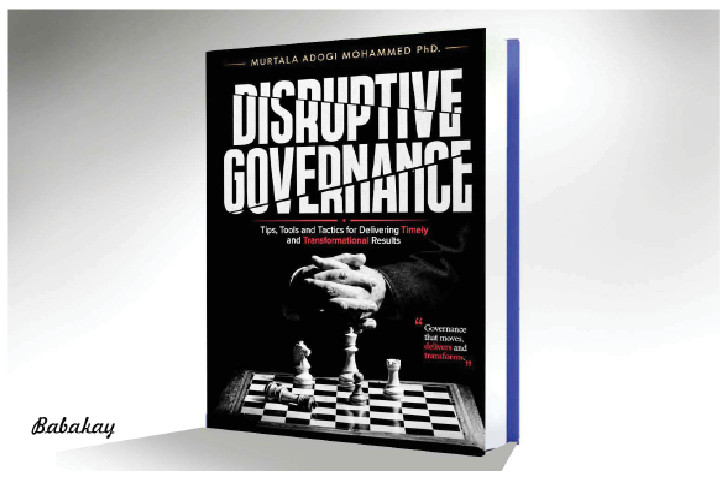
Three weeks ago, Murtala Adogi Mohammed sent me an advance copy of his forthcoming book, Disruptive Governance: Tips, Tools and Tactics for Delivering Timely and Transformational Results, with a simple request: read it and share your thoughts before its official unveiling in Abuja this August. I accepted the invitation with interest, not merely because Murtala is a friend, but because I know the richness of the experiences that have shaped his thinking. Having worked across government, international development and management consulting, he has occupied spaces where ideas are not merely debated but tested against the stubborn realities of institutions, politics and public expectations.
That background is evident from the opening pages. This is not another book that celebrates leadership in the abstract or romanticises public office. Rather, it asks a question that should unsettle every elected official and every citizen alike. Why do governments with enormous mandates and abundant resources so often produce such modest results?
The question is not uniquely Nigerian. It echoes across many developing societies. Yet it is impossible to read the book without reflecting on our own experience. We have become accustomed to measuring governments by the promises they make instead of the problems they solve. We applaud eloquent speeches, celebrate ambitious blueprints and debate political strategy with remarkable enthusiasm, but we pay far less attention to whether those promises translate into better schools, safer roads, reliable healthcare and stronger institutions.
That is where the book begins its intervention. It argues, implicitly and explicitly, that governance must be judged not by its intentions but by its outcomes.
When Activity Replaces Achievement
Perhaps the most thought-provoking argument running through the book is that governments often mistake movement for progress. It is an uncomfortable observation because activity is easier to display than results.
Anyone can organise a summit, inaugurate a committee, unveil a policy document or announce an ambitious reform agenda. These activities generate headlines, photographs and political goodwill. Yet none of them automatically improves the daily lives of citizens.
A ship can sail endlessly in circles while its passengers admire the discipline of the crew. Movement alone is no guarantee that the destination will ever be reached.
This distinction explains why Chapter Five, Delivering Results as a Leader, stands out as one of the book’s most significant contributions. Leadership, Mohammed argues, must ultimately be measured by delivery. The true legacy of a public servant is not the number of speeches delivered or projects commissioned, but the measurable improvement in the lives of those entrusted to his or her care.
That argument deserves wider attention because it challenges one of the greatest weaknesses of governance across much of Africa. Political success has too often been separated from administrative competence. Winning elections has become an end in itself rather than the beginning of a solemn obligation.
The book also revisits the importance of preparation, particularly during the first one hundred days of an administration. The underlying message is clear. Governments should not begin preparing to govern after taking office. They should assume office already prepared.
The Price of Normalising Mediocrity
The most uncomfortable books are often the most necessary because they compel readers to confront truths they would rather avoid. Disruptive Governance belongs in that category.
It quietly forces us to ask whether we have become too tolerant of mediocrity in public life. Have we lowered the bar so much that performing routine governmental responsibilities now attracts extraordinary praise? When functioning hospitals become headlines, and when completed road projects are treated as exceptional rather than expected, perhaps the problem extends beyond leadership. Perhaps it also reflects diminished public expectations.
One of the strengths of the book is its insistence that institutions matter as much as individuals. Great leaders may inspire change, but enduring progress depends on systems capable of outliving personalities. That lesson resonates strongly with Murtala’s professional background in consulting and international development, where sustainable reforms are measured not by temporary excitement but by institutional resilience.
Nevertheless, no serious work should escape critical scrutiny. While the author’s prescriptions are persuasive, I wished the discussion had devoted more attention to the political economy of reform. Good ideas rarely fail because they lack technical merit. They fail because they threaten vested interests. Patronage networks, bureaucratic resistance and elite bargaining often determine whether reforms survive beyond launch ceremonies. These realities deserve deeper examination because they frequently separate successful reformers from frustrated visionaries.
Similarly, disruption, though attractive as a concept, should never become an objective in itself. There are moments when institutions require bold transformation, and others when they require careful strengthening. Wisdom lies in recognising the difference. A society cannot constantly rebuild its foundations without risking instability.
These observations do not diminish the value of the book. Rather, they demonstrate that it opens a conversation substantial enough to invite further interrogation.
Why This Conversation Matters
Ultimately, the significance of Disruptive Governance extends beyond politicians, civil servants or policy advisers. Governance is not an abstract subject reserved for conferences and government offices. It influences the quality of education available to our children, the safety of our highways, the efficiency of our hospitals, the competitiveness of our businesses and the confidence with which young people imagine their future.
That is why this book deserves attention when it is officially launched. Not because it claims to possess every solution to Nigeria’s governance challenges, but because it asks questions that too many of us have stopped asking. Why do reforms succeed in one place and collapse in another? Why do capable individuals sometimes fail once they enter public office? Why do institutions designed to serve the public so often become obstacles to progress? More importantly, what must change if governance is to become genuinely transformational rather than merely transactional?
Readers will undoubtedly agree with some arguments and challenge others. That is precisely what good books are supposed to achieve. They stimulate debate, provoke reflection and compel society to examine its assumptions.
As someone who has followed the author’s professional journey through government, consulting and international development, I recognise in this work the perspective of someone who has observed governance from multiple vantage points. That breadth of experience enriches the conversation, even where one may differ with aspects of his conclusions.
The Greek philosopher Aristotle once observed that “the aim of the state is the good life.” More than two millennia later, that insight remains profoundly relevant. Governments exist not merely to exercise authority but to improve the human condition. Any book that reminds leaders and citizens alike of that enduring truth has already performed a valuable public service. Disruptive Governance is such a book, and for that reason, it deserves to be read, debated and thoughtfully considered.
We’ve got the edge. Get real-time reports, breaking scoops, and exclusive angles delivered straight to your phone. Don’t settle for stale news. Join LEADERSHIP NEWS on WhatsApp for 24/7 updates →