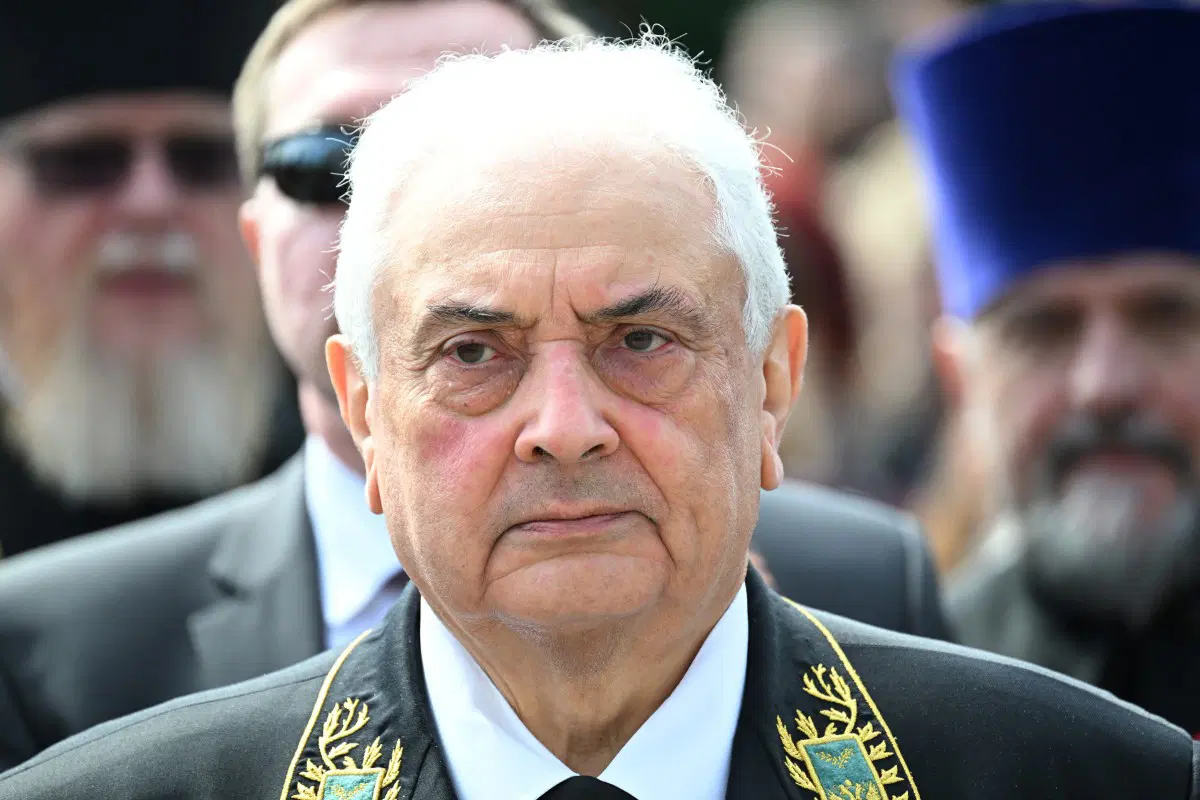
(FILES) Russia’s ambassador to Germany Sergey Nechayev pays his respect at the Soviet War Memorial Tiergarten in Berlin on May 9, 2026 in commemoration of the 81st anniversary of the 1945 victory against Nazi Germany. The German foreign ministry said on July 13, 2026 it had summoned Russia’s ambassador to protest at cyberattacks targeting the European Union which has imposed new sanctions against Moscow with Britain over the attacks. “This morning… we summoned the Russian ambassador to the foreign ministry in connection with hostile cyber attacks,” a ministry spokeswoman told reporters. (Photo by RALF HIRSCHBERGER / AFP)
The European Union and Britain targeted Russia Monday with coordinated sanctions over cyber attacks in Europe, accusing Moscow’s FSB intelligence agency over involvement in digital strikes.
The move comes as Western officials warn Russia has stepped up its “hybrid” campaign to destabilise Europe over four years into the war on Ukraine.
Brussels said it was imposing sanctions on nine people and four entities, while London said it was adding 24 names to its blacklist.
The British government said the sanctions — the first joint cyber package with the EU — “target the Russian state’s persistent and increasingly reckless attempts to sow chaos and division across Europe”.
Among those subjected to asset freezes and visa bans were officers of Russia’s GRU military intelligence agency, and alleged “cybercriminals” working together with the Russian state.
In addition, the EU and Britain also said a recent attempted cyber attack targeting critical infrastructure in Poland, including the power grid, was the latest in a raft of such moves by the FSB’s Centre 16 spying hub.
“This reckless attack failed but could have caused 500,000 citizens to lose electricity in the depths of winter,” the British foreign office said.
“It is another example of the Russian state’s irresponsible attempts to sow chaos across Europe.”
The EU and several of its member states said they were summoning Russian diplomatic representatives to complain about the cyber attacks.
France’s foreign minister Jean-Noel Barrot said the attacks targeted government ministries, companies, and service operators, with the aim “either of capturing information or sabotaging operations, for example rail infrastructure, as was the case in Poland”.
The French foreign ministry added that among the sanctioned targets was “a group that claimed destabilising actions against the Paris 2024 Olympics.”
The EU said that “among others, France, Germany, Poland, Cyprus, the Netherlands, Austria, Slovakia, Romania and Finland have been targeted” in a campaign stretching back years.
The FSB’s Centre 16 has previously been accused by Western intelligence agencies of using malware for decades to try to gain access to spy on countries around the globe.
Britain and the EU — which London left in 2020 — have been at the forefront of trying to punish Moscow with sanctions since its invasion of Ukraine in 2022.
The EU on Monday evening also announced sanctions against 15 individuals and one entity it said were responsible for “serious human rights violations against Ukrainian prisoners of war and civilian detainees rightslations against Ukrainian prisoners both in the temporarily occupied regions of Ukraine and in Russia”.
One of the 15, Russian national Dmitry Neelov, was an official at the Oleenivka prison in the Donetsk region, who was accused of torturing, beating and humiliating Ukrainian prisoners.
AFP