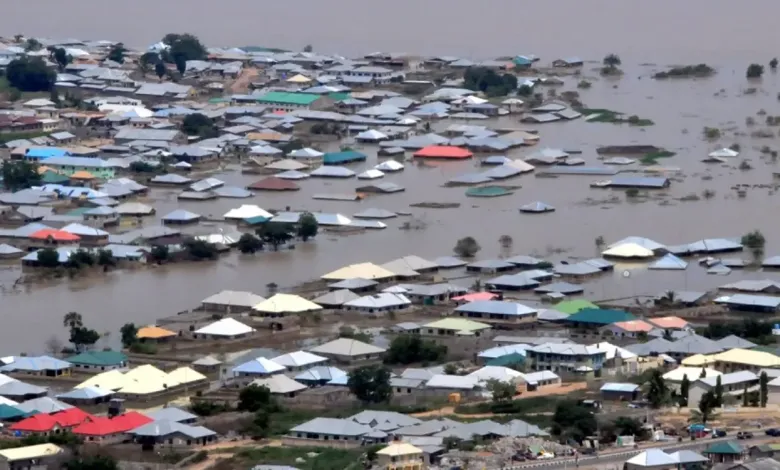
Benue, Plateau, C’River, Niger, Taraba among vulnerable states | Flood washes away graves, destroys 20 houses in Edo
By AZA MSUE, Makurdi; RICHARD NDOMA, Calabar; OKECHUKWU OBETA, Awka; ACHOR ABIMAJE, Jos; ANAYO OUKWUGHA, Port Harcourt; ATTAH ANTHONY, Jalingo; ABDULLAHI OLESIN, Ilorin; ALO ABIOLA, Ado-Ekiti; and ABU NMODU, Minna
Despite the federal government’s flood alert placing Benue, Plateau, Cross River, Niger, Taraba and more than 30 other states, including the Federal Capital Territory (FCT), at high risk of flooding, many residents in vulnerable communities have stayed in their homes, ignoring repeated warnings from emergency management agencies to relocate from flood-prone areas.
However, Rivers, Anambra, Kwara, Akwa Ibom, Cross River, Ekiti and a few other states said they had commenced dredging waterways, constructing emergency shelters and implementing other flood mitigation measures to reduce the impact of the anticipated flooding.
Many vulnerable residents in the affected states cited poverty, a lack of alternative accommodation and delayed government support, even as state authorities said they were intensifying efforts to avert another season of devastation.
A LEADERSHIP Sunday investigation across Benue, Cross River, Anambra, Plateau, Rivers, Taraba, Kwara, Ekiti and Niger states shows that although authorities have stepped up sensitisation campaigns, drainage clearance and evacuation planning, compliance remains low in several high-risk communities, largely due to economic hardship and a lack of alternative shelter.
The Ministry of Environment had earlier issued a Flood Prediction Advisory warning that heavy rainfall between 22 June and 5 July could trigger flooding in riverine settlements, floodplains, low-lying urban centres and areas with poor drainage infrastructure across the country.
Field reports from our correspondents indicate a mixed response across the states, with some governments ramping up preparedness measures, while others continue to struggle with infrastructure deficits and community-level challenges as the rainy season peaks.
In Benue State, our correspondent observed that many residents of riverine communities along Wadata, North Bank and the Makurdi-Gboko Road have yet to relocate despite repeated flood warnings.
Residents of the riverine communities have continued to express concern over their inability to relocate despite repeated flood warnings.
A resident of Fidi riverine settlement, Terdoo Samuel, said financial constraints had made it impossible for him to move to a safer location.
He said: “I heard about the warning, but there is nothing I can do because at the moment I don’t have the financial strength to relocate to a safer location. I am still looking for funds to move.”
One of our correspondents observed that the Benue State Government had constructed drainage canals in the flood-prone Wurukum area of Makurdi, linking them to River Benue, as part of efforts to reduce flooding in the area.
A resident of Wurukum, Onoja Peter, said the intervention would help ease the perennial flooding challenges in the area.
“The 2.1-kilometre drainage canal in Idye, Wurukum, Makurdi, in addition to the other drainage channels constructed, will minimise the flood challenges faced by the area in decades,” he said.
In response to the fresh flood advisory, the head of the information unit at the Benue State Emergency Management Agency (Benue SEMA), Tema Ager, said the agency had intensified sensitisation efforts and was arranging temporary shelters.
“Benue SEMA has produced jingles for awareness and is planning to designate places for victims to move to. There is also an awareness campaign encouraging people to move to upland areas even before the designated places are put in place,” he said.
Meanwhile, in Cross River State, residents of Efut Efio-Ene in Calabar South say they live in fear of flooding because a long-clogged drainage channel diverts stormwater into residential areas.
Residents blamed years of neglect for repeated flooding incidents that affected homes, livelihoods and public health, even as other parts of the state, such as Obubra, Biase and Boki, were yet to record significant incidents in 2026.
A resident, Sam Ebong, said the situation had persisted due to the blocked drainage outlet.
“Trouble began when the outlet that should channel stormwater into the river became clogged years ago,” he said.
Another resident, Prisca Effiom, also blamed poor maintenance of drainage systems for the flooding challenges in the area.
Responding to the alert, the Calabar Urban Development Authority (CUDA) said it had intensified efforts to address flood risks through a coordinated approach ahead of the 2026 rainy season.
The executive secretary, Dr Effiong Ayi, said interventions included dredging waterways, widening canals, clearing drains, removing structures obstructing water channels and enforcing environmental regulations.
“We are actively dredging waterways and widening canals to improve water flow and prevent water accumulation, particularly in flood-prone areas,” he said.
He further noted that the agency was working with emergency and environmental partners to strengthen flood response and mitigation efforts across the state.
Also in Anambra State, the state government said it had set up a flood disaster response committee following the Federal Government’s warning on possible flooding in several parts of the country.
The Commissioner for Information and Value Reformation, Dr Law Mefor, said the committee was chaired by the deputy governor and included more than half of the state’s commissioners.
He said the government took the alert seriously and was working to ensure residents were not caught unprepared.
According to him, the committee had begun monitoring water levels in flood-prone areas across the state.
He added that the state was also in constant communication with relevant emergency agencies to ensure coordinated response efforts.
Mefor disclosed that, due to the widespread vulnerability of the state to erosion and flooding, the government had ordered a statewide environmental clean-up exercise to reduce risks.
Plateau Embarks on Erosion, Flood Control Interventions
In Plateau State, the Agro-Climate Resilience in Semi-Arid Landscapes (ACReSAL) programme said it was executing large-scale erosion and flood control interventions, including a drainage system stretching approximately seven kilometres from the Plateau Club axis through West of Mines junction to the Bingham University Teaching Hospital area.
However, one of our correspondents observed that work on the project site had stalled, with construction activities currently abandoned.
On its part, the Plateau State Emergency Management Agency (PLASEMA) said it had commenced sensitisation campaigns in Jos and Bukuru metropolis ahead of the peak of the rainy season.
The Executive Secretary of the agency, Sunday Abdu, said residents had been advised to clear blocked drainages and avoid obstructing water channels.
Abdu added that flooding in the state was largely worsened by human activities, particularly building on waterways and indiscriminate waste disposal.
Similarly, the North-Central Director of the Civil Liberties Organisation (CLO), Steve Aluko, warned that flooding could increase the spread of waterborne diseases such as cholera and hepatitis.
Rivers Residents Live in Fear
In Rivers State, residents of coastal and riverine communities are living in fear following renewed flood warnings by the Federal Government, with several settlements across the state identified as high-risk areas.
The advisory affects communities in Ahoada, Abua/Odual, Ogba/Egbema/Ndoni, Degema, Akuku-Toru, Asari-Toru, Andoni, Bonny and other low-lying areas where seasonal flooding has become recurrent.
Emergency authorities have urged residents to clear drainage channels, monitor weather updates and comply with evacuation directives where necessary.
They also warned that delays in evacuation could expose lives and property to avoidable risks.
The Rivers State Government, however, reassured residents of its commitment to proactive measures to mitigate the impact of the anticipated flooding.
In Taraba State, residents of flood-prone communities have called for urgent government intervention to prevent flooding and evacuate residents of high-risk areas.
A resident of Jalingo, Malam Ibrahim Ali Usman, said only government intervention could effectively address the threat of flooding, urging authorities to relocate vulnerable residents to safer locations and provide temporary shelters.
Another resident, Melody Amadu, said flooding had become a recurring challenge, worsened by human activities and poor settlement planning.
She called on the government to support affected victims with food, shelter and relief materials where necessary.
The Director of Administration at the Taraba State Emergency Management Agency (TSEMA), Alhaji Sani Garba Maisukwati, said the agency had begun early-warning campaigns ahead of the peak flood period, expected between July and September.
Maisukwati added that last year’s proactive evacuation and awareness campaigns helped the state record zero flood-related deaths.
Kwara, Niger, Ekiti Residents Express Worry
In Kwara State, the government said it had put measures in place to mitigate the impact of possible flooding across the state.
The Permanent Secretary of the Ministry of Environment, Dr Abubakar Ayinla, said the government had intensified drainage clearing, particularly in Ilorin, to ensure the free flow of stormwater during heavy rainfall.
Ayinla noted that the channelisation of the Asa River had been completed, describing it as a sustainable intervention in flood control efforts.
He further said attention had been directed at identified flood-prone areas, while ongoing urban renewal and road rehabilitation projects were also helping to reduce flooding in parts of the state.
He disclosed that residents of riverine communities had been advised to relocate to safer locations where necessary.
Residents in parts of Ilorin, including Okelele, Sobi Specialist Hospital Road, Alagbado and Ayegbami-Dada areas, were also seen clearing blocked drainages to ensure free water flow during rainfall.
Across Ekiti State, residents have called on the government to intensify preventive measures amid increasing flooding risks from persistent rainfall.
Some of the identified flood-prone areas in Ado-Ekiti include Ayemi Garage on Iworoko Road, Faglo-Ikigbinsin, Olorunda, Ijadu, Olorunsogo, Odo-Ado, Adebayo, Basiri, parts of Ajilosun and other surrounding communities.
A resident of Ikigbinsin, Mr Ayo Olabisi, said urgent action was needed to prevent further flooding following alerts issued by the Federal Government.
He said recent heavy rainfall had already displaced residents and caused damage to property, including the loss of poultry and household items.”But we have nowhere to go becaause we cannot affrod it,” she said.
Another resident, Mrs Comfort Ojo of Olorunda community, said flooding had disrupted movement in the area after a downpour submerged connecting roads, isolating parts of the community from the state capital.
The Commissioner for Information, Taiwo Olatunbosun, said the state government had conducted assessments of flood-prone areas and was implementing recommendations from the report.
He said dredging of rivers, drainage clearance and construction of bridges had been intensified across vulnerable locations.
Similarly, in Niger State, authorities and residents have raised concerns over rising water levels in several flood-prone communities, particularly along the floodplains of Rivers Niger and Kaduna.
LEADERSHIP Sunday reports that the state has multiple vulnerable locations, including Shiroro, Mokwa, Lavun and Edati Local Government Areas, where residents say early signs of flooding are already emerging.
A resident of Muregi in Mokwa Local Government Area, Mohammed Bala, said there were indications that this year’s flooding could be worse than previous years based on current water levels and weather patterns.
“But we have nowhere to relocate to. We are waiting for the rain. Government isn’t helping us,” the resident said.
The Director-General of the Niger State Emergency Management Agency (NSEMA), Abdullahi Baba Arah, said the agency had intensified proactive measures even before the Federal Government’s latest alert.
Arah said the agency had also identified temporary safe grounds for the possible relocation of affected persons if the need arose.
He added that ongoing engagement with dam authorities was helping monitor daily water levels and anticipate potential overflow events.
Health Workers Warn of Cholera, Other Water-borne Diseases
Health workers in Rivers, Benue and Cross River states have expressed concern over possible outbreaks of cholera, hepatitis and other waterborne diseases as flooding risks increase across riverine and coastal communities.
In Cross River, Dr Mmayen Ikpeme warned that overflowing drains, contaminated water sources and poor sanitation in flood-prone areas could heighten the spread of infections if preventive measures were not urgently strengthened.
In Niger State, a community health worker, Mrs Rukayat Hassan, also raised similar fears, noting that rising water levels in riverine settlements and the displacement of residents could expose more people to unsafe drinking water and unhygienic living conditions.
She urged intensified public health sensitisation, provision of clean water and rapid response mechanisms to prevent what she described as a potential secondary health crisis alongside the flooding.
We’ve got the edge. Get real-time reports, breaking scoops, and exclusive angles delivered straight to your phone. Don’t settle for stale news. Join LEADERSHIP NEWS on WhatsApp for 24/7 updates →