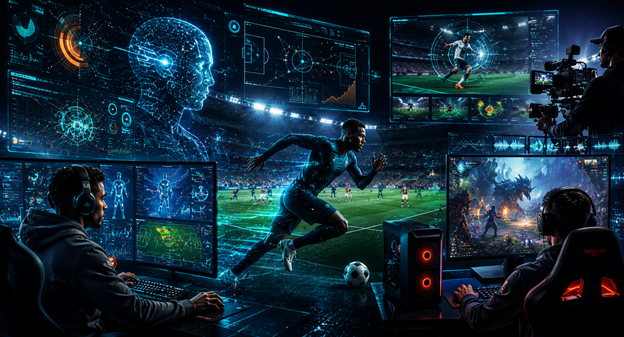
Artificial intelligence is no longer a background technology in gaming and entertainment. It is actively shaping what users see, how they play, and which content they engage with. From Lagos to Nairobi, the shift is visible in the platforms people use daily, the recommendations they receive, and the speed at which digital entertainment responds to their behavior.
How AI Is Reshaping Digital Entertainment
AI gaming technology has moved far beyond the early days of rule-based opponents. Modern AI systems learn from player behavior in real time, adjusting difficulty, recommending content, and predicting what a user wants before they search for it.
Video game studios now use AI to generate environments, create non-player characters that behave more like humans, and compress development timelines from years to months. Games that would have required teams of hundreds can now reach markets faster because AI handles large portions of the production pipeline automatically.
For the viewer, AI works just as actively. Sports streaming platforms use machine learning to track attention patterns and adjust what appears on screen during live events.
Personalized Experiences Through Machine Learning
AI game personalization operates on a simple principle: the more a user interacts with a platform, the more accurately the system predicts what they want next. This is not new in theory, but the execution has improved dramatically in the last two years.
Platforms now track session length, preferred game types, time of day, device type, and even how quickly a user abandons a game before moving on. That behavioral data feeds into recommendation engines that suggest the next title, the next match, or the next piece of content with increasing accuracy.
The personalization extends to difficulty and pacing. Some mobile games in Nigeria have recorded a 30% increase in session length after implementing AI-driven difficulty adjustment. Players stay longer because the game keeps them in a zone where they are challenged but not frustrated.
AI in Sports, Gaming, and Interactive Platforms
AI esports analytics is one of the clearest examples of how far this technology has reached. Professional esports teams in South Africa, Kenya, and Nigeria now use AI to analyze opponent patterns, track player fatigue, and build tactical models before tournaments.
Digital platforms that combine sports, gaming, and interactive entertainment use AI across multiple layers of the user experience. Pin Up, alongside other entertainment platforms, applies AI tools to personalize content delivery, detect unusual activity in real time, and adapt interfaces to individual user behavior without requiring manual input from the user.
The impact on live sports coverage has been just as significant. Broadcasters use AI to identify key moments within hours of a match finishing, allowing highlights packages to reach audiences faster than human editors could produce them.
Benefits and Challenges of AI Integration
AI game development has shortened production cycles and reduced costs for studios operating with smaller teams. The benefits extend to smaller developers in Africa who can now compete with international studios by using AI tools for artwork, dialogue, and testing.
The following factors explain why AI integration has accelerated across the gaming and sports sectors:
- Real-time data processing allows platforms to respond to user behavior within milliseconds.
- Machine learning models improve continuously without requiring manual updates from engineers.
- AI reduces the cost of personalization at scale, making it viable for platforms with millions of users.
These advantages do not come without challenges. Data privacy is the most significant concern in markets where regulation is still developing. When a platform collects detailed behavioral data to personalize content, users need clear information about how that data is stored and who can access it.
What Users Can Expect in the Future
AI game highlights generation is already standard on several platforms. Within minutes of a session ending, AI systems identify the most significant moments and compile them into shareable clips without human editing. This changes how users document and share gaming experiences.
The table below shows how AI is being applied across different types of platforms in 2026:
| Platform Type | Primary AI Use | User Benefit |
| Video game studios | Content generation and testing | Faster release cycles |
| Sports broadcasters | Automated highlights production | Highlights available within minutes |
| Esports platforms | Opponent and performance analytics | Better tactical preparation |
| Interactive entertainment | Behavioral personalization | More relevant content suggestions |
These applications are already live and growing. Users in Nigeria and Kenya are interacting with AI-driven systems every time they open a gaming app, stream a match, or receive a content recommendation on an entertainment platform.
In conclusion, AI is no longer an add-on feature in gaming and sports entertainment — it now shapes how content is created, personalized, and delivered at every stage. As adoption deepens across Africa and other markets, the platforms that read user behavior most accurately, and act on it fastest, will be the ones that set the pace for the next phase of digital entertainment.