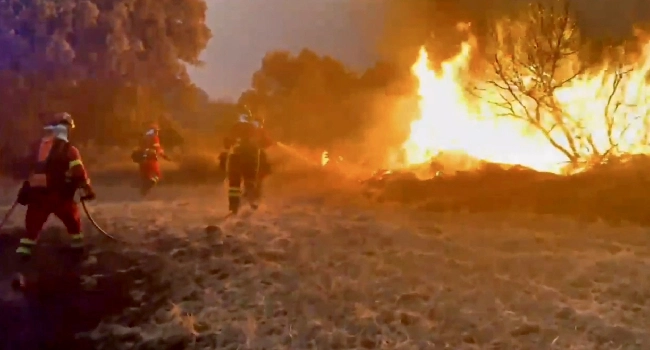
Firefighters were battling a wildfire north of Madrid on Sunday that has burned around 13,000 hectares (32,000 acres) of land and forced some 700 residents to evacuate, authorities said.
Prime Minister Pedro Sanchez said in a post on X that his government was closely monitoring the wildfire and thanked firefighters “working tirelessly” to protect lives and bring the blaze under control.
Around 300 firefighters, supported by 26 water-dropping aircraft, were working to contain the blaze, which broke out on Thursday amid scorching temperatures in Guadalajara province, the regional forest fire response service said on X.
The fire has been described as “difficult” by the head of the regional government, Emiliano García-Page.
It broke out in a forest-covered mountainous area that includes the Sierra Norte Natural Park, home to endangered species including eagles, wolves and butterflies.
READ ALSO: Russia Pounds Kyiv With Ballistic Missiles In Escalating Air War
The wildfire comes after another blaze broke out on Wednesday near Zaragoza, in the northeastern region of Aragon, forcing around 1,000 people to evacuate their homes.
Firefighters, aided by improved weather conditions, had managed to curtail the fire’s spread, Aragon’s deputy regional president María del Mar Vaquero told Spanish public television.
“Emergency services will determine when the residents of the five evacuated villages can return home,” she said.
The fire has burned around 14,400 hectares, Vaquero said, revising down an earlier estimate of about 16,000 hectares.
No casualties have been reported.
Earlier this month, Spain suffered one of its deadliest wildfires in recent history when a blaze in the southern province of Almeria killed 13 people and destroyed around 7,000 hectares.
Spain is on the front line of climate change and has experienced increasingly long and frequent heatwaves in recent years, with temperatures regularly exceeding 40C, creating conditions conducive to devastating wildfires.
Scientists say human-driven climate change is increasing the length, intensity and frequency of heatwaves, drying out vegetation and contributing to a greater risk of wildfires.