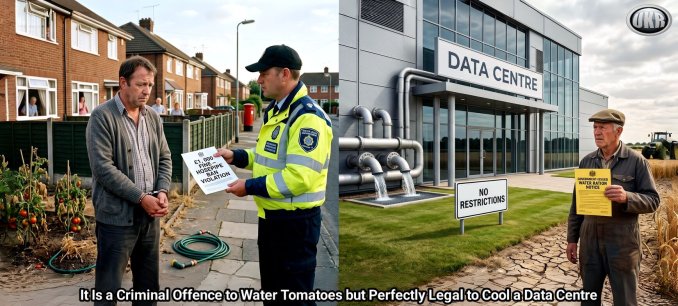
It Is a Criminal Offence to Water Your Tomatoes. It Remains Perfectly Legal to Cool a Data Centre.
Households get fined on sight. Farmers get rationed by government order. Data centres aren’t even asked to say how much water they take.
THE RATIONALS

As of 11 July, it became a criminal offence in large parts of eastern England to water one’s tomatoes. Anglian Water’s hosepipe ban — the first of this scale since 2012 — carries a maximum fine of £1,000 under Section 76 of the Water Industry Act 1991, a statute old enough to remember John Major. The restriction applies to millions of customers from Lincolnshire to Essex. No prosecutions have yet been brought. Somebody, somewhere, is entitled to bring one this afternoon should a neighbour choose to report them. The ban is not a request, it is a statutory prohibition enforceable by criminal penalty.
That would be a routine seasonal story if it ended there. It does not. In the same river catchments, in the same week, farmers face formal curtailment of the water on which their businesses depend, while a newer and considerably thirstier category of user is asked no questions at all. Follow the three through the same stretch of England and a pattern emerges that neither the last government nor the present one emerges from with credit.
While Cambridgeshire adjusts to its ban, the government’s own drought bulletin for 2–9 July records 729 hands-off flow restrictions now in force on abstraction licenses across England — up from 40 in January.
The increase has fallen almost entirely on farmers operating under the sister provision to the hosepipe ban. Livestock producers in East Anglia report forage shortages, winter barley shows heat stress, irrigation reservoirs the department itself describes as “declining rapidly” are doing precisely that.
Months earlier, ministers’ spring drought prospects document had already advised farmers to consider switching to more drought-tolerant crops. Water trading between licence holders has long been a standard Environment Agency recommendation for improving resilience in dry conditions.
Someone in Whitehall wrote that sentence about cropping patterns, filed it, and moved on. It remains one of the quieter indictments of the season.
One user, then, faces a criminal fine for a garden hose. Another, thirty miles away, faces a formal curtailment of the water his entire business depends on, escalating twentyfold in half a year while barely making the news. Both laws date from 1991. Both are enforced without hesitation. Neither user has much capacity to fight back.
Now look at who isn’t being asked to sacrifice anything. Slough, in the same seriously water-stressed South East, is widely described as Europe’s largest concentration of data centres — dozens already running, more coming. In June 2026, the Housing Secretary personally approved a 147-megawatt data centre on a Slough site the local council looked likely to reject, overruling the authority nearest to the people who would actually live with the consequences.
Ten miles up the M40, a starker version of the same pattern appears in Buckinghamshire. At Wapseys Wood sits a 300-megawatt gas-fired facility proposed by a company called Slough Holdings UK Limited — a name that bears no relation to the site’s actual location. Its planning application bypassed the local council entirely and went straight to a minister under Nationally Significant Infrastructure Project rules, granting it more decision-making authority than most parish councils exercise over a bus shelter.
Thames Water has modelled substantial future water demand from data centres in its region and has identified the sector as one of the largest sources of new demand growth. A single hyperscale site can use as much water as a town of 10,000 people.
Here the sentence that turns imbalance into indictment appears in written evidence to a House of Commons committee, solely for want of water, the Environment Agency objected to a cancer hospital in Cambridge. A facility intended to treat cancer patients faced formal objection on water grounds alone, while a gas-fired data centre elsewhere in the South East proceeded with ministerial approval and no equivalent water constraints.

One was subject to the examination expected of major infrastructure projects, the other faced none at all, because no data centre in the United Kingdom is obliged to disclose how much water it uses.
The Environment Agency has told Parliament that it cannot properly incorporate data centres into its national water resources planning because it lacks reliable data on their water use. This is not a limitation the regulator has observed in others. It is one it has admitted about itself, in writing.
This is not a Slough problem alone. Independent analysis found that 84 per cent of proposed UK data centres are sited in areas already, or soon to be, classified as water-stressed — meaning Slough is the pattern’s most visible symptom, not its full extent.
A country that already knows where its water is scarcest has chosen, repeatedly, to build its most water-hungry new industry precisely there, then acted surprised when the two collided.
Government has, at least once, admitted as much itself, in terms sharper than most departments allow themselves, the same Housing Secretary who approved the Slough site later conceded he had made a “serious logical error” in granting planning permission to a separate data centre elsewhere in Buckinghamshire — a rare admission, and one that raises an obvious question about how many of the sector’s other approvals, waved through on the same reasoning, might deserve the same scrutiny in hindsight rather than after the fact.
It is worth being precise about what “no disclosure requirement” actually means in practice, because the phrase can slide past a reader too easily. It does not mean data centres report modest figures that regulators judge acceptable. It means there is no figure at all — no return to file, no threshold to breach, no inspector with a form. A homeowner’s garden hose leaves a more complete paper trail than a server hall’s cooling system, and one of those two uses considerably more water.
It would be convenient, and dishonest, to hang this on one government. It can’t be. The structural rot is Conservative in origin. From privatisation in 1989 until 2024, no law of any kind required a water company to prioritise infrastructure over shareholder dividends. For fourteen of those years — between 2010 and May 2024 — the Conservatives were in government.
Since privatisation, water companies have paid out £52.7 billion in dividends to shareholders while losing 41.4 trillion litres of treated water through leaks, according to analysis of Ofwat data. Nobody broke a law, because until recently there was no legal requirement for water companies to prioritise infrastructure investment over shareholder returns. That regulatory gap existed under governments of both main parties for more than three decades.
But the blind spot currently swallowing Cambridge and Slough is being run today by the current government’s own policy documents. The AI Growth Zones strategy and the AI Opportunities Action Plan — both live Labour policy — do not mention water once, according to evidence given directly to Parliament.
A government that inherited official warnings of forage shortages in East Anglia found room in its flagship growth strategy for grid connections, energy prices, and skills, but none for the resource its own regulator says is under the greatest pressure.
Labour’s flagship reform of the water industry, the Water (Special Measures) Act 2025, was presented as a serious attempt to address poor performance. However, within a year of Royal Assent, companies were already finding ways around its measures.
Ofwat, the regulator strengthened by the Act, concluded in at least one case that arrangements involving payments to executives through offshore structures did not technically breach the new rules. A law intended to close one loophole appears to have opened another.
So, the Conservatives built the house with no smoke alarms. Labour installed one, watched it quietly disconnected within a year, and is now describing this as progress. Neither party can claim to have fixed the underlying problem.

Cross the border and the law changes entirely, and the outcome doesn’t. Scotland has never once imposed a household hosepipe ban since Scottish Water was formed — the Scottish Parliament’s own research service confirms the last one was in 1995, before devolution existed, before mobile phones were common, before anyone in government had heard the phrase “AI growth zone.”
The lever Scotland pulls instead is the farmer, thirteen or more river catchments are currently at “Significant Scarcity,” SEPA’s most severe category, with formal abstraction restrictions across Aberdeenshire, Fife and the Lothians, in some rivers running lower than at any point since the 1970s.
Meanwhile Scotland is the proposed site of 24 hyperscale data centres, including the £8.2 billion Lanarkshire complex — a project whose developers privately admitted a “power provision issue” while publicly promising it would run entirely on renewables, according to FOI documents obtained by the Guardian.
No Scottish regulator requires these sites to disclose water use either. Different Parliament, different regulator, identical shape, spare the household, ration the farmer, wave the data centre through with a press release about jobs.
Wales carries an identical Section 76-style law to England’s, though it remains untriggered this summer. The mechanism is loaded rather than absent, waiting on the same rainfall gods as the rest of the country.
Northern Ireland is the clearest outlier. Its environmental regulator, the NIEA, has long operated under an administrative arrangement with NI Water that left it with limited power to take meaningful enforcement action against the company it was supposed to police. Separately, the UK’s Office for Environmental Protection has found that Northern Ireland’s current water regulations are unlikely to deliver the environmental standards they are legally required to meet. This combination of weak regulatory powers and inadequate legal frameworks makes Northern Ireland structurally distinct within the United Kingdom.
Four nations, then, four different parliaments, four separate legal traditions built in different decades — and not one of them, when tested, has produced a system that treats the newest user the way it treats the oldest. That consistency, across borders that agree on almost nothing else, is itself the story.
None of this is happening for lack of funds, quite. Ofwat’s PR24 settlement requires every water company to hit a mandatory net zero performance target, sitting on the same scorecard as leakage — one of only 24 official performance commitments the entire industry is measured against.
The obligation originates from a March 2022 letter from Defra to Ofwat, which set out the government’s strategic priorities for the PR24 price review and instructed the regulator to treat the delivery of net zero as a key objective.
Ofwat has since embedded that instruction into the industry’s core funding settlement, making net zero a mandatory performance commitment despite customer research showing it ranked low among customer priorities.
Independent research by PwC found that customers, asked directly, ranked cutting a water company’s carbon footprint as their lowest priority of anything on that list — beneath leakage, beneath reliability, beneath nearly everything else Ofwat measures.
And yet the obligation remains mandatory, funded from the same bills, competing for the same capital and the same management attention as the leakage investment the public says it actually wants, while 41.4 trillion litres continue to vanish through pipes nobody prioritised fixing.
Ofwat’s own chief executive, David Black, conceded the absurdity in his own foreword to the methodology: “People question why hosepipe bans are needed when leakage is high.” That’s not a campaigner’s line, extracted and spun. That’s the regulator marking his own homework, in his own document, and still failing it in the very same paragraph.
Four arguments deserve consideration. A case that avoids its strongest objections is weaker for it.
Data centres bring jobs and investment. This is true, but it does not answer the question at hand. Investment can sustain one side of a resource conflict without resolving it or exempting that side from rules applied to others. A facility can generate local employment while drawing water from a catchment in which the Environment Agency objected to a cancer hospital’s connection — without either fact cancelling the other, however convenient it would be for one to quietly excuse the other.
Net zero is a legitimate long-term objective. This is also true, but it does not follow that it should take automatic precedence. The regulator’s own customer research placed reducing carbon emissions at the bottom of the list of customer priorities, yet it was still made a mandatory performance commitment. Ofwat’s chief executive has himself noted the resulting tension in his foreword to the methodology — which is, in its way, a regulator publishing its own rebuttal and filing it under “introduction.”
No UK data centre has been proven to cause a shortage. This is correct, but it is not especially illuminating. The regulatory framework does not require data centres to disclose their water use, so there is no reliable basis on which causation could be established either way. An absence of evidence inside a system that makes no provision for gathering it is not evidence of harmlessness — it is simply a system that was never going to find out.
Reservoirs are being developed, but on timelines measured in decades. Data centre approvals can be secured in months. This disparity is not a defence of the present arrangements. It is the central imbalance expressed as a project schedule. One category of user receives planning permission relatively quickly, while the infrastructure needed to support broader water security remains on the drawing board for the 2040s — a date distant enough that several of the people approving today’s data centres will have retired before it arrives.
Strip away the explanations and one observable fact remains. Britain can fine a householder on sight under a law from 1991, ration a farmer by government order under its twin statute, and record its own regulator admitting in writing that it lacks the data to police a water company — yet has never, under governments of either colour and across all four nations, required its newest and largest industrial water user to so much as fill in a form.
That is not the result of enforcement attempted and failed. It is what occurs when no one in authority was ever required to ask the question in the first place, and found it simpler, decade after decade, not to do so.
The householder did not choose this asymmetry. Neither did the farmer. A hands-off flow notice does not arrive as a fine to be paid and forgotten, it arrives as a restriction on the water a crop depends on. Someone, somewhere in the machinery of four governments, chose this for both of them, and has yet to be asked to explain why.
A garden hose is visible to the law the moment it is turned on. A farmer’s abstraction licence is visible to a regulator that writes to him in advance. A hospital formally objected to on water grounds is visible, at least, to whichever member of Parliament reads the relevant line of evidence.
A data centre drawing each day the volume required by a small town remains, in Cambridgeshire, in Slough, in Lanarkshire and across the United Kingdom, the one user the statutes have still not thought to notice.
It is, this week, a criminal offence to water your tomatoes. It remains perfectly legal to cool a data centre — and nobody has ever been required to ask how much water that takes.
One last thing. The cost of living survey has had a decent response so far, which is more than can be said for most of the institutions covered above. It remains open a while longer for anyone who hasn’t yet filled it in. It takes less than three minutes. Your answers are read, not filed. If you haven’t done it yet, now would be the time. Tell us what you think. Thank you