By Kazeem Ugbodaga
The Lagos State Government has unveiled plans to deepen the digital transformation of its archival system, reaffirming its commitment to digitising historical records and preserving the state’s documentary heritage to safeguard its history, culture and identity for future generations.
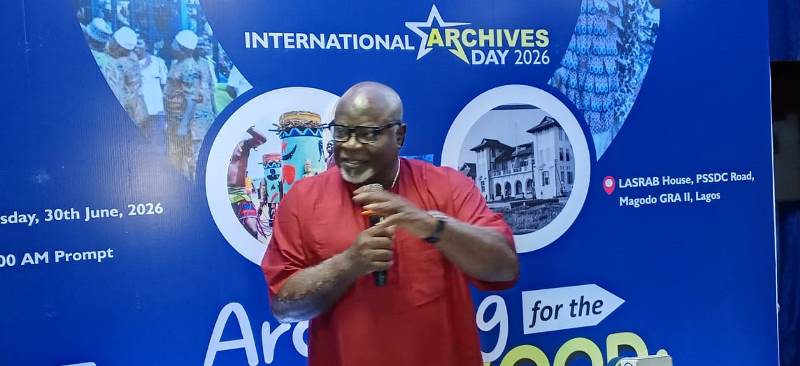
The Commissioner for Information and Strategy, Gbenga Omotoso, disclosed this on Tuesday while delivering the keynote address at the 2026 International Archives Day organised by the Lagos State Records and Archives Bureau (LASRAB) in Magodo, Lagos.
Omotoso said the administration of Governor Babajide Sanwo-Olu remained committed to strengthening LASRAB to effectively discharge its statutory responsibilities, adding that digitisation and computerisation would remain at the heart of the state’s archival strategy.
“The Governor has shown remarkable commitment to ensuring that LASRAB performs its statutory duties. He has asked me to assure you that the government intends to do even more,” Omotoso said.
“We have also spoken about the digitisation and computerisation of LASRAB’s activities, and I believe that is the right direction. Technology is the future of archiving, and we must embrace it,” he added.
He warned that countless historical events were disappearing because they were either poorly documented or not documented at all, stressing that preserving history should extend beyond government records to include the experiences of ordinary citizens and communities.
“Our greatest challenge is preserving the stories of our past. Too many important events take place without being properly documented. We witness history every day, yet we often fail to record it for future generations,” he said.
Omotoso cited the COVID-19 pandemic as an example of a defining period whose complete story has yet to be adequately preserved.
He said the sacrifices of healthcare workers, public servants and ordinary Nigerians, as well as the country’s response to the pandemic, deserved comprehensive documentation for future generations.
“I sincerely hope that all those experiences are being properly documented. Years from now, when all of us are gone, future generations should be able to look back, read those records, understand our experiences and appreciate what we endured during that difficult period,” he added.
The commissioner lamented that many Nigerians were increasingly disconnected from their history, noting that while many recognise the name Herbert Macaulay because of roads and bus stops named after him, few understand his contributions to Nigeria’s nationalist movement.
He also referenced the recent London premiere of a documentary on the late Chief Moshood Kashimawo Olawale (M.K.O.) Abiola, describing it as a timely effort to preserve one of the country’s most significant democratic milestones.
“That documentary is a commendable effort to preserve an important chapter of Nigeria’s democratic journey. This is exactly why archives and historical documentation are indispensable,” he said.
Omotoso urged greater investment in digital preservation technologies, insisting that electronic archiving had become indispensable.
“Another challenge before us is how to effectively deploy technology in preserving our heritage. Digital archiving is no longer optional; it is essential,” he stated.
He also advocated increased funding for preserving historical monuments and heritage sites, citing the Colosseum in Rome as an example of how deliberate conservation sustains cultural heritage.
He defended the state’s refurbishment of the palace of the Oba of Lagos, saying the intervention was aimed at preserving a national monument.
“We are not simply preserving a building; we are preserving a national monument. Such heritage sites are part of our collective history and identity. Whatever resources are invested in preserving them are investments in our history, our culture and our future,” he said.
Earlier in his welcome address, the Director-General of LASRAB, Mr. Razaak Olugbenga Amodu, said the 2026 International Archives Day, themed “Archiving for the Public Good: Preserving Collective Memory for Future Generations,” reflects the growing global recognition of archives as indispensable tools for transparency, accountability and sustainable development.
He described archives as living testimonies of society’s collective journey and said LASRAB remained committed to preserving Lagos State’s documentary heritage through modern records management, digitisation, conservation of historical records, public exhibitions and educational outreach programmes.
Amodu urged government institutions, educational establishments, cultural organisations, researchers and citizens to collaborate in documenting and preserving the state’s history.
“As we engage in today’s activities, I encourage us all to reflect on how each of us can contribute to ensuring that our records, stories and historical experiences are properly preserved for those who will come after us. Together, we can build an enduring legacy that inspires future generations and strengthens our collective identity,” he said.
Delivering a lecture titled “Community Archives: A Tool for Identity, Inclusion and Societal Cohesion,” Professor of Philosophy of Religion at Lagos State University, Prof. Danoye Oguntola-Laguda, said community archives are essential for preserving cultural identity, promoting inclusion and strengthening national cohesion.
He explained that community archives empower people to document their own histories while preserving languages, customs and traditions that could otherwise disappear.
He added that schools, religious organisations, traditional institutions and civil society groups all have important roles in safeguarding historical records.
The professor, however, warned that inadequate documentation in sectors such as the military had resulted in the loss of valuable historical records, making research, accountability and evidence-based policymaking more difficult.
He called for greater investment in archival infrastructure, professional training and digital preservation systems, describing community archives as instruments for preserving identity, promoting inclusion and fostering peaceful coexistence.
Also speaking, former LASRAB Director-General and retired Permanent Secretary, Dr. Biodun Onayele, urged governments and institutions to intensify investment in digitisation and archival preservation, describing archives as the foundation of historical truth, transparency and accountability.
According to him, archives preserve the evidence upon which history is built, protect collective memory and ensure that marginalised voices are permanently represented in the historical record.
“Archives carry out this sacred responsibility by preserving the raw evidence from which historical truth is derived. They promote transparency, protect accountability, and ensure that marginalised voices are given a permanent place in our collective memory. Without archives, a community loses its identity, its collective memory, its legal foundations, and its ability to hold those in authority accountable,” Onayele said.