The Adults Have Left the Room: Geopolitical LARPing and the Defence Debacle Part 3
ÆTHELSTAN
Part Three is therefore the wreckage. The car had already skidded through U-turns and struck the language barrier. Now the engine was over-revving on the world stage. Welfare commitments, stagnant growth, infrastructure decay, spiralling debt interest payments, energy costs and administrative incompetence had left the government without the means to sustain its geopolitical ambitions.
The Chagos Deal
The government’s case on Chagos was that this was not a surrender dressed up as virtue, but an insurance policy for Diego Garcia: concede Mauritian sovereignty, then lease back the strategic core for 99 years, securing the UK–US base against legal and diplomatic challenge.
In that telling, the £101 million annual payment was the price of certainty, not humiliation. Yet the counter-case also has force. The deal was a national scandal, a signal of weakness to China and proof that Labour’s decolonising instincts had overridden British interests.
The criticism is not merely that Britain is paying billions to lease back territory it once controlled. It is that sovereignty was reduced to a leasehold arrangement, strategic geography to an administrative settlement and the national interest to post-imperial tidying-up. The safeguards may be real, but symbolism is statecraft too. A country that cannot distinguish prudence from retreat should not expect allies or enemies to do so.
Brexit Reset
There was an uneasy attempt to “reset” relations with Europe, while never admitting that the Brexit settlement could not easily or honestly be reversed. Labour wanted smoother relations with Brussels, a better diplomatic tone, cooperation on trade, research, migration and defence, and a post-Brexit settlement with fewer sharp edges. These may be sensible aims. But they also expressed the deeper Starmer instinct: to translate political conflict into procedure, sovereignty into negotiation and national renewal into a managed process.
The result was a foreign policy more continental than the Conservatives’, but stability was not a strategy, and internationalism did not magically create military capacity. Starmer could not resist alternating between the White House and Europe, alienating the straight-talking President who cut a beneficial tariff deal, only to see the UK wedded to Windmills and Norwegian North Sea gas.
The first duty of government may be national security, as Starmer repeatedly said, but national security is not a mood. It is money, manufacturing, energy, morale, demography, alliances, secure borders, ships, aircraft, soldiers, resilience, food and fuel supply lines and the willingness of a people to defend something more substantial than a rules-based communiqué.
The War Drags On
Politicians like Starmer may genuinely believe their intelligence briefings about an imminent Russian invasion of eastern and central Europe, while simultaneously claiming that Russia and Putin are on the brink of collapse. This contradiction is seldom explored because both arguments serve the same end: keeping the war going.
The more vulgar case for prolonging the war lies in the political and economic consequences of its coming to an end: Zelenskyy will leave office either after a crushing electoral defeat, in the wake of having to accept lost territories as part of a peace settlement, or by resigning and attempting to relocate beyond the reach of his many enemies among the Ukrainian political oligarchs.
Since Russia’s “full-scale invasion”, Zelenskyy’s government—under martial law approved by parliament—has acquired sweeping powers: military mobilisation; bans on most military-age men leaving Ukraine; curfews, searches, requisitioning and compulsory labour; suspension of elections and referendums; restrictions on assembly, strikes and communications; a unified national television news platform; and sanctions or closure proceedings against media and organisations deemed security threats.
Courts have banned a dozen parties accused of supporting Russian aggression. Ukraine has derogated from certain European human rights obligations, although some of these derogations were temporary. It has also removed the Ukrainian Orthodox Church (UOC) from state-owned religious sites, notably the Kyiv-Pechersk Lavra, by terminating leases and repossessing state property. UN monitors have documented forcible entries into UOC churches.
The 2024 law signed by Zelenskyy permits courts to dissolve religious bodies deemed affiliated with the Russian Orthodox Church. It does not automatically confiscate parish property, but the UN says its broad affiliation tests and sanctions impose disproportionate restrictions on religious freedom. It should be noted that the Ukrainian Orthodox Church historically came under the jurisdiction of the Patriarch of Moscow and the Russian Church in 1686.
The split in the Church saw the Orthodox Church of Ukraine (OCU) formally granted independence from the Russian Orthodox Church on 5 January 2019, when Ecumenical Patriarch Bartholomew I signed the Tomos of autocephaly in Istanbul. This caused an irreconcilable split in the Ukrainian church and among Moscow- and Constantinople-aligned churches, bishops, and laity.
This was partly evidence of an escalating civil and nationalist split between West and East Ukraine, US destabilisation and Russian anxiety and resistance to the placement of missiles on its border following the western-funded coup to remove the elected President Yanukovych and an actual civil war in the Donbas, which preceded the Russian intervention.
Ukrainian Corruption
Below are the principal independently published allegations and cases involving Zelenskyy’s administration or wider Ukrainian state institutions. Allegations are not proof unless a conviction is noted.
Operation Midas/Energoatom: Investigators allege that a network extracted 10–15% kickbacks from contractors and laundered about $100 million. Suspects include Zelenskyy’s former business associate, Timur Mindich, and senior energy-sector figures.
Andriy Yermak: Zelenskyy’s former chief of staff is accused of laundering approximately $10.5 million through a luxury housing project. He denies wrongdoing and was detained in May 2026 pending proceedings. Zelenskyy has not been charged.
German Galushchenko: The former energy and justice minister is accused of participating in the Midas organisation and laundering kickbacks; prosecutors allege that millions reached foreign accounts associated with his family. He denies wrongdoing.
Oleksiy Chernyshov: The former deputy prime minister was accused of accepting an improper discount on luxury property and later featured in the wider Midas investigation concerning illicit enrichment.
Defence food procurement: Defence Ministry officials were accused of purchasing military food at inflated prices, allegedly costing the state more than UAH 733 million. Former minister Oleksii Reznikov was criticised politically but was not personally charged in the reported case.
Mortar-shell procurement: Defence officials and Lviv Arsenal executives were accused of diverting nearly UAH 1.5 billion—about $40 million—intended for 100,000 mortar shells that were not delivered.
Vasyl Lozynsky: The deputy infrastructure minister was dismissed after investigators accused him of accepting a $400,000 bribe linked to overpriced emergency generators and heating equipment.
Mykola Solskyi: The agriculture minister was accused of participating in the illegal acquisition of state land valued at approximately $7 million. He denied benefiting and resigned in 2024; proceedings were continuing.
Vsevolod Kniaziev: The former Supreme Court president was accused of accepting a $2.7 million bribe to influence a judgment. Unlike many other cases, this resulted in a conviction and imprisonment in June 2026.
Oleh Tatarov: Zelenskyy’s deputy head of the Presidential Office was accused by anti-corruption authorities of arranging a bribe in an earlier construction case. Prosecutors closed the investigation on procedural grounds; critics alleged that he had been politically protected.
Zelenskyy’s offshore companies: The Pandora Papers reported that Zelenskyy and his associates maintained an offshore company network, and that he transferred an interest to a close associate shortly before becoming president. The reporting raised questions about transparency and conflicts of interest, but did not establish that possessing the companies was illegal.
Pressure on anti-corruption agencies: In July 2025, Zelenskyy signed legislation placing NABU and SAPO under greater control of the politically appointed prosecutor-general. Critics accused the government of attempting to obstruct investigations involving powerful insiders. Following protests and European pressure, the agencies’ independence was restored nine days later.
The evidence indicates serious and recurrent high-level corruption, particularly in defence procurement, energy and property. It also shows Ukrainian investigators at work, uncovering cases. It does not presently establish that Zelenskyy personally directed the wartime schemes.
War is Good for Profits
The next factor is the financial interest in the war:
United States: Assistance to Ukraine frequently involves the Pentagon contracting with American manufacturers. Raytheon received a $182 million NASAMS contract, while Oshkosh received approximately $202 million for military trucks. US officials explicitly describe assistance to Ukraine as strengthening the American defence-industrial base.
United Kingdom: A £1.6 billion, export-credit-backed deal provides Ukraine with more than 5,000 Thales missiles manufactured in Belfast, creating 200 jobs and supporting another 700. The UK government openly presents this as benefiting both Ukraine and British industry.
European Union: The EU’s ammunition programme has allocated over €500 million to expand production across Europe, partly to replenish member-state stocks and supply Ukraine. Its broader defence-industrial programme provides €1.5 billion to European and Ukrainian manufacturers.
Joint ventures: American and European companies have agreements to repair vehicles, manufacture ammunition and develop weapons jointly with the Ukrainian state or private defence enterprises.
Reconstruction and resources: The US–Ukraine Reconstruction Investment Fund provides American interests with access to future investment opportunities in minerals, infrastructure and strategic industries.
Military-industrial interests benefit financially from sustained procurement, creating a potential institutional incentive against rapid disarmament. Yet much larger reconstruction opportunities depend upon peace. The scale and distribution of that future burden, therefore, matter.
Ukraine Reconstruction
The latest joint assessment by the World Bank, European Commission, United Nations and Ukrainian government estimates Ukraine’s recovery and reconstruction needs at approximately $587.7 billion—more than €500 billion—over ten years. This figure covers not merely the rebuilding of destroyed structures, but also the restoration of services, the modernisation of infrastructure, demining, and economic recovery and rebuilding to higher EU-compatible standards. Direct physical damage alone was estimated at over $195 billion by the end of 2025. Because hostilities continue, the eventual figure could rise substantially.
Ukrainian EU Membership
EU membership would not transfer Ukraine’s entire reconstruction liability to the other member states. Reconstruction would still be financed through a mixture of:
• Ukrainian taxation and borrowing;
• EU grants, loans and guarantees;
• bilateral contributions from the US (Rare Earth’s) , UK and other countries;
• World Bank, IMF and development-bank finance;
• Ukrainian and foreign private investment; and
• Potentially, income from frozen Russian assets or eventual reparations.
The EU is already financing part of the recovery through the €50 billion Ukraine Facility. By comparison, the proposed arrangements for 2028–2034 envisage a Ukraine Reserve of up to €88.9 billion, alongside up to €100 billion in loans. These proposals are considerably smaller than the total reconstruction requirement.
After accession, Ukraine would become eligible for ordinary EU programmes—notably cohesion and structural funds and the Common Agricultural Policy. Some of that money could be used for reconstruction and modernisation. Since member-state contributions largely finance the EU budget, existing members would indirectly pay through some combination of:
• higher national contributions;
• reduced allocations to existing recipients;
• additional EU borrowing; and
• reforms or caps on agricultural and cohesion payments.
One static estimate, assuming present EU budget rules, suggested that Ukraine could receive approximately €18–19 billion net annually from the EU budget. However, actual membership terms would almost certainly include transitional periods, expenditure caps and negotiated reforms. This figure is therefore not an estimate of the total reconstruction bill.
But bear in mind the current net beneficiaries of EU funding: Poland, € 11.9 billion; Romania, € 5.5 billion; Hungary, € 4.4 billion; Greece, € 3.9 billion; and the net contributors: Germany, -€19.7 billion, France, -€ 10 billion, Italy, -€ 3.8 billion, and the Netherlands, -€ 3.2 billion. Neither group has anythign to gain and potentially much to lose from Ukraine joining the EU.
NATO and the Future of European Politics
President Trump has proposed conditions for NATO’s future utility: the way forward in Europe would see a compromise ending to the Ukraine conflict; some opportunity for Russia to re-enter an expanded G8; and a demand that Europe finance the continuation of its own strategic armament and war choices, while at the same time ending the rebadged purchase of Russian oil and gas through third parties such as India and Turkey. The alternative British initiative, with French and German support—the Coalition of the Willing—was essentially buying time, a delaying tactic to avoid a peace compromise and loss of territory in the hope that a future President would reverse course.
The European judgment appeared to be that President Donald Trump was illegitimate, temporary and likely to be removed from power after the midterms or at the end of his second and final term. The globalist world model, with Britain at its centre but essentially in a subordinate role to the United States, found itself at odds with the anti-globalist, tariff-based Pax Americana of the Trump White House. The administration’s critique of mass net immigration, and welfare largesse, as well as formally buying Russian oil and gas whilst claiming it was a strategic military threat, made no sense.
Those most hostile to Trump advanced the familiar settlement: a rules-based international order that was often a divide-and-rule strategy in disguise; endless negotiations and regulatory can-kicking; mass, uncontrolled immigration; zero-carbon industrial extinction; and talk of war with Russia without credible investment in defence spending to prepare for one.
Such leaders hailed Zelenskyy as the new Churchill, whether or not they grasped the oligarchic, vested, and corrupt interests surrounding the Ukrainian state. They were either too weak or too indulgent to question the propaganda victories emanating from the Kyiv intelligence and media machine.
Britain and France placed themselves at the front of a European effort to guarantee Ukraine’s future, coordinate support and prepare a reassurance or peacekeeping force in the event of a ceasefire. The stagecraft was grand: summits, declarations, photographs, military planning sessions, phrases about once-in-a-generation security and the defence of Europe.
But Starmer’s government prolonged the diplomatic and strategic fantasy of British agency while lacking the fiscal, military and industrial means to underwrite it. The claim to leadership exceeded the power behind it.
Ukraine exposed this gap by demanding munitions, air defence, drones, logistics, trained personnel, deployable formations and industrial capacity—requirements that rhetoric could not supply. The Coalition of the Willing sounded like a press conference in search of credible military participants.
This was also where Starmer misread the international moment. Donald Trump was not an incidental disturbance in the diplomatic weather. He represented the repricing of American protection. Europe had spent decades outsourcing hard power to Washington while maintaining the rhetoric of strategic autonomy.
Iran, USA and HMS Dragon
Starmer’s European initiative tried to fill the space opened by American pressure, but Britain was no longer the country imagined by its leaders. It had aircraft carriers without sufficient escorts, weak industrial surge capacity, recruitment problems, munitions shortages, too few operable frigates and a defence budget squeezed by health, welfare and debt-interest spending.
A country can choose to be a serious military power. It can choose to be a commercial state under American protection. It can choose to retrench, rearm, broker or become a heavily armed island fortress. What it cannot do indefinitely is speak like a great power, spend on an expansionist welfare state, procure like a bureaucracy, recruit like a declining society, fail to police its own borders against real threats to its populace, and then propose to grow its military to defend a foreign nation’s borders.
When the conflict between the USA, Israel and Iran moved into major bombing and then active war, the UK was unable to swiftly deploy its Type 45 destroyer, HMS Dragon, to protect RAF Akrotiri in Cyprus after the base was struck by drones in early March 2026. The major delays were due to systemic Royal Navy readiness issues, budget-driven contract changes, and maintenance backlogs. Disagreements over granting the USA access to UK air bases only added to unnecessary tensions with the White House.
Starmer’s Numbers Do Not Add Up
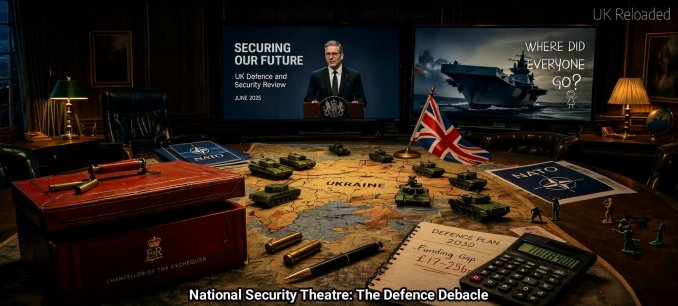
The underlying defence-spending debacle, therefore, punctured the claim that foreign policy was the one area many mainstream journalists believed the Prime Minister had handled well. Starmer announced his ambition: increased defence spending, a long-delayed investment plan, drones, submarines, nuclear renewal, air capabilities and preparation for future wars.
Yet the plan arrived with a huge funding gap and doubts about procurement competence. The resignation of the Defence Secretary and his junior minister became the final political flourish. The departing Secretary raised funding slightly, then left his successor with uncertain efficiency savings and the familiar Whitehall claim that a strategic emergency could be reconciled with departmental trade-offs and future fiscal events. The arithmetic remained unresolved.
The reported dispute over the cost of a proposed mission to Ukraine sharpened the symbolism. A coalition intended to project European seriousness became entangled in the oldest Whitehall question: whose budget would bear the cost? The continental rhetoric had met departmental reality.
This is why the defence episode belongs at the end of this three-part essay. It completes the pattern begun by welfare and exposed by immigration: a government able to identify genuine problems but unable to command the authority, resources, competence or consent needed to resolve them.
Foreign-policy LARPing is especially dangerous because strategic overreach can weaken deterrence. If Britain tells allies and enemies that it is ready to lead while its forces remain under-resourced and its industrial base cannot fund military expenditures, it does not look brave. It looks unserious where seriousness matters.
The Fall of the Managerial Centre
Starmer’s fall should not be made too personal. He was dull, cautious, legalistic, morally anxious, often tin-eared and strangely uncomfortable as a national communicator. But these defects became fatal because they were attached to a political settlement that had exhausted its own methods. He was not the sole author of Britain’s crisis, but the representative of an order whose methods no longer matched the scale of the crisis.
The settled question beneath his premiership was whether the managerial centre could still govern Britain by mood music: competence, decency, fiscal rules, institutional repair, public-service reform, international seriousness and carefully calibrated policy and moral language. The answer was a resounding no. Not because those words are always empty, but because they had become substitutes for decisions the governing class no longer had the courage, consensus or money to make.
The U-turns showed that the state could not correct domestic policy without alarming its own coalition. The immigration speech showed that it could not describe the nation without offending the woke ideology embedded in its institutions. Ukraine and defence revealed the same incapacity abroad.
As Keir Starmer announced his resignation, he pointed to a few overlooked successes, most of which had made things worse. He would stand down when a successor was identified, having been shunned by the electorate, the parliamentary Labour Party, much of its activist base, his Cabinet colleagues, and the media that had originally fawned over the potential of a landslide victory.
We have had seven prime ministers since 2010. Even with a 160-seat majority, Labour could not extend Keir Starmer’s tenure beyond one year, eleven months and eighteen days. The U-turns were symptoms of a government that entered office with a critique of Broken Britain’s condition but no settled programme capable of overcoming the institutional, economic and political obstacles before it. The result has been shocking, and the early soundings from the Burnhamite camp offer little hope of a new direction. The Last Double Down may yet have an encore.