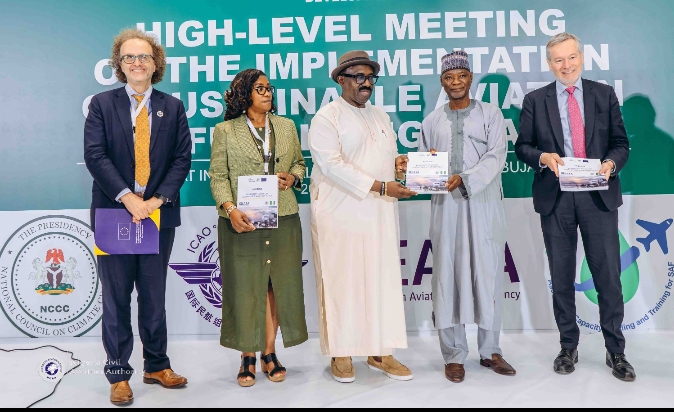
Nigeria has moved to cut its aviation sector’s carbon footprint with the launch of a National High-Level Sustainable Aviation Fuel (SAF) Steering Committee in Abuja.
The launch coincided with the release of a national feasibility study on SAF and the start of a related business implementation study backed by the International Civil Aviation Organization (ICAO).
Speaking at the event organised by the Nigeria Civil Aviation Authority (NCAA), alongside ICAO, the European Union, and the European Union Aviation Safety Agency (EASA), minister of aviation and aerospace development Festus Keyamo described the event as “another significant milestone in Nigeria’s journey towards building a resilient, competitive and environmentally sustainable aviation sector.”
“The committee membership comprises the following: The Honourable Minister of Aviation and Aerospace Development; Honourable Minister of Innovation, Science and Technology; Honourable Minister of Agriculture and Food Security; Honourable Minister of State for Petroleum Resources; The Director General of the Nigerian Civil Aviation Authority (NCAA); The Director General of the National Climate Change Council; and the Managing Director of NNPC Energy Limited.”
Represented by the director of Air Transport Management at the federal ministry of aviation and aerospace development, Ahmed Tijjani Abdullahi, the minister noted that while aviation remains a vital catalyst for economic growth, regional integration, trade and tourism, the sector must also contribute meaningfully to global efforts to reduce greenhouse gas emissions.
He identified sustainable aviation fuel as a strategic opportunity for Nigeria to decarbonise aviation while stimulating investment, creating new industries and jobs, strengthening energy security, and unlocking value across the country’s agricultural, energy and industrial sectors.
Highlighting Nigeria’s competitive advantages, the minister said the country possesses abundant feedstock resources, including its status as one of the world’s largest cassava producers, significant agricultural and agro-industrial residues, expanding refining capacity, growing technical expertise and a strategic geographic location.
He noted that these advantages position Nigeria to become a major producer and supplier of Sustainable Aviation Fuel on the African continent.
In his welcome remarks, the director-general of the Nigeria Civil Aviation Authority, Capt. Chris Ona Najomo described the event as a defining moment in Nigeria’s aviation sustainability journey, noting that it marked the country’s transition from planning to implementation.
Captain Najomo noted that the feasibility study, developed under ICAO’s Assistance, Capacity-building and Training for Sustainable Aviation Fuels (ACT-SAF) Programme with support from the European Union and technical support from EASA, provides the evidence-based foundation for transforming Nigeria’s abundant feedstock resources into commercially viable Sustainable Aviation Fuel production.
He reaffirmed the NCAA’s commitment, as Nigeria’s civil aviation regulator and Secretariat of the National High-Level Sustainable Aviation Fuel Steering Committee, to continue coordinating stakeholders and facilitating the successful implementation of the programme.
We’ve got the edge. Get real-time reports, breaking scoops, and exclusive angles delivered straight to your phone. Don’t settle for stale news. Join LEADERSHIP NEWS on WhatsApp for 24/7 updates →