• Onaiyekan tasks lawmakers on effective representation
From Ndubuisi Orji, Abjua
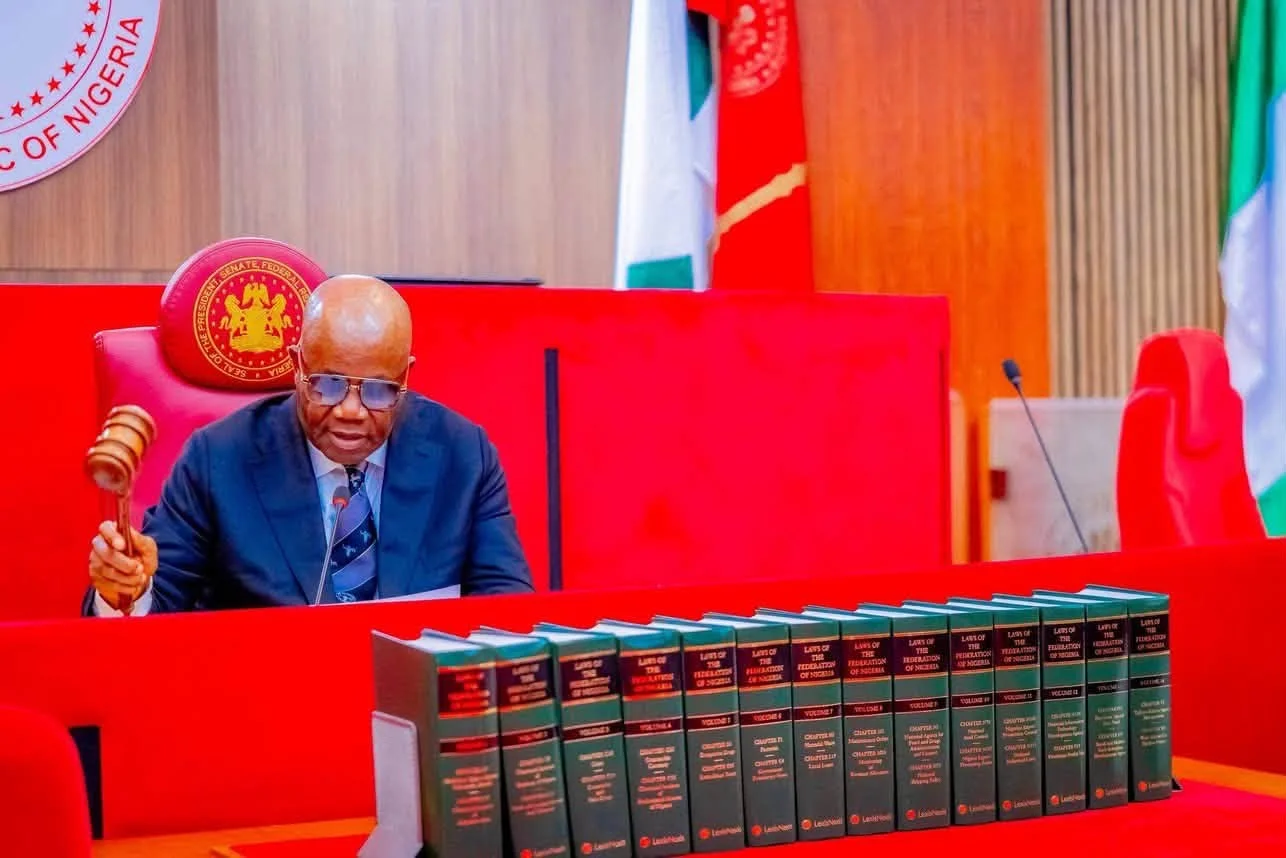
Senate President, Godswill Akpabio, has said the National Assembly may review the Electoral Act 2026, admitting that lawmakers “legislated against themselves” by introducing provisions that left many incumbent legislators unable to secure their parties’ nominations for the 2027 elections.
Akpabio made the remarks at the National Assembly Open Week, organised by the House of Representatives in Abuja, yesterday.
He expressed concern that many members of the 10th National Assembly lost their party primaries and would therefore be unable to seek re-election.
Under the Electoral Act 2026, political parties were restricted to consensus and direct primaries for the nomination of candidates for the 2027 elections, replacing the previous system used in earlier electoral cycles. Critics argued that the new process concentrated enormous influence in the hands of party leadership, resulting in the defeat of more than 50 members of the House of Representatives and many senators during the primaries.
While acknowledging that the new law reduced violence during the nomination process, Akpabio said the National Assembly would revisit the legislation to prevent future lawmakers from facing similar challenges.
“From the Electoral Act that we passed, you can see that not many people were killed, if any, during the primaries in many states of the federation. But we shall tinker with the Act again to make sure that we are not the victims of our own actions.»
“I understand that many members and many senators were overwhelmed by the leadership of their various political constituencies. At the end of the day, we seem to have made a law against ourselves.»
“But I assure you that we shall review it so that future members of the House of Representatives and future senators will not encounter the same difficulty in returning to the National Assembly. The more a legislator returns, the more experienced he or she becomes, and the more the country benefits from that experience.”
Akpabio also defended the legislative record of the 10th National Assembly, saying it had enacted several landmark laws aimed at promoting national development.
He, however, accused many Nigerians of criticising legislation without first studying its contents.
“We strengthened laws against terrorism and insecurity because every Nigerian deserves to live in safety. We enacted measures to return out-of-school children to the classroom because no nation can mortgage its future by abandoning its children.»
“We modernised our tax laws to build a stronger economy while protecting ordinary Nigerians, approved a new national minimum wage in recognition of the dignity of labour, advanced investment and industrial legislation to stimulate enterprise and employment, and established Regional Development Commissions so that every part of our federation would have a stronger institutional platform to pursue development and address long-standing challenges,” he said.
Describing the National Assembly Open Week as “a democratic necessity,” the Senate President urged Nigerians to actively engage with the legislature.
“This Open Week is very important to all of us. We invite Nigerians not merely to observe us, but to engage with us—not merely to applaud us where they agree with us, but also to challenge us where they believe we can do better.»
“A parliament that listens becomes wiser. A democracy that listens becomes stronger. Ultimately, Parliament is judged not by what it says, but by what it does,” Akpabio added.»
In his goodwill message, Catholic Bishop Emeritus of the Abuja Archdiocese, John Cardinal Onaiyekan, urged lawmakers to remain faithful to their constitutional responsibility of representing the people and serving as an effective check on the Executive.
According to him, the legislature occupies a central position in any democratic system and cannot abdicate its constitutional role.
“The legislature is the heart of the three arms of democratic government. The other two are the Executive and the Judiciary. While a military dictatorship may pretend to have an executive arm of government and even co-opt the judiciary, it cannot pretend to have a legislature.»
“If democracy is government of the people, by the people and for the people, then the legislature represents the people and cannot abdicate that popular role or betray that sacred trust.
“My plea to members of the National Assembly is simple: represent the people. Seek their mandate through free and fair elections and, while here, faithfully carry out the will of those you represent. Be an effective check on the Executive on behalf of the people, guided by an independent and competent judiciary committed to upholding the rule of law,” Onaiyekan said.»
Also speaking, the Executive Director of the Policy and Legal Advocacy Centre (PLAC), Clement Nwankwo, said Nigerians expect the National Assembly to strengthen its oversight of the Executive, improve transparency in legislative business and ensure timely consideration of issues affecting the country.
“Nigeria’s democratic future will depend, in no small measure, on the effectiveness of the National Assembly in carrying out the responsibilities entrusted to it by the Constitution.»
“Law-making is important, but legislation alone cannot sustain democracy. The Legislature must remain the foremost institution for accountability. It must ensure that public funds are properly appropriated and responsibly spent, that executive power is exercised within constitutional limits, that government policies are subjected to robust scrutiny, and that the voices of citizens are reflected in national decision-making.»
“Where oversight is weak, corruption flourishes. Where representation is diminished, public trust declines. But where Parliament performs its constitutional functions with courage, independence and integrity, democracy is strengthened and citizens’ confidence in government grows,” he said.