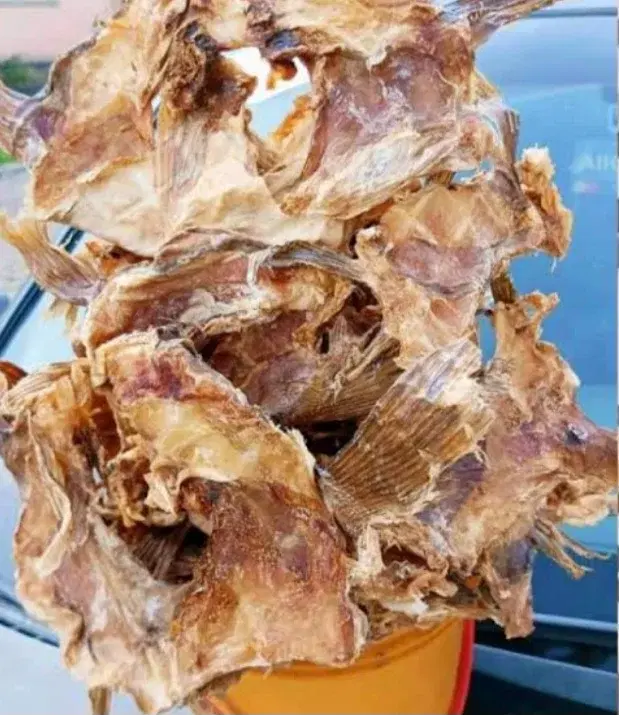
Lagos consumers are increasingly turning to stockfish heads as scarcity of stockfish continues to push up prices of the popular soup ingredient across major markets in the state.
The traders and consumers, who spoke with the News Agency of Nigeria (NAN) in separate interviews on Sunday in Lagos, attributed the development to limited supply, rising demand and distribution challenges.
NAN reports that stockfish, an important ingredient in many Nigerian soups, particularly among Igbo households, is largely imported from Iceland and Norway.
NAN reports that Nigeria remains the world’s largest importer of Norwegian stockfish, with millions of dollars’ worth shipped annually to meet the massive demand for its distinct flavour and texture in traditional soups and stews.
Traders said the product had become scarce in recent months, leading to sharp price increases across Lagos markets.
A wholesale stockfish dealer at Oyingbo Foodstuff Market, Mr Udoka Umeaku, said the increase was driven mainly by supply shortages rather than exchange rate fluctuations.
“A 30kg sack of stockfish head now sells for about N500,000, compared to N385,000 around December last year.
“From January until February, we were still selling at N385,000 before the price moved to N420,000 and gradually increased to N500,000.
“The increase is because of scarcity, not necessarily the dollar rate.
“These stockfish are shipped from Iceland and Norway, but they are not coming into the country at the moment.
“The shipment that was expected to bridge the supply gap was turned back because there was no passage to bring it into the country.
“The America-Iran war has been blamed for the disruption. As long as stockfish remains scarce, prices will continue to rise,” he said.
Umeaku, however, expressed optimism that prices would decline once supply improved.
“When the market is flooded with stockfish again, prices will come down.
“For now, only some traders have received allocations, depending on their sources. If your supplier does not have it, there is nothing you can do,” he said.
Also, the Patron, Aborigine Stockfish Sellers Association, Lagos State Chapter, Mr Orji Onuoha, attributed the price increase to scarcity, exchange rate fluctuations and the long chain of middlemen involved in distribution.
“From the importer, the stockfish passes through many middlemen before it gets to the final seller. Each person adds a profit margin, and that pushes the price higher.
“Scarcity is another major factor. Stockfish is not readily available now, and demand exceeds supply.
“Exchange rate fluctuations also contribute because stockfish is imported. Whenever the naira weakens against the dollar, import costs rise, and the effect is reflected in market prices,” he said.
A stockfish retailer at Oyingbo Market, Mrs Ugochi Nwachukwu, said the high prices had reduced the purchasing power of traders and consumers.
She said a long stockfish body now sells for N75,000 and above, compared with about N20,000 previously.
According to her, a bag of stockfish heads now sells for between N500,000 and N550,000, while the smallest piece costs about N2,000 because of scarcity.
She added that many customers now preferred stockfish heads because they were relatively cheaper than the fleshy parts.
NAN further reports that the rising cost of stockfish has altered consumers’ buying habits, with many households deliberately requesting stockfish heads because of the rich flavour they add to traditional soups.
Mrs Chika Nze said she initially bought stockfish heads because they were cheaper than the body but had continued to buy them because of the flavour they added to soups.
“It was mainly about the price then because the head was affordable.
“But after using it for some time, I discovered it gives soups a better flavour, so I now prefer it.
“Even if I can afford the fleshy part, I still look for the head because of the taste it adds,” she said.
Mrs Ifeoma Ubaeze said the increasing cost of stockfish had made it difficult for many families to prepare traditional soups.
“What is bitter leaf soup, oha soup, or white soup without okporoko?
“The price has gone up so much that many people can only buy small quantities, but we still make sure we include it because the soup is not complete without it,” she said.
Mrs Felicia Onoha said she could prepare soup without meat but not without stockfish.
“I can do without meat, but not without stockfish. It gives the soup a unique taste and aroma that meat cannot replace,” she said.
A housewife, Mrs Foluke Awe, said that, despite rising prices, stockfish remained a nutritious food with a distinctive taste.
“Many people are not even aware that stockfish is very healthy. It is rich in protein, vitamin D and essential minerals that are good for the body.
“I love the smoky taste it gives my stews and vegetable soups. It is not only delicious, it is also healthy,” she said.
A stockfish trader at Oyingbo Market, Mrs Grace Eze, said customers now request stockfish heads more frequently than other parts.
“Many customers ask for the head first. Some even come specifically for the head because they believe it gives better flavour than the body.
“When supplies are limited, the heads finish faster than the other parts,” she said.
Another trader at Lawanson Market, Mr Sunday Umeh, said the growing preference for stockfish heads had also pushed up their prices.
“The demand for the head is very high these days. Before, people preferred the body, but now many customers prefer the head for its taste.
“The high demand has also affected the price because we sell according to availability,” he said.
Mrs Asumpta Ibekwe said the rising prices had increased the cost of preparing traditional soups.
“I bought a sizeable stockfish head for N11,000 after much bargaining with the seller.
“That same size used to sell for between N6,500 and N8,000.
“I still buy stockfish because it doesn’t make sense to cook some Igbo soups without it, but I hope the price comes down soon because it is becoming too expensive,” she said.
Similarly, a food vendor at Lawanson Market, Mrs Ndidi Peters, said she had resorted to buying the bony parts of stockfish to reduce cooking costs.
“I cook in large quantities, so I buy the parts without much flesh because all I need is the flavour for the soup.
“If I continue buying the fleshy parts I used to buy before, I will have no choice but to increase the price of my food, and I do not want to drive my customers away,” she said.
Mrs Bimbo Adelaja said the rising cost of stockfish reflected the broader increase in food prices.
According to her, the prices of many food items rise periodically due to seasonal and supply challenges.
“What I do is look for alternatives. When prices come down, and the product is readily available, I buy in bulk. That’s how I cope with the rise and fall in Lagos markets,” she said.