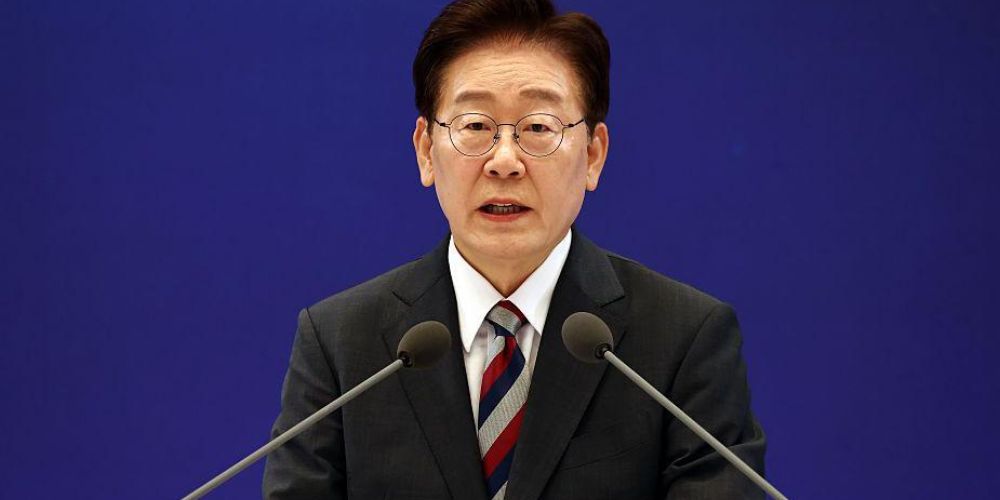
South Korea has unveiled an industrial strategy focused on semiconductors and artificial intelligence, with President Lee Jae Myung announcing investment commitments exceeding 1,000 trillion won, equivalent to more than $1tn, as the country seeks to strengthen its position in the global AI race.
Speaking alongside the leaders of Samsung Electronics and SK Hynix, the world’s two largest memory chipmakers, Lee said the initiative would centre on what he called the “triple axis” of semiconductors, physical AI and data centres. “We must secure the core elements of AI faster than any other country,” he said in a televised address.
Samsung and SK Hynix will invest 800tb won, equivalent to approximately $518bn, alongside suppliers to build four new semiconductor fabrication plants in South Korea’s comparatively underdeveloped south-west region.
Industry Minister Kim Jung-kwan said the project is intended to develop the region into the country’s second semiconductor manufacturing hub.
Samsung Group separately announced a broader 1,000tn won investment over the next decade covering AI data centres, semiconductor fabrication plants, batteries and display technology.
The company said more than 350tn won of the planned investment would be directed towards AI infrastructure, primarily data centres.
Science Minister Bae Kyung-hoon also announced plans for an additional 10-gigawatt AI data centre by 2035, although he did not disclose a separate investment figure.
The announcement comes amid surging global demand for advanced memory chips used in artificial intelligence systems.
Samsung and SK Hynix are the world’s leading suppliers of high-bandwidth memory chips, which are critical for AI training and inference, and both companies have benefited from rising demand driven by the rapid expansion of AI data centres.
The announcement drew criticism from opposition figures, who argued that the decision to locate a second semiconductor cluster in Honam, the traditional electoral stronghold of Lee’s liberal Democratic Party, was motivated by regional politics rather than industrial considerations.
Opposition lawmakers accused the government of pressuring memory chipmakers to invest in the region to strengthen political support instead of allowing companies to determine the most commercially viable locations.