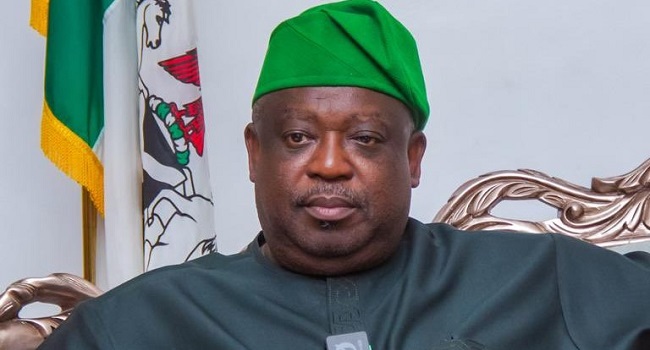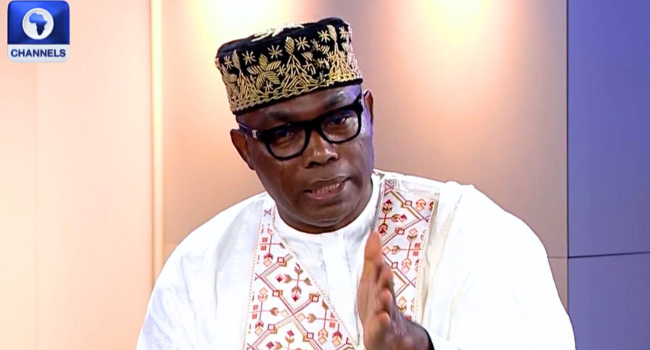
Social Democratic Party (SDP) presidential candidate, Adewole Adebayo, has defended the establishment of state police, arguing that it is a constitutional requirement in a federal system and that fears of abuse by state governors should not be used to oppose the initiative.
Adebayo made the remarks on Friday during an interview on Channels Television’s Politics Today. while responding to concerns over proposals to create state police, including suggestions that funding for the new security outfits be deducted directly from the Federation Account as a safeguard against political interference.
READ ALSO: Court Strikes Out Suit Seeking Recognition Of Turaki-Led PDP Leadership
He argued that Nigeria’s federal structure already empowers different levels of government to make laws within their constitutional jurisdictions, making it illogical for states to legislate on criminal matters without having the authority to enforce those laws through their own police services.
“The moment you have a federation, you have legislative lists given to different levels of government. It goes without saying that every level of government is authorised to police,” he said.
Questioning the reasoning behind denying states policing powers, Adebayo said it made little sense for state governments to have legislatures capable of creating criminal laws and courts to adjudicate them, while relying solely on the federal police for enforcement.
He maintained that the Constitution already contains sufficient safeguards against abuse of power through its provisions on fundamental rights, stressing that such protections apply equally to federal, state and local law enforcement agencies.
Addressing concerns that governors could misuse state police for political purposes, the SDP chieftain argued that similar risks exist at the federal level.
“If you don’t trust the governors, why would you trust the president? There are histories of a president misusing the police. So why have we not abolished the presidency or the federal police?” he asked.
According to Adebayo, policing is an inherent function of government, and every tier of government should be empowered to enforce laws within its constitutional jurisdiction.
He suggested that local government police could also be introduced to handle responsibilities such as sanitation enforcement, market regulations, traffic control and other local offences.
Drawing comparisons with other federal systems, Adebayo cited the United States, where state and city police departments operate alongside federal law enforcement agencies.
Adebayo said fears of abuse should instead be addressed through professionalism, constitutional oversight and democratic accountability rather than denying states policing powers.
“If you have a governor who is misbehaving, then you vote him out in the next election. How you abuse police, or you don’t abuse police, how you manage law enforcement, will be part of what you consider before deciding whether somebody is fit to be a governor.”
On the proposal to deduct funding for state police directly from the Federation Account, Adebayo said the arrangement would not amount to federal control but would instead guarantee stable financing for an essential public service.
He likened the proposal to existing constitutional provisions for the funding of state judiciaries, explaining that direct funding ensures resources earmarked for critical institutions are not diverted for other purposes.
“It doesn’t mean that the federal government will control. What it means is that the money is spoken for,” he said.
He added that under Nigeria’s federal system, areas of concurrent legislative responsibility are already governed by the constitutional principle of “covering the field,” under which federal legislation prevails where conflicts arise with state laws.
Adebayo said the same principle exists in other federations, including Australia, India, the United States and Canada, arguing that Nigeria should embrace the full implications of its federal structure rather than resist reforms consistent with it.