Nigerian women have always risen to global stardom through hard work, determination and grace, despite the challenges they face. BUKOLA OGUNSINA and SAMUEL ABULUDE write about the impact of Nigerian female musicians on the global stage.
With Afrobeats gaining traction worldwide, Nigerian female artists are making waves and beginning to receive the recognition they deserve on the global stage. Tems and Ayra Starr are having a significant global impact, but before them, Tiwa Savage and Yemi Alade, among others, were already on the international scene.
But the rise to stardom has not been easy, as many artistes showed great potential yet struggled because of a lack of adequate support systems and talent managers who ought to have helped them build their careers. As a result, several Nigerian women did not reach stardom.
For the female music icons being celebrated now, the journey did not begin with them but spanned decades, shaped by pioneering women.
In the beginning
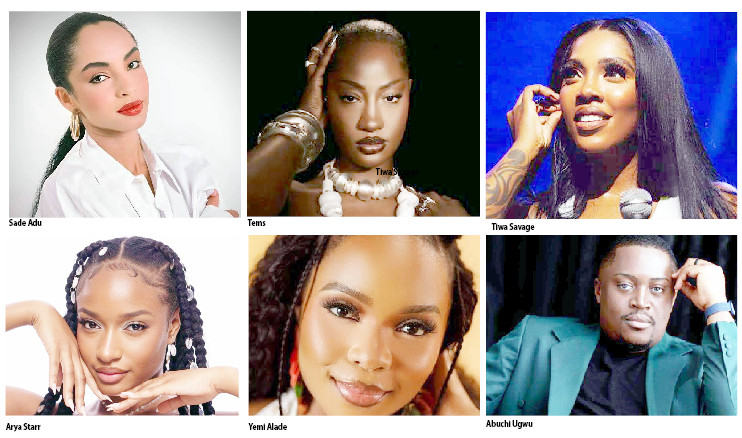
While some may argue that the ‘Sweetest Taboo’ singer, Sade Adu, is British, she is also Nigerian, as her father is from Nigeria, and she was born in Ibadan. In the 1980s, Sade Adu was regarded as the most commercially successful musician of Nigerian heritage in history. The music icon won four Grammy Awards and sold more than 50 million albums internationally.
Another Amazon, Christy Essien-Igbokwe, was regarded in her time as a force to be reckoned with. This Lady of Songs was popular in the 70s and 80s. Christy’s 1981 success ‘Seun Rere’ received international acclaim.
We also have Onyeka Onwenu, who came to prominence in the 80s with various songs, including ’One Love’, a chart-topper that became an international hit.
Lijadu Sisters, Taiwo and Kehinde Lijadu, were also popular in the 1970s and 80s for their signature blend of Afrobeat, rock, and soul, which earned them a cult following in the United States and Europe.
In the 2000s, Asa, born Bukola Elemide, and Nneka, whose full name is Nneka Lucia Egbuna, took the global stage. Asa made a breakthrough in 2007 with her self-titled album ‘Asa’. Her chart-topping song ‘Fire on the Mountain’ became an international anthem. Asa also won the prestigious French Constantin Award in 2008.
Meanwhile, Nneka, who lived mostly in Germany, became an international voice for conscious soul and hip-hop in the mid-2000s, touring with pop stars like Damian Marley and Nas.
Shining On Global Stage
In recent times, female amazons making massive success on the international scene include: Tiwa Savage, Yemi Alade, Tems, Arya Starr, among others.
While Tiwa is famously known as ‘Queen of Afrobeats’, she was the first female artist to win Best African Act at the MTV Europe Music Awards (2018). It was also an honour for her and a feather in Nigeria’s cap to be invited to perform at King Charles III’s coronation concert in 2023.
Temilade Openiyi, alias Tems, is also the first Nigerian female artist to win a Grammy (for her collaboration on “Wait For U”) and the first to debut at number one on the Billboard Hot 100. Tems was nominated for an Oscar for co-writing “Lift Me” for ‘Black Panther: Wakanda Forever’. Another great achievement was co-headlining the halftime show of the inaugural FIFA Club World Cup final last year at MetLife Stadium in New Jersey, where she performed her hit song ‘Love Me Jeje’ with Doja Cat and J Balvin.
Meanwhile, Yemi Alade is regarded as the first African female artist to reach 100 million views on a single YouTube video, ‘Johnny’. She has been a consistent force on international tours and in collaborations, including one with pop star Beyoncé.
Oyinkansola Sarah Aderibigbe, professionally known as Arya Starr, is currently making waves on the global stage. At a very young age, she received global recognition in 2022 with the release of her song ‘Rush’, which entered the music charts of several countries and earned her a Grammy nomination for Best African Music Performance.
So, what makes all these women different and able to attain such heights over such seemingly short periods?
In a chat with the Performing Musicians Association of Nigeria (PMAN) President, Pretty Okafor, he notes,” Nigerian female musicians are the total definition of soft power supremacy circle, that can stand their own anywhere in the world.
“It wasn’t just that they’re Nigerian and sing well. Lots of talented women didn’t break through. These three, Tiwa Savage, Tems and Arya Starr combined craft, branding, and catching the Afrobeats wave exactly when the world started paying attention,” he explained.
He added that Tems has a smoky, alternative Rhythm and Blues (R&B) texture that stood out globally as Afrobeats gained momentum. Tiwa brought elite pop polish and vocal power, carrying the Queen of Afro beats lane for years. At the same time, Ayra Starr hit with a Gen Z, rebellious energy and instantly catchy melodies.
In another interview, Nigerian gospel singer and songwriter Mike Abdul, who was part of the group Midnight Crew, said, “The ladies you mentioned brought distinct identities into a global sound that was already rising; they didn’t just imitate the sound.”
“They gave the world their personal experience, and the world adjusted to them.
“They proved themselves in high-calibre collaborations with artistes who were already at the top of their field, and they prevailed, refusing to be overwhelmed by the immensity of the talent they worked alongside.
They conquered intimidating venues and captivated the audience. Their strong personal branding and undeniable vocal sweetness also make them indispensable when it matters.”
“I also believe that their ability to make the algorithm favour them in the digital space draws attention to their works,’’ he added.
In a chat with Nigerian veteran singer and songwriter Stella Monye, nicknamed ‘Samba Queen’, who rose to fame in the 1980s, the big 3, consisting of Davido, Wizkid and Burna Boy, paved the way for Nigerian female artists to go global.
“I think the big 3 paved the way, and the female artistes capitalised on that, but they were also very pushful.
“The world has become a very big global arena, and people are now receptive to something new. The girls are wiser and tougher now, unlike our own time,” she remarked.
And now many wonder about the Nigerian women in the music industry who did not break into the spotlight. What happened to them?
Challenges faced by Nigerian female musicians
Veteran singer Stella Monye noted that, during her time, female artists faced myriad challenges. “First, your parents are on your back because they believe music is for bad girls. The society at large didn’t help matters. Sexual harassment is another factor, but somehow we pulled through,” she commented.
The Samba Queen also disclosed that there were not many opportunities to expand. “Let me say Naija music was not this accepted globally except for Fela’s music. But it is still the African immigrants that are still making it happen out there, followed by the oyinbo [White] friends,” she concluded.
In a chat with Latoya Aduke, singer, songwriter and dancer, and wife of the famous Afrobeat icon Orlando Julius, she says, “Folks must realise women are the portals of life. Hard to recognise in a patriarchal society. Look at us now… Nigeria alone… We have Yinka Davies. Theatre vocal power is undeniable… Who supports her? She is an International Star! But does Nigeria recognise that? Only to sing the anthem for them?”
Yinka Davies is a soul diva in her own right, having been in the industry for 28 years. She has proven her relevance in the music industry and fought for the rights of Nigerian female musicians, who are often used to fill out artist lineups on record labels.
An analyst, Isaac Daniel, noted that it’s obvious that record labels globally do not know how to position female artists, aside from flaunting their sexuality.
It is a well-known fact that record labels worldwide don’t invest as much in female artistes as they do in male artistes. The reason is that it costs more to promote a female artist than a male artist.
R&B singer, Ruby Gyang, in an interview, noted that “It costs more in the beginning to build and market the female artistes, but it’s worth it in the long haul.
“A record label needs to spend money on the appearance of the female artiste, make-up and all that and position her as a brand. And not all record labels will want to spend the money on female artists.
“Also, one of the challenges or odds is that a female artist needs to work hard and put ten times more effort than a male artist does to achieve great success in the music industry. This has been one of the issues.
“Cultural factors are one of the things that inhibit the progress of female artistes. A young female artist who needs to pursue her career as well as get married someday is being looked at by record labels or investors, as the feeling that they may not be able to recoup the funds invested in her,” she says.
In an interview with the CEO of Chocolate City Group, Abuchi Peter Ugwu, he notes that the industry has made significant progress. However, historical and structural realities still influence how investments are approached across entertainment.
“For a long time, male artistes were often viewed as more commercially predictable in certain markets, while female artistes sometimes had to navigate additional expectations around branding, image, perception, and positioning.
“Those realities have shaped investment patterns across the industry over the years. However, the landscape is evolving rapidly. Today, more female artistes are demonstrating their commercial strength, cultural influence, and long-term viability at the highest level. That success is compelling the industry to become more balanced, more competitive, and more forward-thinking,” Peter said.
Ugwu also maintained that at the end of the day, talent, vision, discipline, execution, and long-term potential should remain the foundation for investment decisions, regardless of gender. “Great talent is not limited by gender, and the industry becomes stronger when opportunities are based on value creation and excellence,” he pointed out.
Few Women Owning Record Labels
The fact that most record labels in the music industry are owned by men has, in some respects, placed women at a disadvantage.
“The challenge is largely structural, historical, and cultural. Like many industries globally, the music business has traditionally been male-dominated, limiting women’s access to funding, executive networks, mentorship, ownership opportunities, and top-level decision-making positions over time,” Ugwu said.
The record label owner also noted that, historically, in many societies, women were encouraged to focus more on domestic roles than on business leadership, which, in turn, has affected representation at ownership and executive levels across industries, including the entertainment industry.
According to him, “Building and sustaining a record label requires capital, strategic partnerships, operational discipline, long-term thinking, and institutional support. While many women have excelled creatively and professionally as artists, lawyers, managers, marketers, and executives, fewer have historically been positioned for ownership and executive leadership roles.
“That said, the industry is changing. More women are stepping into influential leadership roles across the entertainment sector, and that representation matters because it broadens perspectives, creates opportunities for younger women, and strengthens the industry as a whole.”
The Label Executive also affirmed that a stronger, more inclusive leadership ecosystem ultimately leads to a healthier, more sustainable future for African entertainment.
Successful Models
Record Labels:
The life of a musician takes passion and sacrifice, and sometimes things may not pan out as expected. As a result, the artist is compelled to succeed and make the most out of their career to have something worthwhile to fall back on.
For some female artists, co-owning a record label can help attract an audience, as industry stakeholders have noted.
Yemi Alade thrived on the platform of partnership through Effyzzie Music Group, whose CEO, Taiye Aliyu, signed her to the label in 2012. This partnership has been instrumental in her rise to international prominence as the Queen of Afrobeats.
This type of partnership focuses on building the female artist into a brand. A young artist needs a platform, a record label or music management to grow.
Also, Tems and her team have a partnership that has helped her blossom into the pop star she is today. To date, Tems and Yemi Alade each have 4 extended plays (EPs), Tiwa Savage has 2 official EPs, while Arya Starr currently has 1 EP and a 2021 project titled ‘Ayra Starr’.
Tiwa Savage has also hinted at the vital role of record labels in a recent interview on the ‘Afrobeats Intelligence podcast’. She had joined Mavin Records in 2012 before leaving in 2019 to sign with Universal Music Group.
She disclosed that she felt completely at home at her former record label, Marvin Records, owned by Don Jazzy, noting that an artist’s label plays a crucial role in their overall well-being.
The Afrobeats Queen revealed that she used to confide in Don Jazzy and her fellow label mates, a comfort she no longer enjoys at her new record label.
“Who you’re signed to is very important, and I didn’t appreciate it until after I left Mavin. Whenever there was a controversy online, I’d run to Don Jazzy’s room, sit on the floor or bed with other Mavin acts, and we would talk about it.
“I would cry if I had to cry, and we would get through it. But being with a foreign label, they don’t really care about your personal stuff. So, I can’t really go to the Empire office and cry. I miss that part of it,” she said.
Streaming Platforms
These days, streaming systems have allowed artists the freedom to distribute their music internationally without label backing. The process leverages algorithmic recommendations, curated editorial playlists, and real-time performance analytics to help musicians build and engage their fanbases.
Confirming this, the CEO of Chocolate City Group states the obvious advantages of streaming platforms.
“Streaming platforms have completely transformed the structure of the music business. In the past, artists relied heavily on radio, television, physical distribution, and traditional gatekeepers to reach large audiences. Today, platforms such as Spotify, Apple Music, Audiomack, YouTube, and TikTok provide artists with direct access to global audiences.
“An artist can release music from Lagos today and instantly reach listeners across Africa, Europe, North America, and beyond. At its core, modern music distribution is deeply tied to technology, as streaming platforms are technology companies shaping music consumption globally.
“Most importantly, streaming has accelerated the globalisation of African music and culture. Nigerian and African artistes no longer wait for permission to compete globally. The barriers are lower, the audience is larger, and the opportunity to build sustainable international careers is stronger than ever,” the Chocolate City Group CEO added.
An example is Ayra Starr. Streaming platforms led to her breakthrough on the international stage. This digital distribution has allowed her Afrobeats and R&B fusion to transcend geographical boundaries.
In modern-day marketing and promotion, there is a focus on building a fan community, and some artists have benefited from the trust and patronage of their fans.
In this aspect, Nicki Minaj’s dedicated fan base, the Barbz, is an example.
The fans are well-known for their immense, organic support, particularly in creating, promoting, and sustaining her projects through digital campaigns and massive streaming efforts.
Regarding what Chocolate City Group, as a record label, has done to support women in the past and present, the CEO said, “Chocolate City has consistently contributed to the growth, visibility, and development of female talent in the Nigerian music industry through artiste development, strategic partnerships, marketing support, distribution, and long-term career development.
“Over the years, the company has worked with and supported female artistes and creatives such as Victoria Kimani, Candy Bleakz, Ruby Gyang, and Pryse. These artists contributed significantly to the culture and helped shape important moments within African music.
“Today, inclusivity remains an important part of the company’s culture and leadership structure. The contributions of Aibee Abidoye, Executive Vice President at Chocolate City Music, and Ifeyinwa Anyadiegwu, Vice President, Legal Affairs and New Businesses at Chocolate City Group, have been instrumental in driving strategic growth, inclusion, and female representation across the business side of entertainment.
Their leadership reflects the growing importance of women occupying executive and decision-making positions across African entertainment and business.
On the artiste side, Candy Bleakz continues the company’s legacy of supporting strong female talent under the Chocolate City system.”
Ugwu notes that beyond the music, the company continues to encourage female participation across management, legal affairs, marketing, media, operations, and other areas within the creative ecosystem.
He points out that the entertainment industry becomes stronger when there is diversity in creativity, leadership, perspective, and storytelling. Inclusivity is not just important culturally but is also essential for building a sustainable, globally competitive African entertainment industry.
An entertainment enthusiast, Mallam Ibrahim Daud, believes that, in the end, female artists need more support, guidance, and acceptance to succeed in the music industry. This, according to him, will easily pave the way for them to go global and become worthy ambassadors, just as their male counterparts.
We’ve got the edge. Get real-time reports, breaking scoops, and exclusive angles delivered straight to your phone. Don’t settle for stale news. Join LEADERSHIP NEWS on WhatsApp for 24/7 updates →