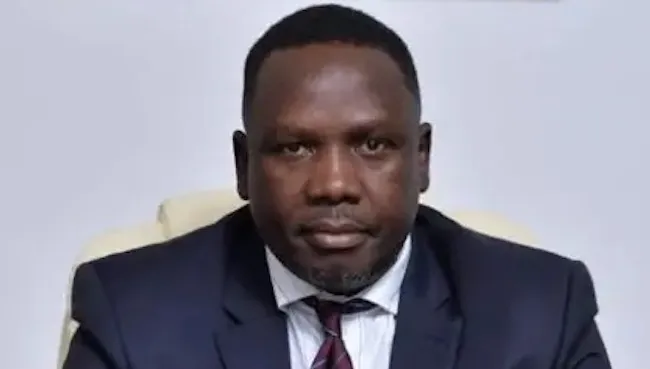
Special Adviser to the President on Policy Communications, Daniel Bwala, has stated that there is a possibility terrorists operating within Nigeria may have agents within the Nigerian Army and other security agencies in the country.
Bwala, who spoke on The Link Up Podcast, a panel discussion hosted by EchoRoom, acknowledged that isolated cases of infiltration or collaboration by individuals within the security services could not be completely ruled out.
Responding to allegations that terrorist groups may have infiltrated Nigeria’s security agencies, Bwala dismissed claims that members of the military deliberately shield terrorists during attacks, describing such allegations as speculative.
“I don’t think so. You see, that is a conjecture, except there is a live case,” he said.
“You cannot rule out the fact that they may have one or two agents in the army, anywhere else… Our police have always been arrested, and soldiers arrested involved in this kind of thing”, he said, referring to previous arrests involving security personnel, including a senior police officer allegedly apprehended alongside Chinese nationals.
Bwala argued that such incidents were not unique to Nigeria, citing former United States intelligence contractor Edward Snowden as an example of how infiltration could occur even in advanced countries.
“This will happen anywhere in the world. Snowden was a contractor to the US national security.
“These are elements that can happen, and why I didn’t want to talk much on that is because there are measures we’re taking and we don’t want people to know,” he added.
Bwala also hinted that the lingering security crisis in the country may have been influenced by external forces.
The presidential aide cited international claims and developments which he said indicate that foreign interests could be playing a role in the country’s terrorism challenge.
Bwala recalled demonstrations in parts of northern Nigeria during which protesters reportedly displayed Russian flags, describing the development as one of the indicators that Nigeria’s security challenge may have dimensions beyond its borders.
“If you remember, there was a decision the Federal Government of Nigeria made at that time, immediately we started seeing these people in Nigeria lifting Russian flags,” he said.
Some protesters in northern Nigerian states, particularly Kano, Kaduna, Zamfara and Katsina, had hoisted Russian flags during the #EndBadGovernance protests in August 2024.
Some of the protesters also chanted slogans calling for Russian President Vladimir Putin to intervene and even called for a military takeover of the government.
The presidential aide also referenced allegations made by United States Congressman, Scott Perry, during a congressional hearing, in which the lawmaker claimed that the United States Agency for International Development (USAID) funded two deadly insurgent groups, Boko Haram and the Islamic State of West African Province (ISWAP).
Although he stressed that he was neither confirming nor endorsing the allegations, Bwala said they demonstrated that discussions about possible external influence on terrorism in Nigeria had been held at the international level.
“I wouldn’t say that, but I will tell you what I saw,” Bwala said.
“When they were having the congressional hearing, I don’t know whether it is true or not, because he’s not a Nigerian, but I’m just providing facts to you, to tell you that conversations like that have gone on.
“So, me, I’m not saying he is right or he is wrong. But what I’m saying is that an event like that has occurred, and as a country we cannot hear that and say you are a liar.”
Bwala also claimed that a rivalry between the Nigerian Army and the Nigerian Air Force during former President Muhammadu Buhari’s administration weakened counterterrorism operations, with troops allegedly denied critical air support for some military missions.
According to him, disagreements between the then Chief of Air Staff and the leadership of the Nigerian Army disrupted operational coordination, resulting in situations where requests for air cover were not honoured.
“I remember during Buhari’s tenure there was this disagreement that was reported to be between the Chief of Air Staff and that of the Army, so that whenever an operation was undertaken, when they asked for air cover, there wouldn’t be support. In this administration, it is not so. There is coordination or cooperation,” Bwala said.