The Adults Have Left the Room Part 1
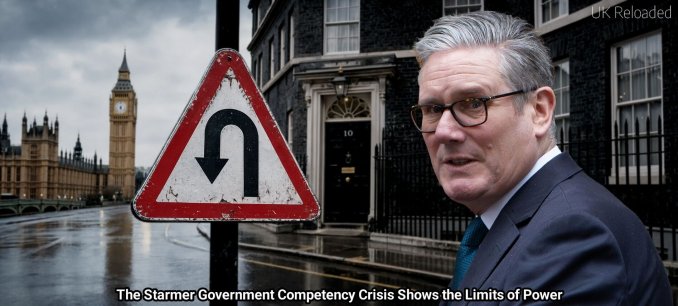
The Starmer Government competency crisis shows the limits of power, and the three-point turn of a political car crash.
ÆTHELSTAN
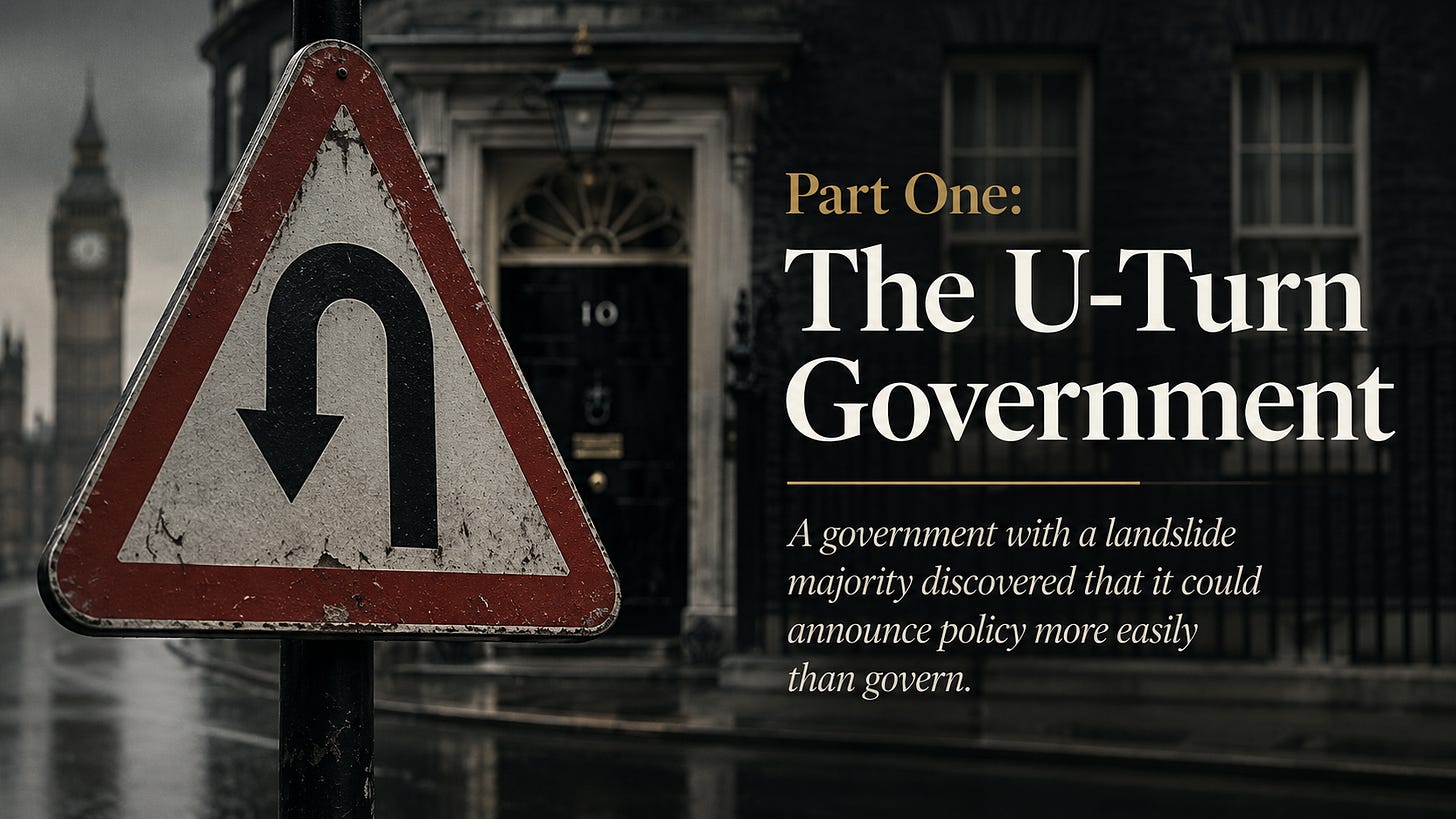
“For the first time in many of our lives, actually Britain looks like a little haven of peace and stability.” — Andrew Marr
“The adults are back in the room.” — Darren Jones, July 2024
The phrase was repeated with the smug relief of a governing class returning to its natural habitat. The adults were back in the room. The grown-ups had re-entered the nursery after the Conservative years of Johnsonian vaudeville, Truss combustion and Sunak managed retreat. Britain, we were told, had once again become a haven of peace and stability. The circus had left town. The lawyers, mandarins, special advisers, institutional loyalists and permanent policy class could return to the work of serious government.
Less than two years later, Keir Starmer’s resignation turned that sentence into an epitaph. The adults had not merely left the room. The more unsettling possibility is that they had entered it without knowing what adulthood in government required. They knew the vocabulary of seriousness, but not the grammar of authority. They knew how to diagnose the broken country, but not how to repair it. They knew how to remove the Conservatives, but not how to govern the Britain that Conservative failure had exposed and Labour orthodoxy had helped to create.
Starmer’s fall should not be reduced to one bad decision, one hostile press cycle, one rebellious parliamentary party, or one unfortunate speech. There were dozens of examples, but these were symptoms, not causes. His premiership collapsed because every major episode revealed the same structural weakness in a different register. Domestic policy showed a government that could not hold a line. Political communication showed a government that could not describe the country without apologising for its own description. Foreign policy showed a Prime Minister larping as the leader of an anti-Trump, continuity-globalist project without the money, military strength or national confidence to sustain the performance.
This is why the period has the shape of an obvious political car crash. First came the skid: U-turn government, welfare retreat, winter fuel panic, stretched fiscal rules, and the modern British state revealed as both overmighty and underpowered.
Then came the impact: the misreading of the Southport murders and their aftermath, the preoccupation with punitive responses to disordered social-media commentary while managing the delayed Rudakubana disclosures, then the immigration speech, the phrase about “an island of strangers”, which resonated with a large section of the public but not with the parliamentary party, and the retreat from the very language of national cohesion the government had briefly tried to borrow.
Finally came the wreckage: geopolitical LARPing, the Coalition of the Willing, Ukraine, and the defence-spending debacle in which strategic ambition collided with empty coffers, manpower shortages, munitions shortages, frigate shortages, an unreliable aircraft carrier, and an industrial and economic base unable to generate the tax receipts required to finance serious military hard power.
There were achievements, or at least claimed achievements. Labour retained an enormous parliamentary majority. Inflation continued to ease. Financial markets did not experience another Truss-style convulsion — yet. NHS appointments increased. Workers’ rights legislation advanced. Relations with European allies became more predictable. These are not nothing. But they did not amount to a governing settlement. They were islands of administrative progress inside a wider sea of drift.
And each had its downside: contested NHS waiting-list improvements, spiralling youth unemployment as employers became more cautious about taking on inexperienced staff under new employment protections, and an unnecessary clash with a White House that wanted a workable transatlantic relationship, potential economic growth and a more favourable tariff regime. The central fact remained: Starmer correctly identified many of Britain’s problems and then governed as though naming them was a substitute for overcoming them.
The tragedy, if tragedy is not too grand a word for this grey episode, is that he was often right about the diagnosis. Britain is overtaxed, overregulated, indebted, administratively clogged, demographically strained, energy-poor, infrastructure-poor and increasingly unable to translate political promises into material outcomes. Public services consume more and satisfy less. The state intrudes everywhere and delivers slowly.
Yet Starmer entered office still loyal to many of the same bipartisan macro-assumptions that had helped produce the crisis: high migration as economic lubricant, net zero as civilisational mission, welfare expansion as compassion, institutional process as legitimacy, and international posturing as moral leadership.
Above all, he made John Major look dynamic. Starmer’s contribution to Prime Minister’s Questions eventually consisted in not answering the question at all. He had no rapport, no connection with the public mood, and even his empathy seemed forced. From the get-go, he appeared to regard almost anything centre-right as the far Right, thereby placing much of the electorate outside the boundaries of respectable concern.
So the car did not crash because the driver failed to spot the wall. It crashed because he could see the wall, describe the wall, convene a task force on the wall, commission a review of wall-avoidance, and remain committed to the road system and policy sat-nav that led directly into it.
He had to go because the Labour Parliamentary Party eventually concluded that anyone but Starmer might give it a squeak of a chance of surviving the pending 2029 electoral reckoning. Yet this, too, was an evasion. Many of those most eager to remove him had not looked seriously at their own excesses, priorities or self-indulgence. The fault was not only in Starmer’s manner, but in a Labour coalition increasingly unable to distinguish moral theatre from political survival.
The first stage of the crash was domestic. A government elected to restore order managed to make even administrative corrections appear improvised, cruel, unstable and reversible. The pattern soon became familiar: announce a hard decision, present it as unavoidable, allow the moral and parliamentary backlash to build, then reverse or dilute the policy while insisting that the principle remained intact. It was not listening. It was government by recoil.
There is a legitimate defence of U-turns. Circumstances change. Evidence improves. Parliament exists to test ministers. A government that never revises policy is usually either authoritarian or stupid. But the Starmer U-turns had a different quality. They did not look like mature corrections. They looked like a governing class discovering, after the event, whether it possessed a constituency for the thing it had just announced.
The winter fuel payment decision was the first emblem. Here, fiscal seriousness was translated into symbolic clumsiness. A payment associated with old age, cold homes, post-war social obligation and the memory of thrift was treated as a spreadsheet item. The original cut restricted the payment to the poorest pensioners. The reversal restored it to millions, excluding only those with incomes above a much higher threshold. In policy terms, this was an adjustment. In political terms, it was the moment many voters first saw the gap between Labour’s language of compassion and the Treasury’s instinct for administrative neatness. The “black hole” spin made it look less like fiscal discipline and more like a desperate lurch.
The amounts were not vast in national accounting terms: the familiar £200 or £300 per household per year. But politics is not conducted in the neutral air of accounting. It is conducted inside memory. Pensioners do not experience winter fuel as an isolated payment code. They experience it alongside council tax, food prices, energy bills, GP access, hospital waiting lists, the cost of keeping a car on a pot-holed road, and the slow humiliation of discovering that after a lifetime of work their prudence has made them just wealthy enough to be excluded from help and not wealthy enough to be secure. The policy was an offence against the political imagination before it was a fiscal error. Other sections of the population wondered whether their own dwindling disposable income would be targeted next.
The welfare retreat was more damaging because it touched the central contradiction of Labour in power. Britain has an unsustainable welfare settlement. The long-term sickness register has swollen. The tax base is exhausted. The working population is asked to carry a benefits system that traps some people outside work while failing others who genuinely cannot work. Any serious government must confront this. But a Labour government also depends upon MPs, activists, charities, campaigners, lawyers and moral entrepreneurs for whom almost any reduction in entitlement becomes an assault on the vulnerable.
Starmer tried to split the difference and discovered there was no middle ground. The government presented its Personal Independence Payment and sickness benefit reforms as matters of discipline, compassion and fiscal necessity. Then the rebellion came. More than a hundred Labour MPs resisted. Existing claimants were protected. The most controversial eligibility changes were pushed into review or removed from immediate effect.
The legislation limped through, but the savings were shredded, and the authority of the Prime Minister was diminished. Worse, ministers, junior ministers and loyal backbenchers who had supported the government and faced down the rebellion were betrayed by the turnaround. The worst parliamentary victory is the victory that tells everyone you are no longer committed to the necessary but unpopular policy you asked them to defend.
This was not merely a problem of party management. It revealed a deeper incompatibility between diagnosis and coalition-building. Starmer wanted to say that the welfare state required reform. His party wanted to hear that the welfare state required more money. He wanted to prove fiscal credibility. His backbenchers wanted to prove moral credibility. The Treasury wanted savings. The Labour movement wanted insulation from the charge of cruelty. The result was neither reform nor reassurance, but a policy corpse dragged through the division lobbies.
The same pattern appeared elsewhere: grooming-gangs inquiry resistance followed by concession; immigration enforcement rhetoric followed by increasing small-boat arrivals; business taxation and investment language followed by National Insurance rises that pushed the economy towards virtual recession; fiscal rules altered while ministers talked of restraint; local government restructuring and election-timing proposals reopened under pressure.
Each episode was different, but the cumulative effect was the same. A large majority began to look less like an empowering juggernaut of necessary change, as it had been for Thatcher after 1983 and Blair after 1997, and more like an out-of-control acceleration towards a debt-bond market denouement.
“My experience now as Prime Minister is of frustration that every time I go to pull a lever, there are a whole bunch of regulations, consultations and arm’s-length bodies that mean that the action from pulling the lever to delivery is longer than I think it ought to be…
“We have so many checks and balances and consultations and regulations and arm’s-length bodies… Every time something has gone wrong in the past, successive Governments have put in place another procedure, another body or another consultation…”
Keir Starmer, Liaison Committee evidence session, House of Commons, 15 December 2025
The modern British state is indeed both sclerotic and self-protecting. It has quangos, regulators, courts, agencies, ombudsmen, consultation duties, impact assessments, risks of judicial review, procurement labyrinths, and institutional memories of every previous scandal. It can prevent elected ministers from moving quickly without necessarily being capable of delivering anything useful itself.
But a Prime Minister does not earn much sympathy for discovering the state after becoming responsible for it. New Labour understood preparation. Blair entered office with a governing machine, a communications doctrine, a moral vocabulary and a ruthlessly pragmatic instinct for Middle England. Starmer entered office with a critique of Tory failure and a belief that decency plus process would somehow convert into delivery. The easy bit was getting into government. The hard bit was changing the country.
The government, therefore, fell into the central paradox of the contemporary managerial centre. It believes in the state but cannot command it. It distrusts the market but depends upon it for growth. It invokes compassion but cannot afford the welfare consequences of its own language. It praises working people while taxing and regulating working conditions and stifling opportunities for entrepreneurship, small businesses and the young. It says public services are broken but remains reluctant to offend the very institutional cultures that preside over their failure.
So Part One of the crash is not simply that Starmer was weak. The more important point is that the political settlement he represented had run out of executable politics. Every serious correction required offending some combination of pensioners, disabled claimants, Labour MPs, charities, bond markets, public-sector interests, legal activists, employers, international institutions, or the regime’s own moral vocabulary. The Prime Minister had a majority, but it was trapped in a culture of vetoes. The car began to skid because every turn of the wheel met institutional resistance from the road itself.
*
Appendix
Starmer Government:
Key Stages, Setbacks and Turnarounds
Summer-Autumn 2024
· “The inheritance is worse than we thought” / black-hole narrative and Britain-is-broken messaging leads businesses to pause investment plans and growth to stall.
· Growing perception that Labour was talking down the economy rather than preparing the country for disciplined renewal.
· Early concerns over tax rises and the gap between campaign reassurance and fiscal reality.
· Shortly after the Chapeltown rioting, Starmer was seen as mishandling the immediate aftermath of the Southport atrocities.
· Starmer seemed unable to channel the country’s grief, fear and anger into a credible account of state failure, public safety, and national cohesion
· The government saw protests over the killings as illegitimate and “far right”, contrasted with the tolerance for the highly provocative demonstrations in London in support of Palestine and Hamas.
· And whilst condemning violent disorder forcefully, the Police in Birmingham explicitly stated that armed Muslim vigilantes were “protecting their communities”.
· The emphasis on disinformation and social-media regulation and a crackdown on social media tweets with some harsh sentences (Lucy Connolly case) and the journalist Allison Pearson case.
· Early emergence of the “two-tier justice” charge: Southport and the subsequent disorder created a durable perception that policing, public condemnation and elite moral interpretation were not being applied evenly.
· Two-child benefit cap rebellion and suspension of seven Labour MPs: an early sign that a large Commons majority did not remove internal party-management problems.
· Prisons, courts and public-order capacity pressures, including early prisoner-release measures, exposed the difference between announcing severity and possessing the institutional machinery to sustain it.
· Lord Alli / donor / freebies row, damaging because it coincided with restraint language and Winter Fuel Payment cuts.
· Sue Gray resignation and No 10 operation reset, exposing early dysfunction inside the governing machine.
· Chagos sovereignty deal began as a slow-burn sovereignty and security controversy.
· First Reeves Budget: major tax rises and a decisive shift from campaign restraint to high-tax governing reality.
Autumn-Winter 2024
· Winter Fuel Payment cuts.
· Rising concern over welfare changes.
· Business concern regarding taxation and employer National Insurance.
· Growing feeling that Labour lacked a positive economic narrative.
· Family farm inheritance tax backlash, giving rural opposition an early organising issue.
· WASPI compensation refusal, adding another pensioner grievance after Winter Fuel.
· Louise Haigh resignation as Transport Secretary, reinforcing judgment and vetting concerns.
· Private school VAT implementation concerns, including questions over pace, practicality and political symbolism.
· Indefinite puberty-blocker ban for under-18s: a medical-safety decision with wider cultural and Labour-internal consequences.
· Chagos controversy continued as a symbol of a government treating sovereignty as a managed process rather than a settled national interest.
Early 2025
· Welfare and PIP reform disputes.
· Immigration concerns.
· Continued weak growth.
· First signs of Reform UK overtaking Labour in some polls.
· Abolition of NHS England announced as a major state-reform measure: a claimed turnaround on bureaucracy but also a risky reorganisation of a strained service.
· Southport returned to the surface through questions over Prevent, safeguarding and institutional failure, sharpening criticism of the government’s initial framing.
· Grooming gangs pressure intensified before the full national inquiry U-turn, turning institutional silence into a central trust issue.
· Sex and gender retreat crystallised after legal and political pressure, with elite language being forced back towards ordinary biological reality.
· The government’s collision with the permanent state became visible: regulators, quangos, courts, arm’s-length bodies and Whitehall processes limited ministerial agency.
Spring 2025
· Temporary improvement following international statesmanship and the Trump/Ukraine diplomacy period.
· Polling briefly recovered before falling again.
· Runcorn and Helsby by-election loss to Reform, providing dramatic evidence that Reform could damage Labour directly.
· Reform’s wider local-election advance reframed the threat from Conservative recovery to populist insurgency against both main parties.
· Immigration White Paper and “island of strangers” speech: an attempt to speak in the language of borders, belonging and national cohesion.
· Retreat from the “island of strangers” wording, converting the speech from strategic repositioning into communication recoil.
· UK-India trade deal: a genuine claimed success, but politically sensitive around mobility and domestic industry.
· UK-EU reset on trade, defence, fisheries and youth mobility: a diplomatic success for supporters, but vulnerable to sovereignty and Brexit critiques.
· The government increasingly appeared to want border control without exclusion, belonging without inheritance and national cohesion without a thick account of the nation.
Summer 2025
· Grooming gangs national inquiry U-turn after months of resistance; this belongs in the main chronology, not as a minor supporting example.
· Welfare/PIP rebellion and climbdown, followed by suspensions of Labour MPs involved in organising opposition.
· Winter Fuel Payment U-turn signalled after electoral setbacks, reinforcing the pattern of policy reversal under pressure.
· Rachel Reeves appeared tearful/visibly upset at PMQs after the welfare reversal; Downing Street had to insist she was going nowhere, while market moves reflected concern that fiscal discipline might be weakening.
· The Reeves PMQs episode became a symbolic moment because a Chancellor associated with fiscal rules was visibly under pressure at the same time as the welfare savings collapsed.
· NHS 10-year plan launched: a claimed reform success, but still competing with public scepticism about whether improvements were being felt.
· Palestinian statehood decision announced under hostage controversy, exposing the government to charges that symbolic recognition was being advanced before all hostages had been released.
· Foreign-policy moral positioning began to outrun strategic leverage: Palestine, Ukraine and Iran increasingly exposed the distance between statement-making and practical power.
Late 2025
· Budget controversy.
· Record-low favourability ratings.
· Taxation concerns.
· Growing dissatisfaction among Labour voters themselves.
· Formal recognition of a Palestinian state while hostages were still being held, creating diplomatic strain with Israel and criticism from hostage families and the Trump administration.
· US-Israel-UK diplomatic strain over Palestine: this became not only a Middle East issue but a domestic political trust issue.
· After Angela Rayner is forced to resign over non-payment of tax in a housing purchase, Starmer’s cabinet reshuffle, to demonstrate grip and control, highlights the opposite when Ed Miliband refused to move from Energy and Net Zero to Housing
· November Budget tax package and continuing argument that tax rises were funding welfare expansion rather than productive growth.
· Two-child benefit cap lifted, a victory for Labour’s left and anti-poverty campaigners but fiscally awkward after earlier discipline of rebel MPs.
· Workers’ rights dilution, including retreat from full day-one unfair-dismissal protection, weakening one of Labour’s clearest ideological dividing lines with the Conservatives.
· Labour polling collapse became measurable rather than anecdotal, with Reform leads and historically poor satisfaction ratings.
Early 2026
· Reform surge.
· Welfare rebellion.
· U-turns accumulate.
· Questions over leadership authority.
· Mandelson / Epstein / vetting scandal, including questions over what Starmer and officials knew.
· McSweeney resignation and later admission that Labour had not properly prepared for government.
· Chagos ratification row continued, keeping sovereignty and consultation questions alive.
· Iran war / US request to use British bases: initial prevarication over legality and alliance obligations, followed by approval of US use of British bases for strikes on Iranian missile sites.
· Leak from the National Security Council over the US base request, exposing division inside government and raising special-relationship concerns.
· Prevarication over Iran exposed the central Part Three problem: Britain wanted to preserve American protection while avoiding clear ownership of escalation.
· Trump relationship deteriorated over immigration, energy and crime, linking foreign policy, migration and net zero to the collapse of Starmer’s international aura.
· China-policy wobble and Trump criticism of UK dealings with China added to the sense that the government’s foreign policy was steadier than Conservative turbulence but not strategically deeper.
May-June 2026
· Local election losses.
· Calls for resignation.
· Burnham leadership speculation.
· Mandelson controversy continued to corrode trust in judgment and vetting.
· Collapse in confidence among MPs.
· Defence ministry resignations.
· Makerfield by-election and Burnham’s return to Parliament, turning leadership speculation into a practical succession route.
· Starmer resignation announcement less than two years after the landslide.
· Post-resignation transition controversy: Burnham ruled out an early general election and indicated he would govern from the 2024 manifesto, giving opponents a democratic-legitimacy line of attack.
· Defence Investment Plan funding gap: the problem was not merely ministerial resignation but the exposure of a defence plan that appeared unfunded or underfunded.
· Trump’s public dismissal of Starmer over energy, immigration and crime became an external humiliation point.
· Strategic overreach: Ukraine, Iran and defence collided with fiscal reality. Britain spoke like a great power while lacking the fiscal, military and industrial means to underwrite its commitments.
· Chagos, Palestine, Iran and Ukraine converged into one sovereignty-and-capacity story: internationalism returned, but internationalism was not the same as capacity.