• Collapsed pedestrian bridge brings anguish to Ibadan communities
• We’re working hard to fix broken bridge, council says
By Oluseye Ojo
For more than two decades, it was simply a bridge. Every morning, schoolchildren hurried across it with backpacks bouncing on their shoulders.
Civil servants crossed it on their way to work. Petty traders wheeled their wares to nearby markets. Pregnant women, nursing mothers and elderly residents relied on it to access healthcare facilities.
Artisans, students and worshippers traversed it almost without a second thought.
The pedestrian bridge over the Yemoja Stream was not a grand engineering masterpiece. It was modest, functional and dependable.
It was the shortest and safest link between Apata and Barika communities in Agbowo, under Aare Latosa Local Council Development Area (LCDA) in Ibadan North Local Government Area of Oyo State. As gathered, the bridge served thousands of lives every day.
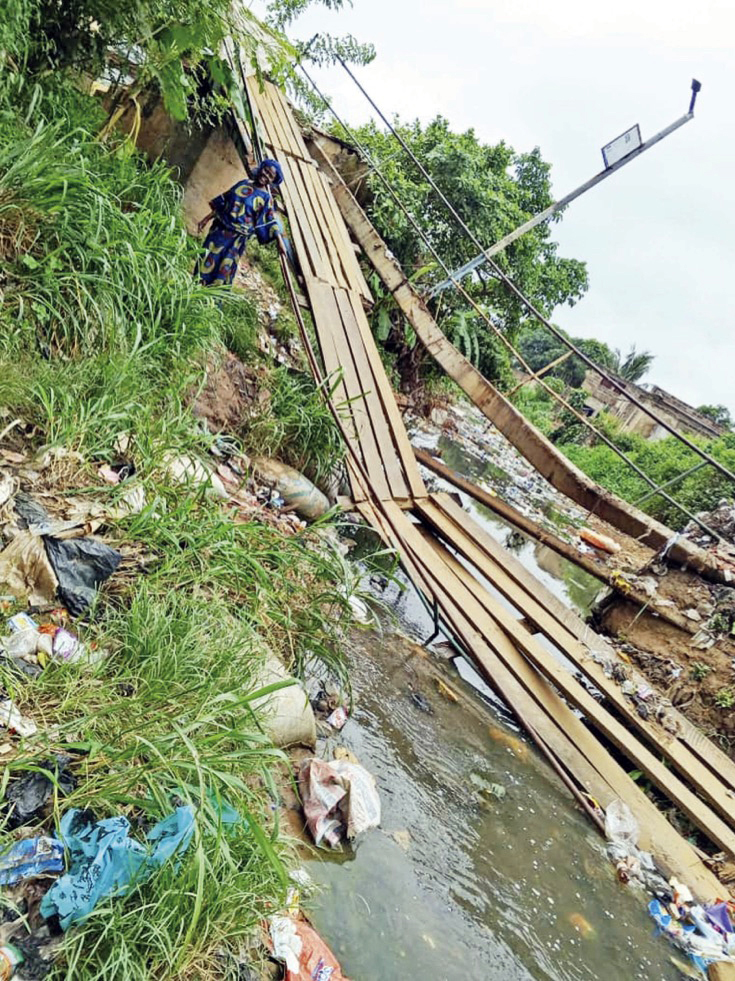
But today, the bridge lies in ruins.
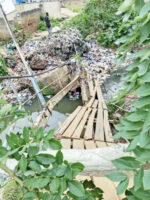
Broken concrete slabs hang precariously over the stream. Twisted reinforcement rods protrude from fractured edges.
Floodwaters have washed away much of the structure, while refuse and thick vegetation now occupy what was once a busy pedestrian corridor.
The collapse of the bridge following heavy rainfall in late May and early June 2026 has turned everyday life into a struggle for residents.
For the people of Apata and Barika, the broken bridge represents far more than damaged infrastructure. It has become a symbol of interrupted livelihoods, disrupted education, limited healthcare access and the growing burden of economic hardship.
Leaders of Barika and Apata stated that the bridge was sustained by community sacrifice. According to them, the story of the Yemoja Stream Bridge is unlike many others across Nigeria.
For years, the communities did not wait helplessly for government intervention. Available documents obtained by this reporter showed that the residents of Apata and Barika jointly maintained the bridge for over 20 years after its construction.
Whenever erosion weakened portions of the structure, community leaders mobilised residents to contribute money for repairs. But they noted that on some occasions, Ibadan North Local Government provided some assistance. Well-meaning individuals also donated towards rehabilitation at different times.
But the responsibility, it was revealed, largely rested on the shoulders of the two communities. The last major rehabilitation was carried out in early 2025.
The community leaders disclosed in their letter that the exercise cost approximately ₦1.4million, towards keeping the bridge functional then.
They explained that repairs became increasingly frequent because the Yemoja Stream had continued to expand year after year, gradually weakening the bridge’s foundation.
The leaders admitted that despite repeated interventions, residents knew they were fighting a lost battle because nature eventually prevailed.
Following heavy rainfall in late May and early June this year, one section of the bridge sank before the entire structure collapsed.
The force of the floodwaters washed away much of the construction materials, while scavengers reportedly removed some of the remaining components.
What remains today is only a shadow of what once served as a connection between the two communities.
It was stated further that the shortest route has turned to the longest journey. The collapse instantly altered daily routines. Journeys that once took only a few minutes now require lengthy detours through Agbowo Express Road, the University of Ibadan Main Gate to Barika or Orogun before reconnecting to destinations near the University’s Second Gate.
For many residents, the additional transport cost may appear insignificant in isolation. If they are added up over weeks and months, however, it would become another financial burden in an economy already battered by inflation and rising living costs.
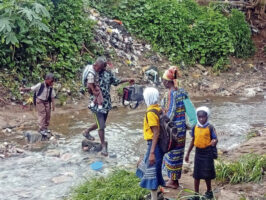
Those who cannot afford commercial transportation are left with only one dangerous alternative, which is to cross the polluted stream beneath the collapsed bridge.
The letters submitted by the communities to the government acknowledged that the bridge was used daily by schoolchildren, government workers, petty traders, artisans and other residents,
The absence of the bridge, the letters stated, has disrupted virtually every aspect of life. Schoolchildren, it was stated, have been paying the highest price. For many pupils in Apata and Barika, however, punctuality has become an almost impossible target.
President of the Agbowo Landlords/Landladies Association, Alhaji Dikirullahi Ayansola Alayande, said the communities did everything within their means to prevent the disaster.
According to him, residents of Agbowo, Apata and Barika contributed nearly N2million several years ago to reinforce the ageing bridge after signs of structural weakness emerged.
He added that every household made financial contributions in instalments, while community committees supervised the rehabilitation.
“We believed we had done our best. But nature eventually won. The bridge has existed for more than 25 years. Water is powerful enough to uproot trees. Unfortunately, it finally collapsed.
“Whenever heavy rain falls, crossing the stream becomes impossible. This is why we need an urgent intervention from the government,” Alayande stated.
He disclosed that one of the community leaders, Alhaji Adewale Raji, had earlier warned that the bridge had begun tilting dangerously to one side.
Another resident of Barika, Mrs Comfort Dominic Abdullahi, said she experiences the reality every school day. She explained that taking her children to school has become an exhausting routine, involving multiple transport connections instead of a simple walk across the bridge.
Rather than crossing the Yemoja Stream directly, she now travels through Agbowo Express Road to the University of Ibadan Main Gate before reconnecting to Barika near the UI Second Gate.
“The distance is affecting the punctuality of my children in school. They now arrive late almost every school day. I take them to school. I don’t like them going late, and it is becoming deeply embarrassing. The longer journey also means higher transportation costs.
“Like many families, I have chosen between spending more money or exposing my children to unnecessary danger by crossing the polluted stream on foot.
“I watched with concern as some parents allow their children to cross through the stream beneath the broken bridge. The sight worries me deeply.
“Imagine a downpour while they are halfway across. It’s a disaster waiting to happen,” she stated.
For another resident, Mrs Aminat Ibrahim, the collapse has introduced another painful reality. She has four school-age children. Before the bridge collapsed, getting them to school was relatively straightforward.
But these days, transportation costs have become almost unbearable, saying: “I have four children. They cannot attend school regularly now because transportation through the alternative routes is just too expensive.”
Although she occasionally waded through the stream herself, she refused to allow her children to do the same.
“I can manage to cross the water because I am an adult. But I cannot allow my children to pass through that dirty stream,” she said.
The bridge also played an important role in healthcare delivery. Residents revealed that the bridge, before it collapsed, provided the quickest route to nearby two primary healthcare facilities in Barika and Apata. Its collapse has increased the distance between patients and medical care.
Pregnant women now travel farther for antenatal appointments. Nursing mothers spend more money reaching clinics. Parents carrying sick children endure longer journeys. The elderly face additional physical strain.
Community leaders fear that emergency situations could prove disastrous. A woman in labour or a critically ill patient can no longer rely on the shortest route.
They expressed concerns that during periods of heavy rainfall, crossing the stream would become virtually impossible. In such moments, they stated that every additional minute matters.
It was further gathered that the impact of the collapsed neighbourhood pedestrian bridge extends beyond schools and hospitals. Petty traders who depended on pedestrian traffic now spend more on transportation.
Also, civil servants leave home earlier to arrive at work on time. Artisans lose productive hours each day.
Perhaps the most disturbing aspect of the collapse is that residents insist it could have been prevented.
Alhaji Dikirullahi Ayansola Alayande, Project Coordinator of the Apata/Barika Development Committee and President of Agbowo Central, said warning signs had been visible long before the bridge eventually failed.
The communities watched the stream widen gradually over the years.
They noticed erosion eating away at the bridge’s supports. Instead of waiting for government intervention, they repeatedly organised repairs.
“We believed we had done our best. But water is powerful enough to uproot trees. Eventually, the bridge began tilting until it finally collapsed,” he said.
The community leaders have admitted that reconstruction has gone beyond what local residents could finance.
Their petitions specifically called for total reconstruction. What the communities require, they insisted, is a professionally engineered bridge, capable of withstanding seasonal flooding for many years.
The collapse did not leave residents silent. Copies of petitions made available to this reporter showed that the Apata/Barika Development Committee formally wrote to the Executive Chairman of Ibadan North Local Government on July 1, 2026, requesting the complete reconstruction of the bridge.
Separate copies were submitted to the Political Head and Administration of Aare Latosa LCDA as well as the Director of Works of Ibadan North Local Government.
Official acknowledgement stamps on the documents confirmed that the petitions were received.
In the letters jointly signed by Chief Folorunso Aiyelagbe, Chairman of Barika Community; Chief M.O. Mojoyinola (JP), Chairman of Apata Community and Joint Community Chairman; and Alhaji S.A. Alayande, Project Coordinator and current President of Agbowo Central, explained that the bridge served schoolchildren, government workers, petty traders and numerous other residents.
Despite the petitions and repeated appeals, reconstruction has yet to commence. Weeks after the collapse, the broken bridge remains exactly where it fell. Each passing rainfall further erodes the surrounding land.
Residents fear that continued delay might encourage desperate commuters to attempt dangerous crossings through the stream.
When contacted, the Head of Information and Public Relations Unit of Aare Latosa LCDA, Fatimah Fadipe, confirmed that the council was aware of the situation.
She said officials had inspected the site and assured residents that implementation would commence soon.