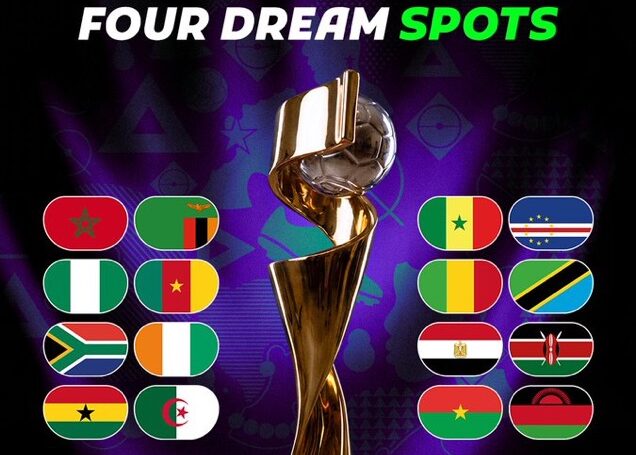

The stage is set for the biggest Women’s Africa Cup of Nations (WAFCON) in history as 16 of Africa’s finest national teams converge on Morocco for the 2026 edition of the continental showpiece.
Running from 26 July to 16 August, the tournament is more than just a battle for African supremacy. With qualification for the 2027 FIFA Women’s World Cup in Brazil on the line, every match carries enormous significance.
For defending champions Nigeria’s Super Falcons, the mission is straightforward: retain their crown and extend their unrivalled dominance with an 11th continental title. For the remaining 15 nations, Morocco 2026 presents an opportunity to rewrite history.
A bigger tournament, bigger stakes
The 14th edition of the Women’s Africa Cup of Nations ushers in a new era after CAF expanded the competition from 12 to 16 teams for the first time.
The participating nations have been divided into four groups of four, with the top two teams in each group progressing to the quarter-finals.

Morocco will host the tournament for a third consecutive edition, having become the home of African women’s football in recent years.
Nigeria arrive as defending champions and the most decorated nation in the competition’s history, while South Africa remain the only other former champions in this year’s field.
Two nations, Malawi and Cape Verde, will make their long-awaited WAFCON debuts, adding fresh storylines to an already fascinating tournament.
Stadiums ready for Africa’s biggest Women’s Football festival
The championship will be staged across Rabat and Casablanca.
In Rabat, matches will take place at the Moulay El Hassan Stadium, Rabat Olympic Stadium, and Al Medina Stadium, while Casablanca will host fixtures at the Moulay Rachid Stadium and Larbi Zaouli Stadium.

Group A: Hosts Morocco eye third time lucky
Morocco
Few teams have improved as dramatically as Morocco over the past four years.
The Atlas Lionesses have reached the finals of the last two WAFCON tournaments but have twice fallen agonisingly short. They lost to South Africa in the 2022 final before surrendering a two-goal lead against Nigeria in the 2024 final, eventually losing 3-2.
Backed by passionate home support once again, Morocco will believe this could finally be the year they lift their maiden continental title.
Algeria
Algeria quietly impressed at the previous tournament, reaching the quarter-finals without conceding a goal in open play or extra time before their eventual elimination.
Another knockout appearance will be the minimum expectation, while their North African derby against Morocco promises to be one of the standout fixtures of the group stage.
Senegal
The Teranga Lionesses have become one of Africa’s most consistent performers, reaching the quarter-finals at each of the last two editions.
Now armed with valuable tournament experience, Senegal will target another place in the knockout rounds.
Kenya
The Harambee Starlets return to WAFCON for the first time since 2016.
Although drawn into a difficult group, their qualification marks an important milestone as they seek to re-establish themselves among Africa’s elite women’s teams.

Group B: South Africa lead a competitive quartet
South Africa
Former champions South Africa arrive among the favourites.
Desiree Ellis’ side welcome back star striker Thembi Kgatlana, who missed the previous edition, as Banyana Banyana seek to reclaim the title they won in 2022 after settling for fourth place last time out.
Côte d’Ivoire
The Elephants enjoyed their finest WAFCON campaign in 2014 when they finished third after defeating South Africa, a result that secured their maiden FIFA Women’s World Cup qualification.
Now making only their third appearance at the finals, Côte d’Ivoire hope to recreate that magic.
Burkina Faso
The Lady Stallions return for just their second WAFCON after featuring in the 2022 edition.
Their ambition is simple: to move beyond the group stage and establish themselves among the continent’s emerging powers.
Tanzania
After ending a 15-year absence by qualifying for the previous edition, Tanzania continue their steady rise.
Making their third appearance overall, the Twiga Stars will aim to reach the knockout rounds for the first time.

Group C: Super Falcons target historic 11th CroCrownigeria
No nation commands greater respect in African women’s football than Nigeria.
The Super Falcons have won 10 WAFCON titles, reached at least the semi-finals in every tournament since the competition’s official launch in 1998, and reclaimed the crown by defeating hosts Morocco in the dramatic 2024 final.
Another triumph in Morocco would further cement Nigeria’s status as Africa’s undisputed queen.
Zambia
The Copper Queens continue to close the gap on the continent’s traditional heavyweights.
Third-place finishers in 2022 and quarter-finalists in 2024, Zambia possess one of Africa’s most dangerous attacking units and will believe their first continental title is within reach.
Egypt
Egypt return after a decade-long absence.
Having exited at the group stage in both of their previous appearances in 1998 and 2016, the Pharaohs will be determined to make history by reaching the knockout rounds.
Malawi
The Scorchers make their historic WAFCON debut.
Inspired by sisters Tabitha and Temwa Chawinga, Malawi’s fearless attacking style could make them one of the tournament’s surprise packages.

Group D: Experience meets new ambition
Ghana
Three-time runners-up Ghana remain one of Africa’s biggest underachievers at WAFCON.
After missing the 2022 edition, the Black Queens bounced back with a bronze medal in 2024 and will hope to finally end their long wait for a maiden continental title.
Cameroon
Cameroon have consistently ranked among Africa’s elite.
The Indomitable Lionesses have missed only one edition since 1998, reached three finals and finished outside the top four just once.
Their pedigree makes them genuine contenders once again.
Mali
Mali continue to grow in stature.
Semi-finalists in 2018 and quarter-finalists in 2024, they possess the quality to challenge the continent’s biggest names.
Cape Verde
Cape Verde are set to write history.
The Blue Sharks secured their first-ever qualification by overturning a first-leg deficit to defeat Mali 4-3 on aggregate, earning a deserved place among Africa’s elite.
Brazil 2027 Qualification raises the stakes
Beyond continental glory lies an even bigger prize.
The tournament doubles as Africa’s qualification pathway to the 2027 FIFA Women’s World Cup in Brazil.
The four quarter-final winners will qualify automatically, while the losing quarter-finalists will enter additional play-offs, with two progressing to the FIFA Inter-Confederation Play-Off Tournament.
Reaching the last eight, therefore, guarantees every nation remains firmly in the race for a World Cup ticket.
Record Prize Money on offer
CAF has significantly increased the financial rewards for the tournament.
The champions will receive $2 million, double the $1 million awarded at the previous edition, while the overall prize pool has risen by 67 per cent, from $3.475 million to a record $5.8 million
Stars ready to light up Morocco
Some of the biggest names in African women’s football will headline the tournament.
Asisat Oshoala (Nigeria) remains the face of the Super Falcons. The record six-time African Women’s Player of the Year continues to set the standard with her experience, leadership and winning mentality after successful spells across Europe, Saudi Arabia and the United States.
Ghizlane Chebbak (Morocco) enters the tournament as the reigning CAF Women’s Player of the Year. The Moroccan captain and back-to-back WAFCON Golden Boot winner will shoulder the hosts’ hopes of finally lifting the trophy.
Rasheedat Ajibade (Nigeria) has developed into one of Africa’s most complete players. Nicknamed the “Girl with the Blue Hair,” the PSG Féminine star combines relentless work rate, creativity and exceptional one-on-one ability while captaining the Super Falcons.
Esther Okoronkwo (Nigeria) arrives full of confidence after a sensational previous tournament where she registered two goals and six assists, including a Player of the Match display in the final against Morocco.
Thembi Kgatlana (South Africa) returns after missing the previous edition. The 2018 Golden Boot winner and Player of the Tournament remains central to Banyana Banyana’s title ambitions.
Barbra Banda (Zambia) is widely regarded as one of the world’s most feared strikers. The NWSL star combines explosive pace with ruthless finishing and will spearhead Zambia’s quest for a maiden continental title.
Tabitha Chawinga (Malawi), alongside sister Temwa, gives tournament debutants Malawi genuine attacking firepower. The Lyon forward has established herself among Europe’s elite and possesses the quality to trouble any defence.
Gabrielle Aboudi Onguéné (Cameroon) continues to inspire the Indomitable Lionesses. A proven leader with over a decade of international experience, her goals and determination remain vital to Cameroon’s hopes.
Chloé N’Gazi (Algeria) was among the standout goalkeepers at the previous edition and will once again be crucial after helping Algeria produce one of the tournament’s strongest defensive records.
Everything to Play For
With a record prize fund, expanded format, World Cup qualification at stake and some of the finest players on the continent preparing to compete, Morocco 2026 promises to be one of the most fiercely contested editions of the Women’s Africa Cup of Nations.
For Nigeria, it is an opportunity to strengthen an already unmatched legacy with an 11th title. For Morocco, South Africa, Zambia and several emerging challengers, it is the chance to usher in a new era.
Over the next three weeks, Africa’s best will battle not only for continental supremacy but also for a place on the road to Brazil 2027, ensuring that every match could shape the future of women’s football on the continent.