•Tomato Growers finger industrial buyers exit
•Our stew now black –Housewives
By Cynthia Alo
Many housewives, caterers and other tomato consumers across the country are lamenting over the worsening tomato price instability, saying it has reduced the quality of meals and contributed to rising food inflation.
Farmers, however, blamed the collapse of industrial off-take arrangements and the shutdown of major tomato processing companies for deepening losses across the value chain.
They said the exit of large-scale buyers has discouraged production, heightened market uncertainty and contributed to rising prices.
Despite being Africa’s second-largest tomato producer after Egypt, producing between 1.8 million and 2.3 million metric tonnes annually, tomatoes have remained one of the key products driving food inflation. According to the National Bureau of Statistics (NBS), food inflation rose to 16.96 per cent in May 2026 from 16.68 per cent in April.
Prices double in three weeks
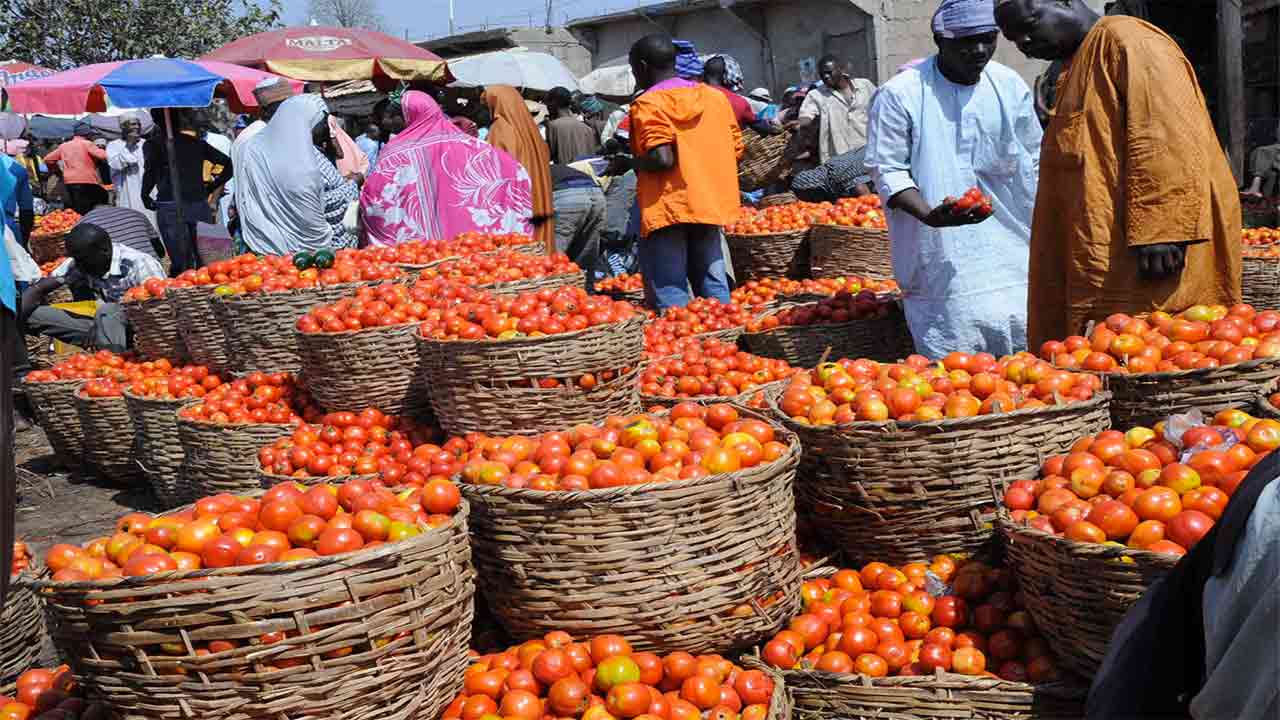
A Vanguard survey at Mile 12 International Market, Lagos, showed that tomato prices more than doubled within three weeks.
A large basket of Jos tomatoes, which sold for between N60,000 and N70,000 in May, now sells for between N120,000 and N150,000, while a crate of rose from about N25,000 to N70,000.
The survey also found that cheaper South-West tomato varieties had flooded the market. However, many retailers and consumers complained that the variety contains more water and yields less paste than tomatoes from the North.
According to Madam Jerome, a foodstuff retailer, consumers now buy tomatoes out of necessity rather than preference.
“I bought a basket equivalent to three paint containers for N40,000. Many people prefer this type because of its plumpness and colour. Tomatoes are gold in the market now,” she said.
Another buyer, Blessing, said her household prefers northern tomatoes because they produce thicker paste.
Madam Jerome also lamented losing money after buying a basket of Jos tomatoes for N120,000 only to discover that many of the tomatoes underneath were unripe and partially spoilt.
Speaking on the price surge, a tomato seller Ibrahim Aminu attributed it to poor farming conditions in the North.
“Arewa are not farming well due to rainfall and drought on the farm,” he said.
Housewives, caterers react
For Mrs Susan, tomatoes have virtually disappeared from her weekly menu.
“Usually, I buy a paint of tomatoes for N3,500, but recently I got a paint for N15,000. We now use vegetables, carrot and cabbage sauce and even palm kernel stew. The last vegetable sauce I made was as black as the back of a pot because I used very little tomato.”
Another consumer, Mrs Ebele, said a paint bucket that previously sold for N4,000 in her location now costs N10,000.
“I buy only half the quantity and mix it with vegetables so it can go round my family,” she said.
Caterers also said the development has significantly reduced their profits.
Mrs Princess recounted how she lost most of her expected profit from an event after tomato prices rose sharply from about N70,000 to N150,000 per basket.
“I regretted collecting full payment before the event. I lost so much money and even settled workers from my pocket,” she said.
Another caterer, Juliet, said many operators now reduce the quantity of fresh tomatoes used in meals or mix them with tomato paste to cut costs.
Other commodities affected
The pressure is not limited to tomatoes.
A pepper trader, Murtala said adverse weather conditions in the North have pushed pepper prices higher, warning that northern pepper could become scarce in the market.
A medium-sized bowl of pepper and shombo now sells for about N30,000, while tatashi sells for as much as N40,000.
Mustapha, a ginger trader, disclosed that a sack of ginger now costs N700,000 compared to about N200,000 previously.
NATPAN reacts
Reacting to the situation, National Secretary of the National Tomato Growers, Processors and Marketers Association of Nigeria (NATPAN), Sani Danladi-Yadakwari, described the current surge as a seasonal supply crisis worsened by insecurity and the absence of major industrial buyers.
“Three days back, even from the farm gate, a crate was going for almost N50,000. There is simply no tomato available right now. Almost all of it has finished,” he said.
According to him, only two major tomato-processing companies are currently buying from farmers, while firms such as Dangote Tomato Processing Company, GBFoods and Savannah Integrated Farm have either reduced operations or stopped off-taking tomatoes.
“There is no guaranteed off-taker system for fresh tomatoes in Nigeria. Because there are no reliable buyers, farmers are afraid to invest heavily in its production,” he said.
Danladi-Yadakwari explained that during harvest periods tomatoes often flood the market because there are no processors to absorb excess supply, resulting in heavy losses for farmers and traders.
He, however, warned that insecurity in farming communities was compounding the crisis and could worsen supply and prices next year saying, “Most people in the farming areas are dealing with insecurity; many have already abandoned their farms and that will definitely affect the prices next year. I don’t think it will be any better.”
He also identified climate change, rising production costs and the destructive Tuta absoluta pest as major challenges facing producers.
According to him, with climate change affecting tomato production, seeds that should germinate within 21 days now take nearly 40 days because of excessive heat.
Danladi-Yadakwari expressed optimism that supplies would improve from August when rainy-season harvests begin arriving in markets.
Also reacting, Secretary of the Tomato Section of Mile 12 International Market Association, Sulaiman Adawa, admitted that the absence of major processors remains a challenge.
“In the past, some companies were buying from farmers in large quantities, but many of them have stopped. Maybe they felt it was no longer profitable,” he said.
Way Forward
To address the crisis, NATPAN urged farmers to adopt greenhouse farming and urged government to invest in solar-powered irrigation systems to reduce production costs and encourage year-round cultivation.
“If farmers use solar energy instead of fuel-powered generators, production costs will reduce significantly. That will encourage more farmers to return to production,” he said.