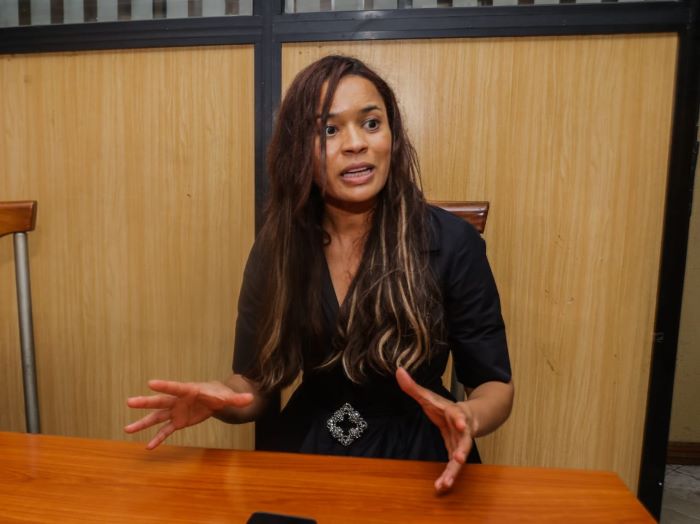
Terri Ochiagha is a deeply perceptive literary scholar who has an exceptional talent for explicatory prose. Her voice is clear and lucid. Unquestionably, her body of work so far is immensely satisfying. Her first book, Achebe and Friends in Umuahia, won the African Studies Association’s Fage and Oliver Prize for the most outstanding book on Africa published between 2014 and 2015. Born to an Igbo father and a Spanish mother, she earned her BA, MA and PhD in English Literature from Complutense University, Madrid, Spain. She is a lecturer in the Department of English and Scottish Literatures, University of Edinburgh. Dr Ochiagha has been awarded several prestigious fellowships: the McMillan-Stewart Fellow at the Hutchins Center for Africa and African America Research at Harvard University (Spring 2025); a Visiting Fellow at All Souls College, University of Oxford (Trinity Term 2025); a Baxandall Visiting Fellow at Robinson College, University of Cambridge (Lent and Easter Terms 2026); and her research is currently funded by British Academy Mid-Career Fellowship. In April 2026, she spent a month at the Bellagio Center Residency in Italy, having been selected by The Rockefeller Foundation as one of the leaders, trailblazers and change-makers in the world. In January 2027, she will take up the Smuts Visiting Fellowship in Commonwealth studies at the University of Cambridge. On 9 June 2026, Terri Ochiagha and Okey Ndibe, who has been managing her British Academy-funded public engagement campaign in Nigeria, visited Press House, 27 Acme Road, Ikeja, Lagos, and spoke to KUNLE AJIBADE, Executive Director of TheNEWS and PM NEWS, about her work-in-progress: Chinua Achebe: A Life at the Crossroads. NEHRU ODEH, Assistant Editor, transcribed the interview. EMMANUEL IJIOLA took the photos.
PM: First of all, congratulations on your impressive book, Achebe and Friends at Umuahia. Tell us about the biography of Chinua Achebe that you are working on.
TO: Thank you very much for your very kind words on my work. I’m here to do research for my next book: the first full-length biography of Chinua Achebe, which will be published by Princeton University Press. The title is Chinua Achebe: A Life at the Crossroads. I’ve been very generously funded by the British Academy and Princeton University Press to come to Nigeria to do several things. Those of us who work in the West tend to come here, do research, take it back there, publish it, and not many people in this country get much benefit from it. The British Academy public engagement campaign that I’m doing is actually supposed to bring the research to people here, to tell them what biographical research really is about, which is what we did at Government College, Umuahia, which was the setting of my first book, and where Achebe did his high school. So I thought it would be a good idea to talk to the students about Achebe’s time at the school. I also got to speak to a group of old boys of the college and other stakeholders on questions of heritage and education– in the best sense of that word–at Umuahia and the ground is being set as we speak for future collaborations in these crucial areas.
PM: When did you go to Umuahia for that public engagement?
TO: That was exactly six days ago. I talked to the students about the school. I talked to them about my first book, and I also ran an essay competition, because the book is Achebe and Friends at Umuahia, and it hinged on the whole question of literary networks and friendships within a school system, and I wanted them to reflect on that. Each of the three winners of the essay competition got a copy of my book, and the other two finalists got some University of Cambridge notebooks and pens to get them inspired. The principal of Government College, Umuahia, during Achebe’s time in the school (1943-48), William Simpson, studied at King’s College, Cambridge, and I thought it would be a nice gesture to get them a memento from his college, where I purchased the stationary. Apart from that, in the future, I’m going to set up a mentorship scheme with the school’s most prominent literary students, so that I’ll be mentoring them virtually to ensure a flow of knowledge. That was one part of the programme. We also went to Peter University in Awka the day after, and Okey Ndibe and I had a conversation in front of the students about biographical practice.
In theory, a lot of people tend to think that they know what biographies are, but biographies are not songs of praise. They’re supposed to be rigorous studies of the life and work of your subjects–in my case, a rigorous study of the life and work of Chinua Achebe. So that’s what we’re trying to transmit in that public engagement campaign. At the same time, I’ve been doing research in key locations of Achebe’s life, and telling the audience that to write a book like this, you have to immerse yourself in the culture, you’ve got to immerse yourself in location, and so on. And why do you want to go to a place? People think I just want to take pictures. But it isn’t about taking pictures, it’s about getting a sense of locale. If you go to Achebe’s office, as we did at the University of Nigeria, Nsukka, for instance, you tried to imagine what he saw through the window when he was writing whatever he was writing at the time. You can take pictures and that’s fine, and you can describe locations, but you do have to think about the ways in which space actually impacts the writer at work. It definitely does.
PM: There is a very good biography of Chinua Achebe by Ezenwa-Ohaeto. In what ways is your book going to be different from his? And why have you chosen Chinua Achebe: A Life at the Crossroads as your title?
TO: The first thing is that his ended in 1993 and Achebe died in 2013. So there’s all that uncovered period. Ezenwa-Ohaeto relied very much on interviews. He was very lucky to be able to do all those interviews because most of those people he interviewed have died. He also relied on some newspaper articles. But he did not rely on many of the archives that are dispersed around the world. Either they weren’t available then or he didn’t have access to them. And my biography is very much archive-based. I’ve seen over 30 archives in the U.S. alone, more than eight archives–both institutional and private–in the U.K. And we’ve seen some archives in Nigeria, too. It’s very much about looking at his correspondence, looking at his editorial work. For instance, when we say Achebe was the first editor of the African Writers Series of the Heinemann Educational Books, London, what did that entail? And then you look at his annotations on other people’s work, you look at the editorial notes that he produced, you see him at work. True, Ezenwa-Ohaeto’s book is very thorough, and I’m absolutely grateful for it as a sort of foundation for what I’m doing but, in many ways, and I’m not trying to be unduly critical here, I’m just trying to talk about departure, it is a sort of catalogue of dates and accomplishments.
I want to look deeper than that. I want my reader to end up saying, This is what Achebe was like. When you finish Ezenwa-Ohaeto’s book, you know that Achebe was an extremely accomplished man, and you know where he was at each point in his life up until 1993. But what did he look like at all these different stages of his life? How did he move? What was his style? Because one’s own personal style changes through time, and we need to see the author’s embodied presence. Also, what was his interior world like? What can we detect when we look at his manuscripts, for instance? I’ve seen his manuscripts at Harvard University. But what was his working process? What did he cancel? When he canceled something, what sorts of things did he cancel? What did he insert in their place? Was he changing the meaning of words? Was he changing the cadence? Was he attuned to the sonority of the text? For instance, from the first short story he wrote after the Nigerian Civil War, ‘The Madman,’ now published in Girls at War and Other Stories, what do we deduce about his mental state? And it really does tell us a lot of things, because you can see the hesitations at first, and you see when he’s not cancelling things anymore– when he started to flow.
And so, those are the sorts of things that I’m looking at. When he’s at Bard College in upstate New York, after his accident, what was his life like? And what was his mental state from what we get from his interviews? I did say my work is mostly archive-based, but I’ve also been interviewing as many people as I can. For example, if people were visiting him at Bard College, what was his temperament like? What did he say that might denote the state of his mind? And then, of course, it’s location-based. You don’t just say, he went to Government College, Umuahia. You describe the beautiful compound, the quadrangle. We went into his dormitory, because he was a school prefect, so he had a cubicle. What did he see through his window? What’s the size? What was the relation of this space in comparison to the dormitory space that everyone else was occupying? In the end, when you close the book, you’ll be able to say, I know as much as one can know about who this man was, rather than just, I know what he accomplished. As for the title of the book, it is inspired by what Achebe says in his essay, ‘Named for Victoria, Queen of England’: “But still the crossroads have a certain dangerous potency; dangerous because a man might perish there wrestling with multiple headed spirits, but he might also be lucky and return to his people with the boon of prophetic vision.” Clearly, he is very specific in the essay about the cultural crossroads–Christianity and heathenism; the ambivalence he experienced when he was growing up in his village, Ogidi. But generally, I ask: What multiple headed spirits did Achebe wrestle with in his life and work? I try to understand these and the boon of his vision in its complexity.
PM: You said early on that you’ve been talking to people. Have you spoken with the Achebe family: his wife, children, relations, the people who knew him intimately?
TO: I had some conversations with them early in the process, but I have decided to work independently to ensure the biography’s objectivity. I’ve tapped into interviews they’ve given for other purposes. And I’ve also read the memorial book that was produced in the aftermath of his funeral, where they shared some of their most intimate reminiscences of him. I’ve tapped into that, rather than me having a continuous engagement with his family.
PM: Talk a little bit about your lecture at Harvard University on life writing. What do you consider as problems and possibilities of life writing?
TO: What I actually was trying to say or to convey, in that lecture, was the fact that up until now, and again, with all due respect to the scholars who have done it, Chinua Achebe’s life has been explored in uncritical ways. I think Ezenwa-Ohaeto’s work is very thorough. We must not forget that he was his student. He had the sort of access that I haven’t had, and I think he managed to be close to the family. And I think that sort of proximity can be seen in some of the ways in which some of the key aspects of Achebe’s life are dealt with. He just says, Well, this happened, and he quickly moves on. But sometimes we just need to probe and interrogate the evidence. We have to question the author when he talks about himself. Whatever Achebe said, he reproduced. Of course, you have to faithfully reproduce. That’s part of the job.
But you also have to wonder if there’s another perspective or the version or someone else who might have something else to say. And I’m not saying you’re going to privilege the opposing view, but we need to have both, and, as intelligent readers, we then make up our minds. I don’t think Ezenwa-Ohaeto allows for that sort of probing. If Achebe said he was in Italy, I’m giving an example now, if Achebe said, I was in Italy, and I went to this place, and I met with this person, and this happened, Ezenwa-Ohaeto did not try to see if there’s any archival material about that visit, or tried to get in touch with the person that he met. And if Achebe said, I quarrelled with that person while in Italy, Ezenwa-Ohaeto did not try to find that other perspective. That was one of the things that I said I was not going to do. Again, I respect his work, and it’s a legitimate way of working, and I understand. And that’s why I think it’s important to have a level of distance from the subject.
Talking about the necessity to keep a measure of distance, Chinua Achebe, in the essay from which you just quoted, ‘Named for Victoria, Queen of England,’ writes: “The distance becomes not a separation but a bringing together like the necessary backward step which a judicious viewer may take in order to see a canvas steadily and fully.”
I would try as much as possible not to be too close, so that I can see steadily and fully. I must insist, I will always insist, that Ezenwa-Ohaeto is thorough in what his book covers, and that he was a scholar. But then, there are other biographical books that are just merely songs of praise. One of them is Phanuel Egejuru’s Chinua Achebe: Pure and Simple, An Oral Biography. She had the privilege of interviewing all of these people, but never questions what they said in the final analysis. And what I say is that, again, that’s legitimate if you want to do that. I’m a scholar, I’m an academic, I’m a literary critic. My job is to look at complexity, probe it deeply and sensitively, wrestle with it. That was basically the argument of that lecture.
PM: True, documentary evidence is central to this kind of work, but when the archival material is not adequate, what do you do? You were at the National Archives of Nigeria at the University of Ibadan, for instance, and you couldn’t get all the pieces that Achebe wrote for The University Herald as an undergraduate in the Department of English. To tell the full story, what can one do in a situation like that?
TO: I intend to have at the end of the book a section called Notes on Sources, which is going to lay out every single archive, the dates that I visited, because I want to be absolutely transparent in case someone says, Oh, where did she get that from? Well, this is where I got it from and this is when I went there. And if you doubt what I’m saying, you can travel and see what’s there. I do want to be honest about what’s there and what’s not. Instead of deceiving the reader, which one sees in some biographies where you’re vague and you pretend you’ve seen all of it, but you’ve only seen one piece. In terms of, for instance, the student magazines that aren’t in the National Archives, Bernth Lindfors has published Early Achebe, and he has some fragments, excerpts, of what he has seen. And then you quote that. You didn’t see it with your own eyes, but that’s as close as you get. I will, of course, make reference to Lindfors. I do prefer to delve into things that I myself have seen. I will mention the existence of the things that aren’t there. I’ll try to extrapolate from sources or from other sources, including interviews or material I may come by. But I just delve deep into the things that I have evidence for. You don’t want to speculate. You have to fully lay it out. And there are implications for this about self-mythification and about our literary history. And again, you don’t take for granted the things that you haven’t seen. Don’t say, for instance, Oh, he wrote this short story and he was clearly anticipating things that were going to happen in Things Fall Apart. Well, you don’t know because if you haven’t seen the first version, then you’re in no position to say that because he might have modified it afterwards. And unless you have a record of that modification, you cannot say this text is precursive of that text. You have to be very cautious. Of course, I’m a human being and one can have failings, but to me it’s really a priority to make sure that whatever I say, that whatever I assert, I have something to show for it. And if someone were to email me and question anything I say, I’ll just go to my own interview transcripts and archives, because I digitize everything, and tell the person, Well, here’s the evidence. What do you have to say about that now?
PM: You started work on Chinua Achebe: A Life at the Crossroads in 2024. When is Princeton University Press going to publish it?
TO: Academic careers these days aren’t like in the past where one was free to go out and do research and disappear from one’s department. The only way you can do that right now in the UK system is that you have your sabbatical, which I had in 2024 for a number of months, and then you have to buy yourself out. That is, you have to get grants with which they’ll now pay someone to do your lecturing and your administrative work, and then you’re free to go. And I’ve been very fortunate, because, as I said, the British Academy is buying me out for a whole year. Next year, I’m going to teach for a semester from September until December, and then I’m buying myself out again. Or let me put it this way: rather than buying myself out again, I’m taking up a five-month research position at the University of Cambridge in January which will then lead into the summer period at the University of Edinburgh, when there is no teaching, and that gives me more time to get on with my work. I’m saying all of this to underscore the fact that I wish I could just write and write and finish, but you’re very much depending on the availability of time, which you get, thanks to research funding. But if everything goes as it should, I would very much like for it to be published in 2029, which is the year after the anniversary of Things Fall Apart in 2028.
I do not want to publish it during the year of celebrations. And as this is a work that’s meant to be objective, then it needs to exist and emerge in its own time and space, not alongside everything else that’s going to come out, that is going to be a period of praise, a period of celebrations. In terms of the archival research, in many ways, one can say that I finished all of that today at the University of Lagos, unless someone says, Oh, I’ve got these papers, or have you looked here or there? Until the very last day that you submit the manuscript of the book, things might appear. I keep seeing archives all the time. I keep interviewing people all the time. I’m not weary of travel for this project. I’ve written four of the book’s nine central chapters. There will be a prologue and an epilogue. I do keep revising them. I’ve written, for instance, the chapter on the Nigerian Civil War. But now I have to go back, because when we were at Umuahia, I went to the war museum. I went to Ojukwu’s bunker. I now have to capture what I saw, and imagine Achebe in that space and go back to the chapter and just revise it. So it’s a constant process of writing and rewriting and moving forward. But it is very pleasurable. I’ve said, and I hope I don’t have to take this back, that from now on, all I want to do is biographical work. I love life writing because it’s been so fulfilling. I’ve grown and learned so much. No one teaches you how to do life writing. There aren’t really masters or PhDs in life writing. You’re a literary critic or you’re a historian, or whatever field you’re doing, and then all of a sudden, you’re doing a biography. But you don’t really have formal education in it. And the process of learning has been exhilarating for me. And now I don’t want to do anything else.
PM: Why do you say that?
TO: I say that because I wrote, for instance, my first book, Achebe and Friends in Umuahia, and A Short History of Things Fall Apart, purely as an academic. There are unwritten rules of how academic express themselves. I’ve never done creative writing in my life. Everyone says, I write poems, I have a book of poems at home that I’ve never shown anyone. That’s the way it is at least in the UK. I’ve never in my life written a poem. I’ve never in my life written a short story or a novel. I didn’t think I had the creative bug in me, so to say. There are many amazing biographies out there, but one of the first I read when I took on this project was Leon Edel’s five volume biography of Henry James. From that biography, and from several interviews and articles that he wrote on it, I discovered the importance of finding the right form for one’s story. I usually highlight this in every talk I have given and in every grant proposal I have written since I had this epiphany: the commitment to truth–inasmuch as the truth of a life can be retrieved–has to coexist with the commitment to beauty. And in my quest for the right form to convey the truth of Achebe’s life, I discovered a different way of writing; a different way of being. I fell in love with this quest itself.
For instance, how do I recreate a moment of sorrow? Do I use a flashback? In the Nigerian Civil War chapter, I use a flashback to reflect the poignancy of the death of Christopher Okigbo while Achebe was writing the poem ‘Mango Seedling’ in early 1968, because I do have a testimony from one of Okigbo’s friends who wrote a memoir. And this Englishman was a secret service agent, so no one has ever heard from him about this in particular where he talks about visiting Achebe with Okigbo on New Year’s Eve in Lagos. You tell the reader about that encounter and where they were–Lagos. That time, Nigeria was a country full of promise, and everything was great, and Okigbo was vibrant. And then the reality of secession, and tragedy, and death. In order to create an impact, you juxtapose both scenes. This is one of many creative ways to convey a story. And I never in my life thought, if you had asked me some years ago, that I would be able to do this.
PM: So, you’re obviously working on this project not just as a literary critic, but also as a creative artist
TO: Yes.
PM: Achebe and Christopher Okigbo ran a publishing house in Enugu called Citadel Press. What research have you done on that publishing house? How did it operate during the Nigeria-Biafra war? What role did Okigbo play in it before he enlisted in the Biafran Army and was instantly commissioned a Major? And after he was killed in the battlefront in August 1967 how did Achebe carry on with Citadel Press?
TO: Well, a lot of the information on that comes from Obi Nwakanma’s excellent biography of Christopher Okigbo, Thirsting for Sunlight, which is really gripping and very fascinating. I think he does a great job of recreating Okigbo as a character. I went to the Christopher Okigbo archives at the Harry Ransom Research Center at Texas, and I wasn’t able to see much, but what I saw was very touching. I saw three sheets of letterhead. And one might say, well, but was there anything written in them? No, there wasn’t anything written in them. But just holding them, looking at their appearance, touching them, it just brought back something about those days. You see a paper that’s dusty, reddish dust, and it was actually rescued from the site. Again, it tells you something. It might not tell you something tangible about what meetings they were having, but it’s useful as a sort of tool. Then there was also a certificate of incorporation when Achebe became the managing director of the press and it tells you who was who and who were the shareholders. No one’s ever talked about that. You see that in the archives. You then bring in what Achebe himself has said about the founding of the press and then there’s been some interesting material, but that is one of the surprises in the book, and I wouldn’t want to divulge it right now. Let’s just say that there’s an archive somewhere that sheds more light on some of the operations of the press.
You find things in the most unexpected of places. And sometimes those things might seem tiny, but when you bring them together with all the information that you have, it always complicates the picture of what the principal actors say. Which is why I love archives, because when you’re talking to someone, or when you write an autobiographical essay or you’re giving an interview, you’re conscious of what you say. You say, Oh, this is my mission, this is the story that I’ve got to tell. But when you’re signing papers or signing contracts or corresponding with an editor or with a publishing house or with someone else, you’re not necessarily thinking at the time that this is going to be archived. You just want to get the business out of the way. And I feel that contains something closer to the truth than the stories we tell. But that applies to all of us.
PM: But people can also archive lies.
PM: Yes.
PM: So how do you navigate the terrain of lies in the process of searching for the truth or to perceive deeper truths?
TO: Let me think of the right example. Of course, I don’t give full credibility to the archives, but one has to look at archival material alongside other archives, not zoom in on that particular collection of papers. Because a collection can suffer all sorts of distortions. The person might take out some things, reshape them. But I think if you find something about, let’s say, an incident in one archive, and then you go to another archive and you find another version and then you interview some people, then by bringing everything together, you are close to the truth. I think the truth with capital letters can never be known about anything unless you were a witness. But, as I said, by comparing and collating and thinking carefully about what’s available, one gets as close as one wants to the truth.
PM: The attitude of the person visiting the archives also matters a great deal. Isn’t it? So how do you make sure that your own bias does not impinge on the truth?
TO: I think a biographer should not be a commentator. I think a biographer has to lay out the evidence and have his or her own perspective of what that evidence is pointing towards. But you have to let your readers make that decision for themselves. When you have the evidence and you can produce the evidence, people with their own biases or values will read that evidence differently. One person might say, That’s absolutely wonderful. Another person might say, oh, that’s appalling. But it is not your job to take them in that direction. So I constantly go over what I’ve written. I revise it a million times and make sure that I do not intrude too much. I see biography as an art, as a painting. That’s how Leon Edel saw it. That is, the work is really a work of research, but also a form of telling a story. Your job is to tell a story that’s compelling, that’s as faithful as possible, or as close as possible to the truth. But you do have to take a step back and not really be a presence in it. There are biographies where there’s too much of a presence of the writer. I’m not going to do that. And if there’s something, well, that maybe controversial, maybe polemical, I do not make any pronouncements. This is what John said, this is what Mary said, and then this is what we find elsewhere. You put it together in a beautiful way, you don’t do the cut and paste thing, but rather narrate it so there’s no disruption of the narrative. I want to think that my reader is an intelligent reader. He or she decides.
PM: Not hagiography?
TO: You don’t want it to be hagiography. You want it to be balanced. And you want to take out your personal biases. There are some things that you as an individual might like, or might dislike, but those are your own personal prejudices. You can’t impose those on the reader. If you’re doing that, you’re not being a good biographer, you’re not being a good scholar. You’re just doing the opposite of hagiography, perhaps, which is equally suspect, and which is equally unscholarly. It’s about constantly trying to make sure that you don’t make those mistakes. Well, I’m just going to lay out what I see. But what do you see? And it’s okay if you see something differently from me. We’re fine. I still did my job because I gave you the information and then you did what you wanted with it. It’s a human being’s life, it’s a person’s life. You can’t pretend to be God or to be omniscient, and to know everything that is going on in his head.
Some people might disagree with what I’m going to say but, as a critic who works in the West and in one of the top English literature departments in the world, I’ve been in the game long enough to be able to say this is the case: As much as Achebe is considered an important writer, a canonical writer, I do think there are limitations, or there are limits, to the canonicity that he has been given in the West. Everyone talks about Chinua Achebe’s Things Fall Apart. Yes, Things Fall Apart. I read that in high school. Oh, Achebe’s essay on Joseph Conrad’s Heart of Darkness, I read it. And that’s it. But when we mention James Joyce, I don’t think everyone jumps and screams only Ulysses. Then they’ll talk about A Portrait of the Artist as a Young Man, and so on. There is more of a sense of the author and his work more broadly, the entire oeuvre, rather than a singular novel. They know that Achebe is a writer, but they don’t see him as they would see, say, Charles Dickens or T.S. Eliot. And some people here might just be satisfied with Things Fall Apart. They want to whitewash everything about it. They would say that’s enough; it’s already canonical. No one can change that. And I think Chinua Achebe’s space in literary history is secure. But I do not like tokenisation. He deserves a million times more than being remembered as the author of one single novel that he wrote when he was very young, and which isn’t even his masterpiece.
PM: Arrow of God is more accomplished than Things Fall Apart. What do you think?
TO: By far. But it is not known in the West. This flattening and reduction is a result of Western bias. I also know, and this is a controversial stance, that some African literary critics are complicit in this flattening and reduction. I will explain this in my introduction to Achebe in Context, a specially commissioned collection of twenty-three essays, which I’m editing for Cambridge University Press. My biography aims to introduce Achebe in all his complexity to the world. Of course, it would talk about Things Fall Apart because it’s a seminal moment, but it’s spending as much time talking about any of the other supposedly minor works, and their context, and his own psychological state at the time. I’m hoping that when the book is published and read, people will say, I now need to read Arrow of God, or I need to find out for myself if a particular short story isn’t as accomplished. It just whets that appetite. You suddenly realise that this person you had placed in a box all along, that you’ve given a specific kind of place, largely exceeds that place. And I think that is what Achebe deserves. And that is the treatment that I’m giving him, the same way that Western biographers look at the entirety of an author’s work, and also not necessarily just literary work, but also political interventions in the case of Achebe. Then anything other than that is just giving him second best. Literariness is of key importance to me, but also giving a sense of the richness, not just of the Nigerian culture that nurtured him, but all these different locations.
I’ve been taking pictures of plants. One might think that that’s insane. What sorts of flowers are prevalent on Nsukka campus? Because that’s different from seeing pine trees, or seeing the rolling English countryside with some sheep sprinkled throughout. And when you read it, there isn’t that sort of weird kind of flattened image of Africa. Nigeria itself is very diverse. When you go from one part of the country to the other, there’s a change in the climate, even the colour of the soil, and you want Western readers to read, same as they’re reading about the beaches in Sussex when they are reading about Virginia Woolf, and what the waves were looking like, flapping in the air and so on. You want them to be able to see Achebe like that. You don’t want them to locate him in some sort of weird Africa that they’ve imagined, and then there’s this man in the middle of it. You want them to imagine what Colonial Lagos was like. You want them to see him in Biafra wearing his safari suit, and moving around. That’s incredibly important to me. Again, literariness is key, but every other dimension that goes into the making of that literariness is also important.
PM; Achebe, in his essays and lectures, never misses an opportunity to talk about himself. There is also his memoir, There Was A Country. How much of his autobiographical writings are you in conversation with in the process of writing Chinua Achebe: A Life at the Crossroads?
TO: The life writing is good because that’s as close as I get to talking to him. He’s not around anymore. I can’t go and sit down with him and ask him the questions that I would ask. I have read his interviews–both in print and electronic media. There are some videos out there, there are recordings, and then the life writing. You quote the life writing because you want him to have a voice in the telling of this story, but you supplement it with what you find. As with everything else, and with every interview that you do, you can’t take it at face value, even though he is the subject because autobiographical writing illustrates the work and the worldview, but it is also a form of self-mythification. So you do need to say, Well, if he’s talking about this particular period, and I have got this interview that he gave at this particular period, how does what he says in retrospect match up with what was said then, for instance? You just constantly juxtapose. And as a judicious person who’s taken a step back, you then say, Okay, this is what he says. That’s a little bit more complicated than that. Let’s tell the reader about that, and as with everything else, the reader will say, Oh, well, we don’t care about those papers. This is what he says. And that’s absolutely fine. Who am I to challenge the reader? But you might say, Oh, these papers tell me something about the dates and the dates are not matching up, or maybe there’s something I’ve missed from the self-narration.
And we are talking about writers who have lived purposeful and creative lives. It is very important to think about the ways in which every one of them is invested in self-image, in self-preservation, and in image burnishing. Famous writers that are already assured a place in literary history are aware that they’re part of the historical record, and when you’re aware of something like that, then you are different from someone who doesn’t hope to leave any mark in history. You become more careful about what you project and what you say, and that in itself is very important. It’s not a bad thing at all, because anyone who has any prominence, who is aware of his immortality, will do that at some point. So this isn’t something particular to Achebe–it’s particular to all of us. But at the same time, that process tells us something about their psychology. What facets of the self are you highlighting when you talk about yourself? You have to look at patterns in that sort of self-narrative because it tells us something about what they value and what they want us to keep. But, at the end of the day, they’re not in full control of what gets to be passed on.
PM: Let me take you back to Biafra. Chinua Achebe operated at the highest level of its decision making. He was a front row witness and an active participant: He worked in the Biafran Ministry of Information and represented Biafra in various diplomatic and fund-raising missions. But his personal history of Biafra, There Was A Country, is silent on the process of decision-making at that level and a number of other very important matters. Did Chukwuemeka Odumegwu-Ojukwu take decisions calmly or impulsively? Was he democratic or dictatorial? How much influence did the Louis Mbanefos and the Eni Njokus really have on him? One more thing: Chinua Achebe wrote poems, now collected in Beware, Soul Brother, during the war but not after the war. What do you say to that?
TO: Well, Chinua Achebe: A Life at the Crossroads is a work- in- progress. I will say Chapter five, which is a war chapter, aims to fill the notable gaps in There Was A Country. So, everything that one looks for in There Was A Country will, hopefully, as much as the record allows, makes its way to that chapter. That definitely is on the table. Poetry is quite key in the war and in the post-war chapter. And I do talk about not just the poetry itself and its form, and I don’t only see it as a literary text, but I also think about the psychology behind Achebe’s poetic tone. Because up until the war, Achebe hadn’t written, as far as we know, poetry. He had written short stories; he had written novels. Poetry was a new thing for him. And one of the things that I do is to trace the emergence of that poetic voice. At that point in time, during the war, he talked to a lot of journalists. And some of those interviews haven’t seen the light of day up until now, or they haven’t been quoted by any of the critics. It’s interesting to note that, and I will explore this in a lot more detail in the biography itself, that the poetic voice emerges when the novelistic voice is silenced. And so, I see his poetry as a particular manifestation of silence.
PM: Silence because he didn’t have much time for long form. Or shall we just say a manifestation of eloquence in a different form?
TO: Yes. It took a while for him to get back to long form after the war. He didn’t publish Anthills of the Savannah until the 80s, and there’s a 22-year-old gap. And before that, during what I call the golden years, which was after the publication of Things Fall Apart up until the war, he’s averaging a novel almost once every year and a half, yet he’s very busy as a broadcaster, and he’s travelling the world. So the question of time, 100 per cent, holds in the war context. But then we’ve got to ask about what happens afterwards. And he had many explanations about that, explanations that he gave different people in different ways, and then we need to bring all of those together and see what we make of it. I do not know, and this is something that you’ve made me think about, whether anyone was actually writing long form during the war, or whether any of the early novels that were published after the war, were written during the conflict. It would be interesting to look into that. But as I say, there’s something about that shift. And then another thing that I want to point out is that Achebe’s poetic phase is limited. It lasts roughly until 1974, and that’s it. It wasn’t sustained in time.
PM: What’s next after this book?
TO: As of now, it’s difficult to think about anything else. This is just like a marriage of sorts. Chinua Achebe is the man I live with now. (Laughs) So I can’t leave the house and be looking for boyfriends. It wouldn’t be right. I mean, there are people who might do that, but that’s not my personality; not my natural flow and preference. It will come to a point where, symbolically, when the biography is finished, he will die, so to say. And when I’ve had my period of widowhood, then maybe I’ll take off my ring and see what suitors there are out there. And who else I’m going to spend some years with.