The Realignment of British Politics
THE TRADITIONAL PRAGMATIST
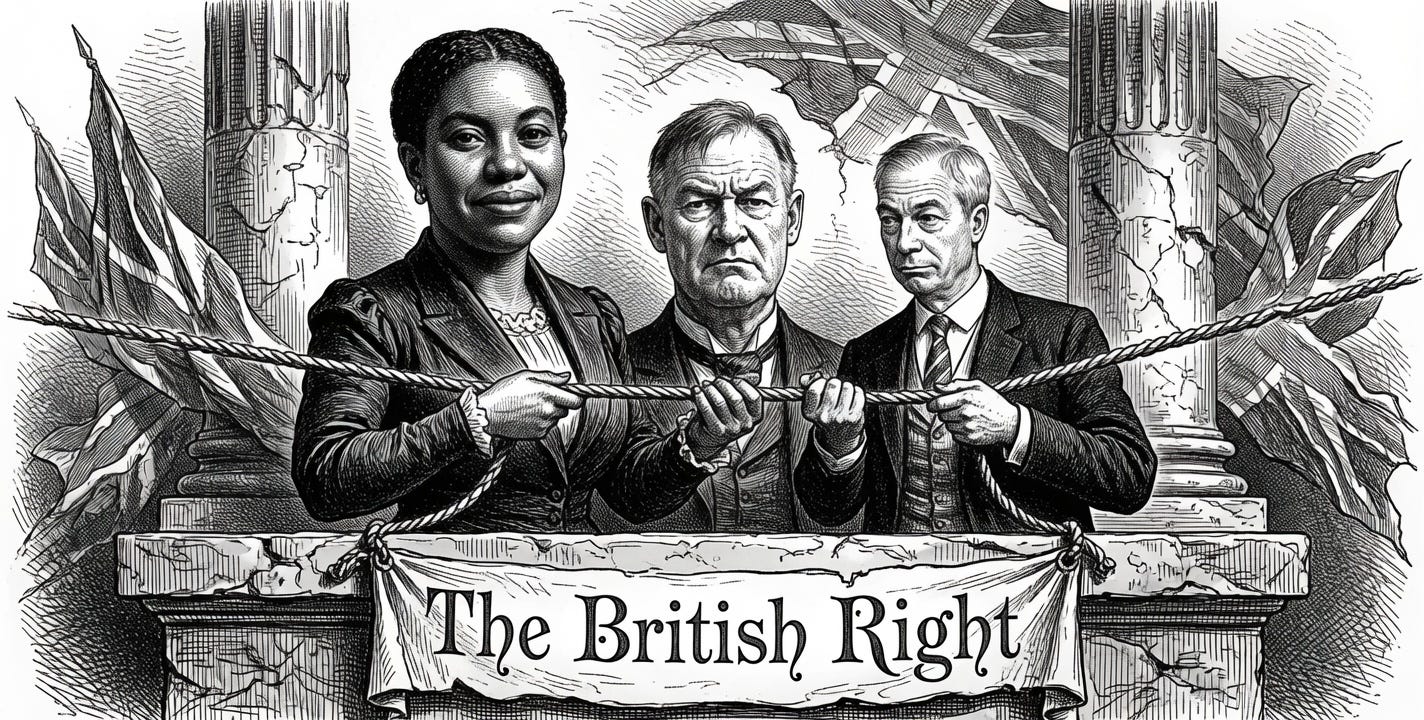
My latest piece for The Daily Sceptic explores why calls to “unite the Right” – however understandable in narrow electoral terms – are premature. The deeper fractures over identity, belonging, and the proper scale of the state run too deep for an easy coalition at this stage. This sits squarely alongside the themes in Tuesday’s essay on why British politics no longer works. As I mentioned in yesterday’s update, I’ll be bringing more regular, shorter pieces like this while continuing the longer essays. I hope you find it useful and interesting. This weekend, I’ll publish a new original piece examining Andy Burnham’s rapid rise and what it tells us about devolution, subsidiarity, and the theatrical nature of our current politics.
During the campaign and since the Makerfield by-election, calls for a variation on the theme of “uniting the right” have intensified. Whether explicit appeals for unity or warnings about “splitting the vote”, the underlying idea is the same: the right must consolidate because more voters overall support leftist politics. If the right remains fractured in the way the left has always been, it cannot win power, and Britain will be governed by a coalition of left-wing parties, with disastrous consequences.
It is hard to fault this analysis as far as it goes. For decades the Conservative Party held together as a broad coalition of (mostly) right-of-centre voters and politicians, and had a remarkably successful electoral record, governing for 32 of the last 50 years. In the same period the left-of-centre vote was routinely split between Labour, the Liberals/Liberal Democrats, the Greens, and earlier incarnations of the SDP. Challenger parties on the right (the BNP, UKIP, the Brexit Party) were mostly single-issue vehicles that functioned as pressure groups rather than serious contenders for government. However, what the analysis misses is that an easy coalition on “the right” cannot currently exist. The old Conservative broad church, accommodating libertarians, paternalist One Nation Tories, and Burkean conservatives, was sustainable because these factions were largely aligned on the economic axis around broadly free-market principles, standing in opposition to statism and socialism. That alignment has broken down.
British politics is undergoing what Stephen Davies has termed the “Great Realignment”: a structural shift away from the old economic axis of markets versus state towards one dominated by questions of identity, sovereignty, belonging, cultural continuity, and the scale and nature of governance itself. Davies is right that this is the new organising logic. My own thinking had been moving in similar directions before I encountered his work, and it provides a very helpful frame.
The left began the process decades ago by colonising the commanding heights of culture, institutions, education, speech, and group identity. The right’s response has been slower, more fragmented, and often reactive. The very labels “right” and “left” have become largely negative. Much of what now passes for the right is defined only in contradistinction to whatever the progressive left has claimed. Many figures now routinely considered on the right are, in important respects, classical liberals or former leftists. They find themselves there not because they have adopted Burke or Scruton, but because they reject the latest progressive settlement.
The result is a right composed of partially competing first principles, where once there was a shared economic philosophy. Some prioritise demographic realism and civilisational continuity above almost everything else; others focus on shrinking the unmanageable state and confronting the permanent bureaucracy of quangos and officials; still others emphasise fiscal discipline or residual commitments to classical liberalism. Many of these principles are held in common to a degree, but the order of priorities varies hugely. They reflect different diagnoses of Britain’s core predicament and therefore different hierarchies of what must be done first, what can be compromised, and what cannot.
Among these competing hierarchies, questions of national identity, cultural continuity, demographic balance and the nature of Britishness stand out as the sharpest and least negotiable fracture. Because most others have been reconciled in previous paradigms, this seems the most important to discuss here. This is not an issue that obsesses only one segment of the right. Significant voices continue to view relatively high levels of net migration as economically vital or morally imperative. Others accept that current inflows are too high and argue the priority must be to stop the arrivals and tighten borders. A third current goes further, maintaining that the existing scale of demographic change already poses an existential threat to social cohesion and the viability of inherited institutions and that substantial returns will be necessary. Between these positions sits a managerial centre-right that treats rising pressures on housing, services, integration and public trust as problems to be managed and contained and sees immigration as mostly a matter of velocity and identity as a question of assimilation. The differences remain unreconciled, if not irreconcilable.
The identitarian currents within the broader right, who place civilisational continuity and demographic change at the absolute centre, are not a transient fringe that can easily be marginalised or wished away. Thus far, attempts to exclude them from debate have only led to growing street protests. Continued attempts to police these voices, to drag the entire right back inside establishment-respectable guardrails, or to dismiss stronger positions on belonging as inherently “extreme” certainly do not encourage consolidation and are not building a coalition.
Purists exist on every side, technocratic managerialists, uncompromising small-state libertarians, and identitarian hardliners alike. None will be easily won over to a compromise. But meaningful compromise on the new axis of realignment cannot emerge without serious, sustained dialogue that engages these positions on their own terms rather than through thought-terminating clichés or boundary enforcement. A refusal to engage that insists on narrowing the Overton window to the managerial centre only drives the unresolved questions underground or into parallel vehicles, producing the very vote-splitting and volatility that “unite the right” rhetoric aims to avoid.
The gap may not, in fact, be as large as advertised. I have heard mainstream right-wing commentators express distinctly identitarian views and then go on to show a disdain for “ethnonationalists” in the same interview. There are prominent voices dismissed as extremists by establishment figures, who are also criticised for being ‘milquetoast’ on the more stridently nativist side of the debate. A lot of presuppositions seem to have been formed about people’s intentions and character, which are actively preventing dialogue from taking place. Such moves, whatever their short-term tactical intent, reinforce the perception that the deeper conversation about what kind of nation Britain can realistically remain is being dismissed rather than resolved.
In the kind of genuine structural realignment that Stephen Davies has described, these tensions must be contested openly. Forcing electoral consolidation before the dialectic has done its work risks creating coalitions that collapse under the weight of unresolved first principles. More than mere indiscipline, the right’s fragmentation is the surface expression of a society working through fundamental questions about identity, governance and continuity that the postwar order left unresolved. Pretending otherwise will not make those questions disappear. The temptation must be enormous to drift towards the centre, as it brings more positive coverage in the media and some opportunity to pick up votes, but the centre has governed for many years, and the national problems remain.
Electoral logic makes “unite the right” appeals understandable. Under first-past-the-post, a divided right hands seats and power to a fragmented but often better-coordinated left, and the system as a whole lends itself best to pre-election coalitions. However, the deeper structural reality is that unity cannot be imposed from above while first principles remain unresolved. Attempts to manufacture a broad coalition by suppressing or sidelining certain views, or by insisting that people vote tactically, simply try to recreate the old Conservative broad church on terms that no longer fit the new axis. Arguably, it was the Conservative Party’s own failure to understand this realignment and accommodate itself to the changed organising logic that broke its historic grip on the right-of-centre vote in the first place.
The most likely results of such forced unity are threefold. First, the party or vehicle positioned as the natural hegemon on the right will struggle to generate the energy and enthusiasm needed to secure a working majority, since voters who feel sidelined will just stay at home or support parallel efforts. Second, even if it reaches office, it will lack a coherent, worked-out programme capable of delivering the fundamental restructuring and renewal Britain urgently needs; the internal contradictions on identity, migration, and the scope of the state will produce muddled compromises rather than decisive action against the expansive state. In the process, it’s likely to alienate more voters, as they make the now-familiar journey from hope to frustration, to despair. Third is a fragile coalition, which struggles to survive a stress-test once in government because it has not properly debated its ideas beforehand.
The repeated insistence on drawing lines against “that lot,” ruling out accommodation with emerging vehicles, or dismissing demographic realism as fringe thinking does not consolidate the right, but fragments it further. It tells a significant and growing constituency that their deepest concerns about the pre-political “we” are outside the acceptable conversation. In doing so, it makes more likely the very vote-splitting and disillusionment that unity advocates fear.
The last time British politics underwent a genuine shift in its organising axis was in the 1920s and 1930s. A century ago, with the rise of Labour, the move was along class lines, driven by the extension of the franchise, the Great War and the Great Depression. That realignment was resolved, in the end, not by enforced unity but through open contestation and the gradual forging of new principles. To succeed today, the right must engage in that same dialogue, treat one another as good faith actors, and aim to achieve a synthesis. There can be no resolution otherwise. Without it, the deeper fractures will persist, the right will remain fragmented, and the risk of prolonged left-wing governance will only grow.