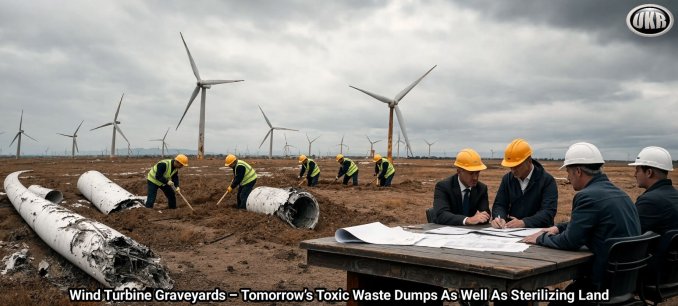
Wind turbine graveyards – tomorrow’s toxic waste dumps as well as sterilizing land to a depth of essential 3 feet deep concrete base platforms
Eat ze bugs!!!???
PETER HALLIGAN
Let’s start with the amount of concrete necessary for the platforms of land based wind turbines. From Brave AI:
“Modern land-based wind turbines typically range from 60 to 120 meters (200–390 feet) in hub height.
“The amount of concrete used in a land-based wind turbine foundation varies by turbine size, soil conditions, and design, but typically ranges from 100 to 500 cubic meters (approximately 240 to 1,200 tons) per unit. “
Just for the UK:
“As of 2025, there are over 9,200 operational onshore wind turbines in the United Kingdom. These turbines are distributed across 2,656 onshore wind farms, contributing to a total installed onshore capacity of approximately 15–16 GW
9,200 units at 1,000 tons/unit = 9.2 million tons of concrete
“900,000 kg (or 900 metric tons) of CO2 are emitted for every 1,000 tons of cement used in concrete production.
That ‘s 9,200 units x 900 metric tons of CO2 per unit = 8.28 million tons of CO2 = around the emissions of 1.8 million cars @ 4.6 tons of CO2 emitted per year per car.
Check my arithmetic please!
Anyway, the point is, the wind turbines are built on pristine mostly arable land to a depth of at least 3 feet, rendering it permanently unusable.
Now for those blades:
From Brave AI:
“Wind turbine graveyards vary significantly in size and regulatory status across the US, Germany, and the Netherlands, with the US currently hosting the most visible large-scale disposal sites while European nations have largely banned landfilling.
“United States
- Sweetwater, Texas: A prominent site holds approximately 4,000 decommissioned blades piled across a 25-acre field, where they remain largely unrecycled.
- Casper, Wyoming: The regional landfill has buried over 1,000 blades, with capacity for roughly 9,000 more; each blade consumes about 7 cubic yards of space.
- Scale: The US faces a growing crisis, with an estimated 720,000 tons of blade waste expected in the next two decades and 8,000 blades discarded annually.
Germany
- Landfill Ban: Germany has banned wind turbine blades from landfills due to limited land area and high population density.
- Waste Volume: Germany is expected to generate approximately 23,300 tonnes of blade waste by 2030 as early wind farms are decommissioned.
- Disposal: Instead of graveyards, blades are processed through methods like pyrolysis or repurposed for construction materials, though large-scale recycling infrastructure is still developing.
Netherlands
- Landfill Ban: The Netherlands has also banned blade landfilling, focusing on repurposing and recycling.
- Repurposing: Rather than storage graveyards, decommissioned blades are creatively reused, such as in the Wikado playground in Rotterdam, which uses five blades for slides and tunnels.
- Waste Volume: The Netherlands contributes to the broader European estimate of 40,000–60,000 tonnes of blade waste by 2030, managed through circular economy initiatives rather than accumulation sites.
Around 800,000 tons of windmill turbine waste in the next ten years on top of the thousands of acres of arable land sterilized.
Has anyone done a full environmental impact assessment???
“The most significant disposal challenge involves fiberglass or carbon fiber blades, which are difficult to break down and often end up in landfills. While some blades are repurposed into infrastructure like playgrounds or bridges, or ground down for use in cement production, the volume of retired blades is growing rapidly, leading to the creation of dedicated wind turbine graveyards in countries like the US, Germany, and the Netherlands.
Yeah really!
Another point Wind starvation, or “wind shadow,” occurs when large clusters of wind turbines extract kinetic energy from the atmosphere, creating wakes of slower, depleted air that significantly reduce power generation for downstream turbines.
Recent studies have shown that offshore wind farms can create wakes stretching 34 miles or more, effectively “stealing” wind from neighboring installations and causing a spatial planning crisis for dense renewable energy deployments.
- Physical Extraction: Turbines slow the wind as they convert kinetic energy to electricity; while individual turbines have a minimal impact, dense arrays compound this effect, reducing wind speed by approximately 30% behind the farm.
- – the blades MIGHT last 20-25 years but
- Generators: Typically last around 20 years, though they may need repair sooner in high-wind environments.
- Gearboxes: Often require replacement every 10 to 15 years due to wear on bearings and gears.
Try running a turbine without a generator or gearbox.
A further point – a study from 2019 here:
https://www.dlr.de/en/latest/news/2019/01/20190326_dlr-studies-interactions-flying-insects-wind-farms
“The German Aerospace Center (DLR) study indicates that insect strikes can reduce wind turbine power output by up to 50 percent. This reduction is caused by the accumulation of insect remains on rotor blades, which increases surface roughness, disrupts aerodynamic flow, and significantly increases drag while reducing lift.
Key Findings from the DLR Report:
- Mechanism of Loss: When insects collide with blades, their exoskeletons break and bodily fluids adhere to the surface, creating contamination that degrades aerodynamic performance.
- Scale of Impact: The study estimates that approximately 1,200 billion insects are struck annually by wind turbines in Germany, contributing to this efficiency loss.
- Operational Consequence: To mitigate these losses, a global cleaning industry for rotor blades has emerged, as dirty blades require regular maintenance to restore efficiency.
- Aviation Context: The DLR also found that similar insect accumulation on aircraft wings (specifically natural laminar flow areas) can increase fuel consumption by 1.1% to 4.4%, with as few as 400 insects causing measurable drag penalties.
I bet that study was not included in the costings of wind farms. Mat Klaus Shwab thought this would be added to the human food system instead of livestock!
“
You can also donate via Ko-fi – any amount from three dollars upwards. Ko-fi donations here:
https://ko-fi.com/peterhalligan