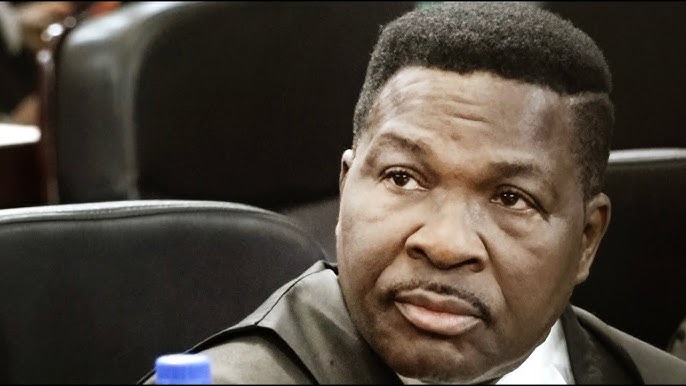

Senior lawyer Mike Ozekhome’s defence team on Monday grilled a forensic expert brought by the Economic and Financial Crimes Commission (EFCC) as a prosecution witness to prove forgery nas impersonation charges against Mr Ozekhome and his co-defendant.
The grilling during cross-examination by the defence team at the FCT High Court in Maitama, Abuja, elicited answers from the witness on the technical procedures and the general principles of the probe he conducted into the forgery allegations against the defendants.
The defendants are facing charges of impersonation and forgery of a Nigerian passport presented before a London tribunal by the defendants to support Mr Ozekhome’s failed bid to claim a London property.
The allegedly forged passport, bearing the name Tali Shani, took the centre stage in the second prosecution witness Bamaiyi Mairiga’s testimony on Monday.
Defence lawyer Tayo Oyetibo, a Senior Advocate of Nigeria (SAN), took Mr Mairiga to task over the findings of his forensic examination of the Tali Shani passport.

Mr Oyetibo said the conclusion of another forensic expert stated that Mr Mairiga’s report is a “product of speculation.”
However, Mr Mairiga, an official of the EFCC’s Department of Forensic Examination, denied the allegations.
“No. My report followed the International Civil Aviation Organisation (ICAO) standard for passport issuance among several standards. ICAO has set one of its standards for the authentication of check-digits to ensure accuracy and integrity in international passports, and this standard applies to all ICAO-issued member countries, including Nigeria.
“And if a data-page (for passports) fails such check-digit checks as specified by ICAO, then that data-page is not fit for issuance.”
Mr Mairiga is the second prosecution witness in the alleged forgery case, and his testimony speaks to one of the charges the office of the Attorney-General of the Federation (AGF) preferred against Mr Ozekhome and his co-defendant, Ponfa Useni.
Mr Useni is the son of the late Jeremiah Useni, who served as the Minister of the Federal Capital Territory (FCT) during the regime of former military dictator, the late Sani Abacha.
The older Mr Useni, who died in January 2025, owned the London property in question under the fictitious name Tali Shani, and his purported attempt to transfer its ownership to Mr Ozekhome allegedly led to the presentation of documents, which the property tribunal in London found to be forged to support the false identities of Tali Shani.
On 27 February, the office of the AGF arraigned Messrs Ozekhome and Mr Useni on 12 counts of forgery and impersonation.
According to the charges, the defendants conspired in 2020 alongside the late Jeremiah Useni, a retired general, and made a false Nigerian passport with number A07535463 and name Tali Shani, supporting it to be issued by the Nigeria Immigration Service, to claim a property in the United Kingdom.
Similarly, the prosecution charged them with “using a false passport to facilitate the claim of the property.”
The prosecution also alleged that Mr Ozekhome helped Ponfa Useni to impersonate Tali Shani in 2020. The prosecution said they created a fake “Irrevocable Power of Attorney” to help Mr Ozekhome claim the property.
They denied all the charges.
Defence queries witness over other forensic process
Mr Oyetibo also insisted during the cross-examination of the witness that his forensic report is a “result of a warped examination of a document.”
While the prosecution lawyer, Aisha Tahir, objected to the line of questioning, which she said was meant to annoy the witness, the trial judge, Chizoba Oji, allowed the question. “I am looking at him (the witness); he does not look annoyed,” the judge said.
Mr Mairiga insisted that his calculations were in line with ICAO standards and the technologies used, including VSC 8000, which was produced by the leading manufacturers of forensic, Foster and Freeman.
The witness also said three technologies were used: Keesing Technologies Document Checker (KTDC), VSC 8000 ICAO Optical Character Recognition (OCR) E-Passport Checker and Manual Publication/Calculation, which could not be wrong.
Earlier during the proceedings, Mr Oyetibo asked the witness about the processes of forensic examination.
He asked the forensic expert if he checked for page substitution.
Mr Mairiga replied that that he carried out the process on the booklets.
He added that the request for the forensic examination of the data page of Tali Shani was for him to “compare the content of the visual inspection and machine-readable zone to determine if they match.”
He added that he did not need to check for page substitution.
Mr Oyetibo asked the witness if he checked for photo replacement, but the witness said “no.”
He explained that the Date of Birth (DOB), Date of Expiry (DOE) and passport number have check digits mathematically encoded to ascertain the genuineness of the data page.
Again, Mr Oyetibo asked if he checked for erasures. He said no, repeating the same reason he gave for the page substitution.
However, the witness noted that he proceeded to the second stage of high-magnification examination and VSC 8000 imaging.
When asked about the micro-printing, intaglio, Ultra-Violet (UV) light, holograms and optically variable devices, the witness replied that it was not possible to check these on a photocopied document, implying that the Tali Shani passport was a photocopied or scanned document.
However, Mr Mairiga said that while it was not the original, the document he carried out for forensic examination was clear enough, adding that infrared examination was carried out.
Thereafter, Mr Oyetibo said the VSC 8000 alone does not automatically declare the genuineness of a passport.
Mr Mairiga replied, “No, I don’t agree. In forensic science, different methodologies are used, and in this case, in line with ICAO document 9303, which has specified the procedure for calculating the check digits as encoded in the machine-readable zones of an international passport.”
He explained further that the procedure was followed using manual calculations and all technologies previously stated, and it clearly showed that Tali Shani passport’s data page failed the standard authentication.
However, Mr Mairiga said he did not check if the data page falls under Stolen and Lost Travel Documents (SLTD) because he had no access to the SLTD database.
What ICAO Standard mean
The witness explained that the ICAO standard specifically chose entries on the data page’s visual inspection zone (of the passport); date of birth (DOB), date of expiration (DOE) and passport number are mathematically encoded. He said their check digits are calculated by 713 continuously by 713, and that the sum is multiplied and divided by 10.
During the previous proceeding, the witness explained that the analysis of the data page was carried out to examine the check digits.
The witness explained that the CD is a single numerical character from 0 to 9 placed after the DOB, DOE and passport number to check the accuracy and integrity of the date provided on the visual inspection zone (of the passport) to ensure it matches that of the machine-readable zones.
He explained that the significance of the CD is to assist the immigration officers, border control officers and forensic document examiners in identifying forged and counterfeited data pages, the witness said.
Query over issuance by NIS
Mr Oyetibo then asked if the witness worked for NIS when this investigation was done. Mr Mairiga replied no.
He noted that in 2009, he was recruited into the NIS and underwent training for six months, including passport and other travel documents and forgery detection.
He also noted that he had worked in the fraud unit of NIS with a core duty of analysing counterfeit of forged documents.
Mr Oyetibo asked the witness if he had access to the NIS database. The witnesa said the technologies used allowed him to obtain specimens of Nigerian A-Series passports.
When asked if the Tali Shani passport was issued by NIS, forged or altered, Mr Mairiga maintained that for every passport to be deemed genuine, it must go through the ICAO standard, adding that the passport in question failed the ICAO standard.
The witness also said he did not interrogate NIS officers in Abeokuta, where the contested passport was issued, because it was not part of the request sent to him.
He clarified that he did not know if the passport was scanned or photocopied.
Thereafter, the judge adjourned the matter till Tuesday, 30 June, to hear Mr Ozekhome’s application to travel for medical reasons.
In March, the first prosecution witness, a Nigerian Immigration Service (NIS) officer, testified that the passport with the name Tali Shani was fake.
Akim Aridegbe, a principal staff officer to the Comptroller-General of the NIS, said the passport was not issued by the NIS.
Despite the passport sharing features of a genuine copy, it has no record in the NIS database, Mr Aridegbe said.
On 24 June, PREMIUM TIMES reported that the Legal Practitioners’ Privileges Committee suspended Mr Ozekhome’s SAN rank pending the completion of a disciplinary hearing.
READ ALSO: LPPC suspends senior lawyer Mike Ozekhome from SAN rank
Backstory
Mr Ozekhome’s prosecution in Nigeria stems from a London Tribunal’s judgement that blocked him from claiming a property in North London in September 2025.
In August 2021, Mr Ozekhome sought to transfer the property to his name, claiming it was a gift from a man who presented himself as Tali Shani in appreciation for legal services.
But this was challenged in September 2022 by Westfields Solicitors, claiming to represent “Ms Tali Shani,” who insisted she was the registered owner of the property since 1993 and had never signed any transfer.
Ruling on the dispute, Judge Paton of the UK Tribunal ruled that the house was secretly bought in 1993 by the late Mr Useni, former Nigerian Minister of the Federal Capital Territory, using a false identity.
According to the tribunal, Mr Ozekhome’s steps to claim the property were built on a network of fraud, impersonation, and forged documents. Still, it concluded that the late Mr Useni, former Minister of FCT, was the genuine purchaser of the property in 1993.
Similarly, the London tribunal uncovered fraudulent Nigerian identity records, including a passport, a National Identification Number (NIN), and a Tax Identification Number (TIN) allegedly generated with the connivance of corrupt officials at the National Identity Management Commission (NIMC), the Immigration Service, and the Federal Inland Revenue Service.