By Leslie Osigbemhe
Artificial Intelligence is no longer merely a technological curiosity. It has become the new currency of economic power, geopolitical influence, national security, scientific advancement, and human development. Just as the Industrial Revolution transformed the nineteenth century and the Internet defined the late twentieth century, AI is rapidly becoming the defining force of the twenty-first century.
The question before Nigeria is no longer whether artificial intelligence will shape its future. It is whether Nigeria will become a creator of that future or merely a consumer of technologies designed elsewhere.
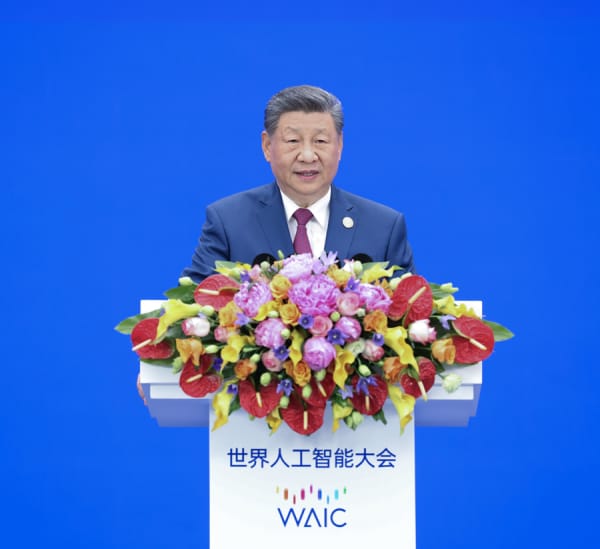
This interrogation has acquired even greater urgency following the 2026 World Artificial Intelligence Conference (WAIC) held in Shanghai, China, where world leaders, researchers, and technology experts gathered to discuss the future of AI development and governance.
At the opening ceremony, Chinese President Xi Jinping outlined a comprehensive vision that extends beyond technological innovation to embrace ethics, security, international cooperation, and equitable access to AI. His speech offers valuable lessons for developing countries like Nigeria seeking to navigate the AI revolution.
Nigeria is not starting from zero. The country possesses one of Africa’s fastest-growing digital ecosystems. Lagos has become home to a vibrant technology community. Nigerian startups are already deploying AI solutions in fintech, agriculture, education, healthcare, logistics, cybersecurity, and customer services.
Government institutions have also begun recognizing AI’s strategic importance. The National Artificial Intelligence Strategy (NAIS), the National Information Technology Development Agency (NITDA), research institutions, universities, and private innovators are gradually laying the foundation for an AI-enabled economy. Indeed, we are a digital giant.
Yet Nigeria still faces formidable challenges. Reliable electricity remains inadequate. High-performance computing infrastructure is limited. Data governance frameworks are evolving. AI research funding remains relatively small. There is also a shortage of highly skilled AI professionals compared to global demand.
Perhaps even more concerning is the widening digital divide between advanced economies and developing countries. Without deliberate action, AI could deepen existing inequalities rather than reduce them.
AI Governance Matters as Much as AI Innovation
President Xi’s address was remarkable because it did not portray AI merely as a race for technological supremacy. Instead, it emphasized responsible governance alongside innovation.
As he observed: “We human beings must answer the questions posed by our times: How to get along with thinking machines? How to ensure security when algorithm is part of decision making? How to tackle ethical challenges by technologies through adaptive governance? How to realize AI for all when the divide keeps widening?”
These questions resonate strongly with Nigeria. AI already influences financial services, elections, public communication, policing, employment, mass media, education, and healthcare. Without robust governance frameworks, algorithmic bias, misinformation, cybercrime, surveillance abuse, and digital exclusion could undermine public trust.
Nigeria therefore requires not only AI developers but also AI regulators, ethicists, lawmakers, judicial experts, educators, and civil society organizations capable of ensuring that technology serves humanity rather than the reverse.
President Xi proposed four guiding principles that deserve serious consideration. First is openness and collaboration. He urged nations to embrace open innovation and international cooperation rather than technological isolation. He reiterated that we should “seize this rare, historic opportunity to encourage open source, openness, collaboration and sharing.”
Indubitably, Nigeria would benefit immensely from participating in international AI research networks, open-source development communities, and technology partnerships that strengthen domestic capabilities.
The second is AI safety. For Nigeria, where cybercrime already presents significant challenges, AI governance must prioritize transparency, accountability, cybersecurity, and human oversight, because, according to Xi, it “should be a trusted tool for humanity.”
The third is inclusiveness. AI systems should respect cultural diversity rather than impose uniform technological values upon diverse societies. To be sure, Nigeria’s linguistic diversity, indigenous knowledge systems, and rich cultural heritage present opportunities for uniquely African AI applications.
The fourth is global governance. President Xi argued that AI should not become another arena of geopolitical fragmentation but should instead be governed through broad international cooperation.
Why Nigeria Should Join WAICO
Perhaps the most significant announcement at the Shanghai conference was the formal establishment of the World Artificial Intelligence Cooperation Organization (WAICO). For Nigeria, joining WAICO would represent far more than diplomatic symbolism.
It could provide access to international expertise on AI governance, technical standards, research collaboration, capacity building, regulatory best practices, and technology partnerships. This effectively enables us plug in to the rhythm of what President Xi described as ‘symphony of international cooperation.”
More importantly, Nigeria would gain a seat at the table where global AI rules are increasingly being shaped. Countries absent from today’s governance discussions may eventually become rule takers rather than rule makers. Hence, as Africa’s largest economy and most populous nation, Nigeria has both the responsibility and the opportunity to help shape global AI governance from the perspective of developing countries.
As a matter of fact, it does not take any stretch of the imagination to visualize how AI could transform sectors such as flood forecasting and agriculture through the Nigerian Meteorological Agency [NiMet] and the Nigeria Hydrological Services Agency [NIHSA). With our persistent ecological emergencies, this would connect the global discussion directly to Nigerians’ everyday lives.
China’s Growing Contribution to Global AI Governance
It could also be worthwhile to draw parallels between China’s AI strategy and China’s earlier success in renewable energy, electric vehicles, and digital infrastructure, as incentive to tap into their present experience in the spirit of South-South cooperation, looking towards a shared future.
All things considered, AI may become the next area in which China helps shape global development, particularly for the Global South. The Asian giant’s contribution to AI extends beyond technological breakthroughs. Over the past few years, Beijing has increasingly promoted international governance initiatives designed to ensure that AI development benefits humanity collectively.
These efforts include the Global AI Governance Initiative, support for the UN General Assembly Resolution on international AI capacity building, the AI Capacity Building Action Plan for Good and for All, the AI Plus International Cooperation Initiative, and now the establishment of WAICO.
China has also released policy documents and white papers outlining its approach to AI governance, emphasizing innovation, ethical development, international cooperation, security, and equitable access. These initiatives position China as one of the principal contributors to ongoing global discussions on AI governance.
For African countries, China’s emphasis on capacity building is particularly noteworthy.President Xi announced that over the next five years China will provide 5,000 AI training and seminar opportunities for developing countries, establish international AI application cooperation centres with regional organizations including the African Union, and expand access to AI-powered meteorological warning systems.
Seizing Nigeria’s AI Opportunity
Nigeria should actively seek to benefit from these initiatives. And there are deliberate steps to take, with strategic thinking to boot. The country should invest aggressively in STEM education and AI literacy from primary schools to universities. It should establish national AI research centres connected to industry.
Local language AI models should be developed for Hausa, Igbo, Yoruba, Fulfulde, Kanuri, Tiv, Ibibio, and other Nigerian languages.
Government should encourage AI adoption in agriculture, climate prediction, flood forecasting, healthcare, tax administration, education, public services, manufacturing, and security. Equally important is the development of a comprehensive AI governance framework that balances innovation with ethical safeguards.
President Xi concluded his address with words that capture the urgency of our era: “With AI advancing at a staggering speed, we must ensure its development is for the positive, for good and for humanity.”
This is a call Nigeria must heed. By embracing AI innovation, strengthening governance, investing in human capital, and joining emerging international institutions such as the WAICO, Nigeria can position itself not merely as Africa’s largest market for artificial intelligence, but as one of its leading architects. The AI age has arrived; Nigeria still has time to shape it – but that window of opportunity will not remain open forever.
________________________________________________
Osigbemhe, an international affairs analyst, writes from Lagos