— Says economic reforms must lift every Nigerian
— As FG rolls out 5 World Bank-backed initiatives to tackle poverty, strengthen healthcare, education, etc
By Johnbosco Agbakwuru & Progress Godfrey
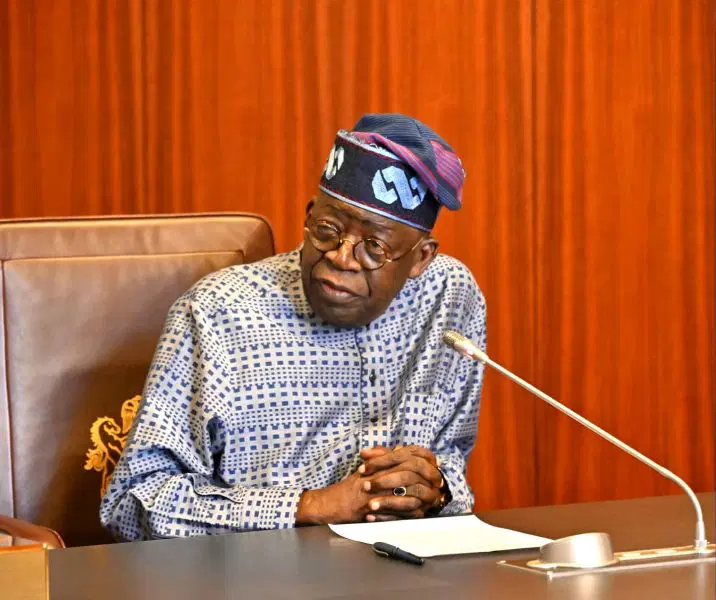
ABUJA — President Bola Tinubu on Thursday launched five social protection and human capital development programmes valued at about $3 billion, aimed at eradicating poverty and bringing dividends of democracy to all classes of Nigerian citizens.
The President said the success of his administration’s economic reforms would ultimately be judged by their impact on the lives of ordinary Nigerians rather than by macroeconomic statistics.
He added that the government is building a Nigeria where extreme poverty should be a thing of the past.
Unveiling the programmes at the Banquet Hall of the Presidential Villa, Abuja, the President said the initiatives would drive the next phase of the Renewed Hope Agenda by reducing poverty, strengthening healthcare and education, expanding livelihood opportunities, supporting internally displaced persons and building resilient communities across the country.
He said the numbers tell a story of recovery, stressing that real GDP grew by 11.2% and that per capita income grew by nearly 10% in USD terms last year.
“It is on track for a repeat this year, making Nigeria not only one of the fastest-growing economies in the world but also one of the fastest at lifting people out of poverty.”
He said foreign reserves have surpassed $50 billion and inflation has fallen sharply from its 2024 peak.
“These are not abstract figures. They are the foundation for the next phase of our national development: making sure this recovery reaches every Nigerian. Through expanded cash transfers, we have already reached 15 million vulnerable households, lifting an estimated 7.5 million people out of poverty. Today’s programmes build directly on that momentum,” Tinubu said.
He said the launch included NG-CARES additional financing of about $1.25 billion, a World Bank-supported programme focused particularly on smallholder farmers and small businesses, and SOLID, a $300 million World Bank initiative that bridges humanitarian relief and long-term development by investing in infrastructure, livelihoods and services for displaced persons and host communities.
“This is how we reveal not just hopes, but hope,” he said.
Also introduced was HOPE, a three-in-one programme — a $1.5 billion investment in Nigeria. “Through HOPE-GOV, HOPE-PHC and HOPE-EDU, we strengthen primary healthcare, improve foundational learning in our public schools, support our teachers, and build more transparent, more effective governance at the ward level.”
President Tinubu, who was represented by the Minister of Finance and Coordinating Minister of the Economy, Taiwo Oyedele, described the interventions as “promises kept.”
He explained that the programmes were designed to ensure that the benefits of ongoing economic reforms reach every household as Nigeria pursues its ambition of becoming a $1 trillion economy by 2030.
“Positive results are emerging from our reforms. Robust growth is returning and confidence is rising, but that progress must be felt in every household, not just in national statistics. Real prosperity means no Nigerian is left behind on our journey to a $1 trillion economy by 2030,” Tinubu said.
He said the programmes would serve as the bridge between macroeconomic stability and improved living standards by investing directly in people, communities and human capital.
“These are not just programmes; they are promises kept. We came into office pledging to reform our economy, secure the nation and invest in our people. Today, we are acting on that pledge by protecting the vulnerable, empowering communities and building the human capital that will carry Nigeria forward,” he added.
Tinubu disclosed that the expanded cash transfer programme had already reached 15 million vulnerable households, while the new interventions would deepen support for smallholder farmers, micro, small and medium enterprises, internally displaced persons, healthcare delivery, basic education and grassroots governance.
According to him, the programmes represent a single coordinated national strategy in which livelihoods, healthcare, education, social protection and community resilience reinforce one another through a ward-based implementation framework involving the federal, state and local governments.
“We are building a Nigeria where extreme poverty is banished, where every child has access to quality education and healthcare, and where every community can withstand adversity and recover faster and stronger,” he said.
Earlier, the Minister of Budget and Economic Planning, Senator Abubakar Atiku Bagudu, said the programmes were designed to ensure that the gains of President Tinubu’s economic reforms translate into better livelihoods for ordinary Nigerians.
While noting that the administration had restored fiscal stability and investor confidence through difficult but necessary reforms, Bagudu stressed that economic success must ultimately be measured by improvements in citizens’ welfare.
“Our reforms have succeeded in stabilising the macroeconomy and restoring confidence among investors, but we must be deliberate in ensuring that every Nigerian is included. The President has consistently insisted that the benefits of these reforms must be felt at the grassroots through better livelihoods, stronger human capital and more inclusive development,” he said.
Bagudu explained that the package includes the $1.25 billion NG-CARES Additional Financing Programme, which builds on the first phase that reached 17.6 million Nigerians; the $300 million SOLID Programme, designed to move displaced communities from humanitarian relief to long-term development; and the $1.5 billion HOPE Programme, covering governance, primary healthcare and education.
He said the interventions, approved under a National Economic Council framework, would be jointly implemented by the federal government, states and local governments to strengthen social protection, improve food security, enhance community resilience and expand economic opportunities nationwide.
“The true strength of these programmes lies in their complementarity. Together, they form an integrated framework for tackling poverty and vulnerability while creating opportunities for sustainable development,” Bagudu said.
Also speaking, the Minister of Health and Social Welfare, Prof. Muhammad Ali Pate, said the Tinubu administration had revitalised more than 3,000 primary healthcare centres, with another 1,000 facilities nearing completion nationwide.
He disclosed that quarterly visits to primary healthcare centres had increased from fewer than 10 million in 2023 to about 45.5 million, while 43,000 pregnant women and newborns had benefited from the national emergency medical transport system and 78,000 frontline health workers had been retrained.
“The reforms are ultimately about the Nigerian people. Infrastructure and economic growth are important, but investing in health, education and wellbeing is the foundation for sustainable national prosperity,” Pate said.
The Minister of Education, Dr. Tunji Alausa, announced the $552 million HOPE for Quality Basic Education Programme, saying it would benefit 30 million pupils, 500,000 teachers and about 65,000 public primary schools across all 36 states and the Federal Capital Territory.
He said the programme would strengthen foundational literacy and numeracy, reduce learning poverty and deploy digital technology to improve planning, accountability and education management nationwide.
World Bank Country Director for Nigeria, Dr. Matthew Verghis, commended President Tinubu’s leadership and described political commitment as the defining ingredient of successful reforms worldwide.
He said the Bank remained committed to supporting Nigeria’s efforts to strengthen institutions, expand access to quality healthcare and education, and build resilience against economic shocks.
“The presentations by the ministers have demonstrated that these programmes are already delivering remarkable results at scale. It is an honour for the World Bank to be part of this journey with the Government of Nigeria,” Verghis said.
The Nigeria Governors’ Forum (NGF) also pledged the commitment of all 36 state governments to the implementation of the programmes.
Speaking through Ondo State Governor Lucky Aiyedatiwa, NGF Chairman and Kwara State Governor AbdulRahman AbdulRazaq said the initiatives would strengthen governance, improve service delivery and deepen investments in health, education and social protection.
“We are not simply launching new projects. We are building the institutional foundation for stronger public financial management, improved service delivery, greater resilience and long-term sustainability across our states,” he said.
President of the Senate, Godswill Akpabio, represented by the Chairman of the Senate Committee on Finance, Senator Sani Musa, assured the administration of the National Assembly’s backing, saying the legislature would provide the legal framework and oversight needed to guarantee the success of the programmes.
“It is often said that a nation’s greatness is not measured by the abundance of its wealth, but by the extent to which it uplifts the lives of its most vulnerable,” Akpabio said, adding that the programmes reflected the true purpose of government: to improve the lives of citizens and ensure that no Nigerian is left behind.